Atlassian
Atlassian Corporation – Class A Common is currently exhibiting a “bottom bounce” technical pattern, with recent volume support helping the stock stabilise after falling nearly 48% year-to-date and 84% from its all-time high.
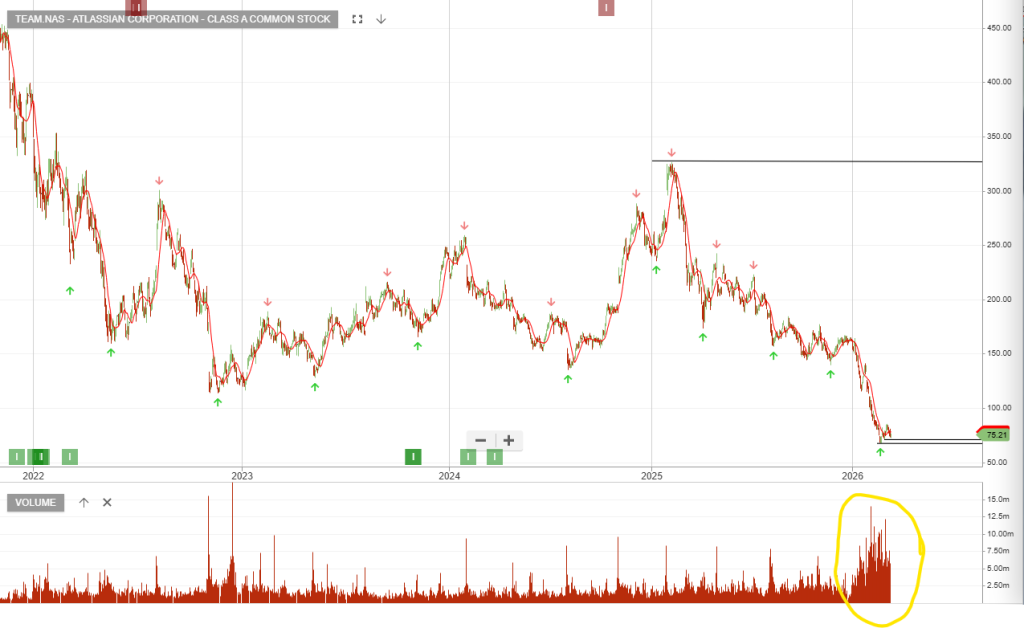
The trading volume for Atlassian (TEAM) has seen significant increases since January, characterized by three primary waves of activity linked to earnings milestones, institutional conferences, and a broader sector rotation.
### 1. February Earnings Spike (The Primary Surge)
The most substantial increase in volume occurred in early February following the company’s Q2 fiscal 2026 earnings report on February 5.
- Volume Peak: Trading reached approximately 14 million shares on February 6, nearly double the session volume of the preceding days and significantly higher than the ~3 million daily average seen in early January.
- Driver: While Atlassian surpassed $1 billion in quarterly Cloud revenue for the first time, high GAAP operating losses (driven by share-based compensation) led to a sharp -6.3% price dip, triggering high-volume sell-offs and re-positioning.
### 2. March “Relief Rally” & Conference Surge
A second wave of elevated volume occurred in the first week of March, specifically around March 5.
- Volume Spike: The stock saw a high-volume session of 12.19 million shares as it jumped +7.4% in a single day.
- Driver:
* Morgan Stanley TMT Conference: Management presented on March 5, highlighting their AI product (Rovo) and its 5 million monthly active users.
* Sector Rotation: A broader “relief rally” swept the software sector as investors rotated back into beaten-down SaaS names, leading to high turnover in TEAM.
### 3. Overall Trend Comparison
The average daily volume (ADV) has shifted higher throughout the quarter:
- Early January: ~3.0M – 4.5M shares per day.
- February Average: Elevated by volatility, often hitting 8M+ on high-activity days.
- March Status: Currently averaging between 7.0M and 7.5M shares, indicating a sustained increase in market interest as the stock tests multi-year lows.
### Summary of Drivers
Institutional Flows: Large-scale positioning updates from firms like Morgan Stanley and DNB Asset Management (which grew its stake by 266% recently) have contributed to the increased liquidity and trade frequency since the start of the year.
AI Narrative Shift: Market sentiment transitioned from “AI fears” (concerns that AI would disrupt software) to “AI adoption” (viewing Rovo as a monetization catalyst).
