Newcrest Is Back In The Buy Zone

The benign result of the first round of the French elections has triggered a “risk on” relief rally in global financial markets.

As such, Gold opened the Asian session down $20.00 at $1265.00 and has steadily recovered as the reality of the election result settles into the market.

Technically, Gold is still in an uptrend with the 30-day moving average still below the market at $1256.00. We expect Gold to recover and re-test the April 17th high of $1295.00 in the near-term.

Over the last five trading days, shares of NCM have dropped close to $2.00.
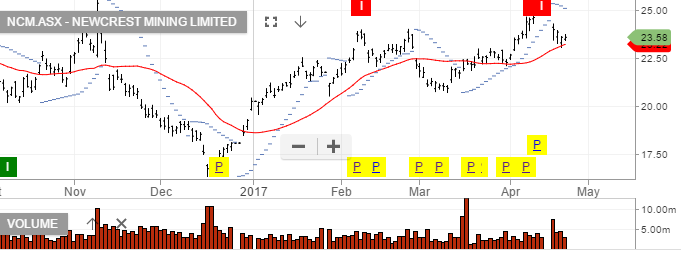
The lower price of Gold combined with the closure of the Cadia mine has pushed the stock down into the buy zone of $23.20; still above the 30-day moving average at $23.00.

We expect both the price of Gold and shares of NCM to rebound and trade higher over the medium-term. Investors looking to profit from higher Gold prices can also look at the QAU BetaShares Gold ETF.
The French Election

By the time the ASX starts trading on Monday, the results of the first round of the French Presidential election should be confirmed.

At 4pm Sydney time today, French citizens will begin casting their ballots in what has been one of the most contentious elections in its history, and where the future direction of the European Union could be in the balance.

From a market volatility perspective, the most positive result would be a large turnout for centrist Emmanuel Macron against any of the other three leading candidates.

The worst case scenario for the markets would be if Mr Macron doesn’t get enough votes to qualify for the second round of voting scheduled for May 7th.

Current polling shows that the most likely outcome will be Mr Macron running against the anti-EU candidate, Marine Le Pen, in the second round of voting.

In this case, the market reaction will be determined by the size of the margin between these two candidates.

Crunch Time For US Earnings

US earnings season will go into full swing next week with several DOW components and high-capitalization  S&P 500 companies reporting Q1 earnings.

Thus far, the results have been mixed with IBM missing badly and forward guidance on the major US banks showing concerns for future revenue growth.

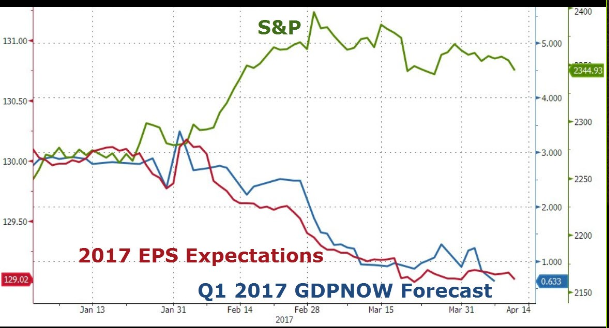
The chart below shows that the expectations of S&P earnings, relative to the current pricing of the S&P 500 index, are very much out of line.

If next week’s earnings reports don’t exceed expectations, we could see further downside range extension on the SP 500 index, which could pressure the XJO index lower.

We have been looking at the May 5800 XJO puts as a short-term portfolio hedging instrument for a move lower in the local market.

We have also been buying the BetaShare BBOZ inverse exchange traded fund. Shares in BBOZ gain value as the local market trades lower.

A Triple-Top Formation In AMP

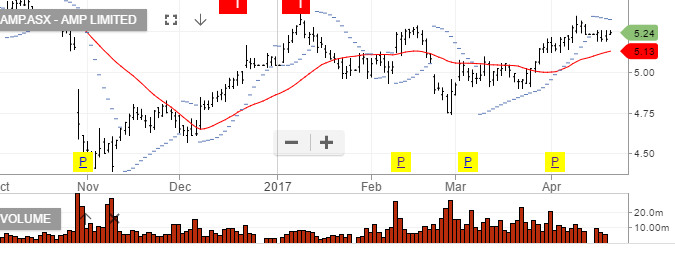
Shares of AMP have been carving out a triple-top pattern since October of last year. Since then, the share price has topped out around the $5.30 level on January 9th, and again on April 4th.

Regular readers will recall that AMP posted a loss of $344 million back in February. This was the company’s first full year loss since 2003 and exposed ongoing concerns about their life insurance and wealth protection divisions.

We are currently holding a $5.00/4.60 put spread into June and suggest investors look at downside opportunities from AMP.

Our near-term target is $4.60, but see scope for a move back to the November low of $4.30.

A Yield Play For Telstra

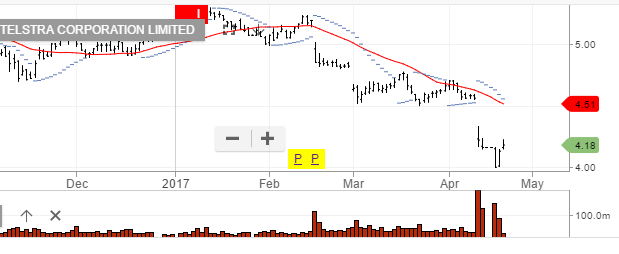
Shares of Telstra have dropped close to 15% over the last month. When the shares traded at $4.00 on Tuesday, this was the lowest price since October 2012.

While some of the pricing fundamentals may be unclear going forward, from a pure yield perspective, we see the potential for value.

At current prices, if TLS matches it’s previous dividend of 15.5 cents in September, this puts the stock on a forward yield of over 8%; plus franking credits.

We consider this good value and like the long side of TLS for a move back over $4.50 in the medium-term.

 Telstra

Drop In Crude Oil Puts CTX back In The Buy Zone

WTI Crude Oil prices posted their largest one-day loss in six weeks, as the US Energy Information Administration reported a smaller than expected draw down on crude supplies.

The Spot crude price fell $1.97, or 3.8% to settle at a 4-week low of $52.90. The next level of support will be found at $52.50.

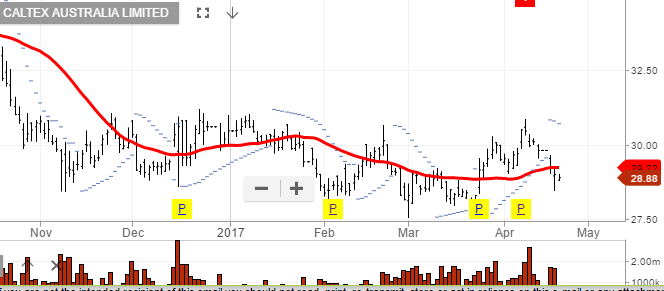
We expect the overnight fall to put shares of Caltex (CTX) back into the buy zone around the $28.80 level.

Regular readers will recall that we sold our long positions in CTX early last week in the $30.50 area.

The Daily chart pattern is showing a trading range of $28.30 to $30.50, we are looking to trade this range over the near-term.

Chart Caltex

BHP And RIO Trade Lower As Iron Ore Continues To Unravel

The Spot Iron Ore price continued to trade lower overnight, losing 4.6% to reach a 6-month low of $63.20 per dry tonne. This is a 33.5% drop from the high of $95.00 last traded on February 21st.

It’s worth noting that the sharp selloff is picking up pace just weeks away from the delivery of the Australian Federal Budget.

Since Iron Ore remains the country’s single biggest export, Federal revenue projections are highly sensitive to the outlook for Iron Ore prices.

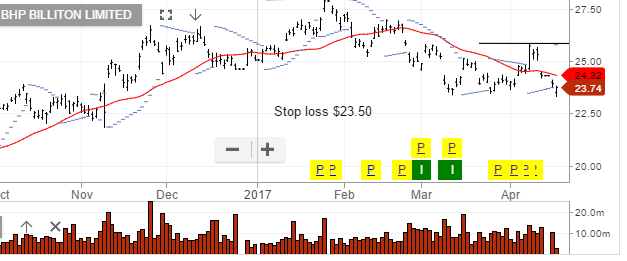
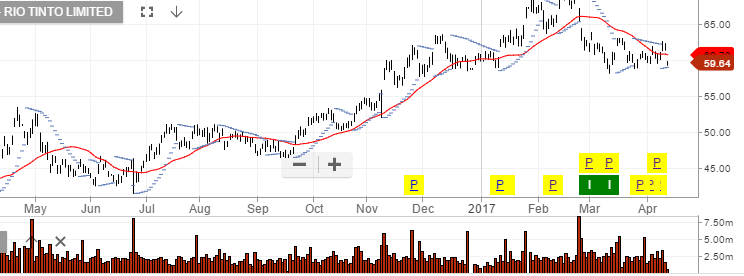
Both RIO and BHP have traded lower on the open,  reaching new 5-month lows of $57.60 and $23.30, respectively.

Unless Iron Ore stages a dramatic rebound, we look for the the next key support level in RIO at $56.20, and at $22.60 for BHP. 


CBA Nears Key Resistance

Australian banks are currently trading at lofty levels and close to significant chart resistance points.

We consider CBA to be most vulnerable to a down side correction considering the technical pattern and the premium at which it trades to its peers.

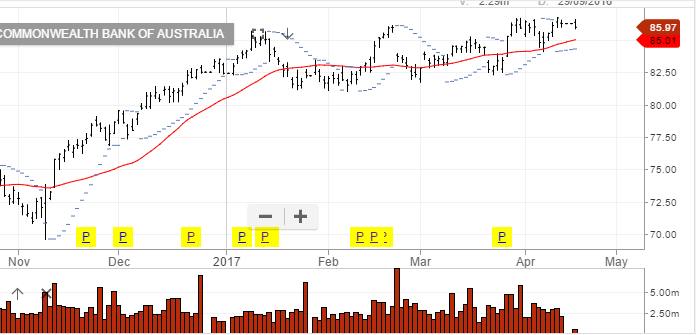
Going back to December 2015, there have been four occasions when CBA shares traded into the $85.00  to $86.00 price range before rolling over for a 5 to 10% correction. At this point, we are looking for a technical move back to the $80.00 level.

Fundamentally, huge consumer debt burdens, stagnant domestic wages growth and an overheated housing market will likely act as a headwind to further meaningful price appreciation.

Investors holding long CBA positions can look to sell covered calls into June, or buy the May $83.00 outright put option.


JP Morgan Slips 1% After Q1 Earnings Report

Shares of JP Morgan fell over 1% today as their Q1 earnings report included a sharp increase in write-downs.

The company reported earnings of $1.65 per share, which was up from an adjusted $1.35 reported a year ago and higher than the street estimates of $1.52.

However, concerns emerged in the bank’s consumer group, where credit costs surged to $1.4 billion, up almost $400 million from Q4 2016. This expense was driven by higher credit card charge offs.

As the other major US banks report their earnings next week, we will watch for similar write downs as a source of selling pressure.

JPM shares closed at $84.40, which is over 11% lower than the $94.00 high posted on March 1st.

RIO Pressured Lower On Falls In Copper & Iron Ore

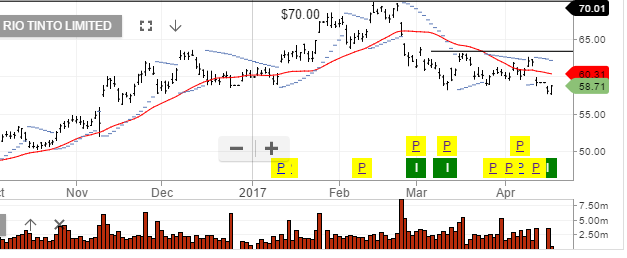
Shares of RIO Tinto have opened over 2% lower as both Iron Ore and Copper prices fell sharply in overnight trade.

Iron Ore prices seem to be in free fall, suffering an 8.5% drop to $68.00 per tonne. This is the largest overnight fall in over a year and extends the losses since February to over 28%.

Copper prices fell over 5% to $2.54 per pound in NY trade. This is a new 5-month low and technical indicators are pointing lower.

Rio shares are currently at $59.50. We see a key support area at $58.40, and would suggest a break of that level would extend materially to the downside.

Rio Tinto