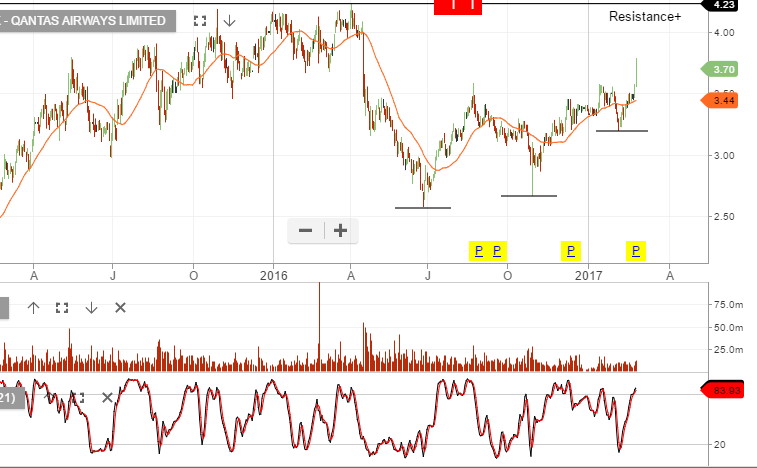
QANTAS – 1H17 Earnings Result

QANTAS announced first-half net profits fell to $515 million from $688 million during the same period last year.

A restructuring cost of $137 million was largely responsible for the profit miss, but the company also pointed to increased competition on international routes as a source of profit stress.

Underlying profit before tax fell 7.5% to $852 million for the six months to December 31st, which was higher than the company’s guidance range of $800 to $850 million.

That compares to the record profit of $921 million announced over the same period last year. Company officials didn’t provide any profit guidance for the 2016/17 period.

Qantas declared an interim dividend of 7 cents per shares (50% franked)

Chart – QAN


Woolworths

Even though Woolworth’s first-half profit outperformed rival Coles for the first time in seven years, the group’s earnings fell short of the street’s expectations.

For the six months ending December 31st, the group announced a profit of $725 million, up from a $972 million loss during the same time last year. market analysts were expecting a profit number of over $800 million.

Despite the solid earnings growth, the company cut its dividend to 34 cents per share, compared to 44 cents in the corresponding period last year. The street was expecting a dividend of 45 cents per share.

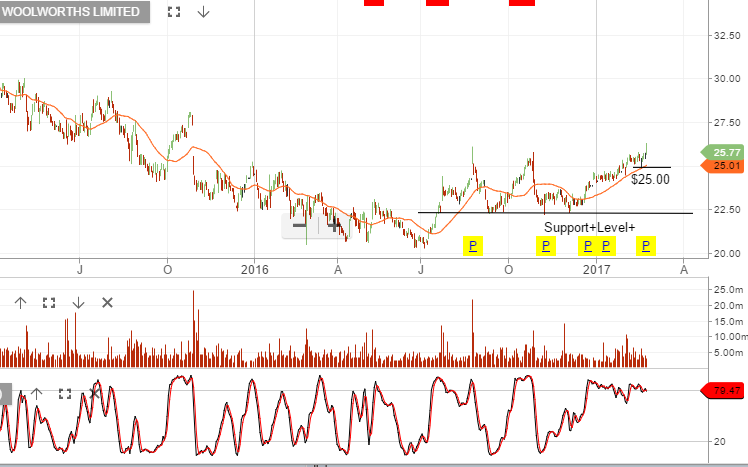
We’ve been selling European covered calls over WOW for an additional $0.72 per share credit, lifting the annualized yield to over 10%.

Chart – WOW

BHP – 1H17 Earnings

The rebound in Iron ore prices helped BHP post a first-half profit of AUD 4.2 billion. The resource giant announced its underlying profit for the six months to December 31st surged to USD 3.24 billion from USD 412 million during the same period a year ago.

The result was slightly better than the street’s forecast of USD 3.1 billion.

The company declared an interim dividend of 40 US cents per share, which is much better than the 16 US cents it paid a year ago. This takes into account the USD 155 million charge in relation to the Samarco dam failure in Brazil.

BHP’s bottom line has benefited from strong gains in commodity prices during H2 2016. Prices of Iron Ore more than doubled during 2016 on improved demand from China, while Crude Oil prices have recovered more than 40% from the multi-year lows hit in February last year.

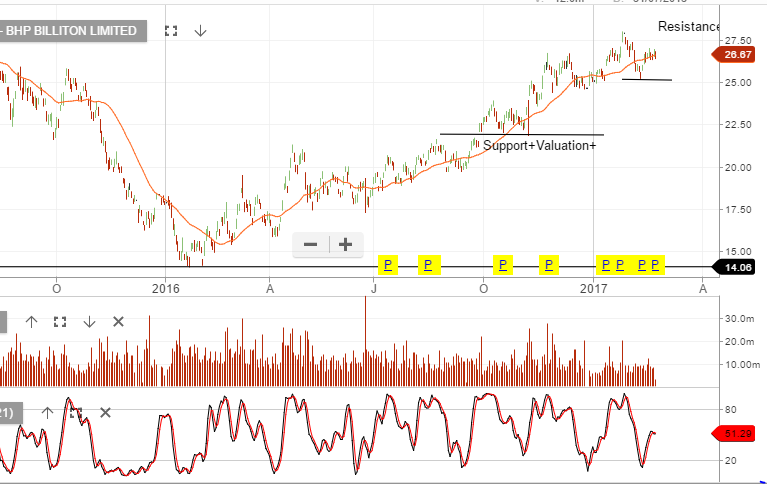
The price correlation between BHP and Iron ore is very strong. Since posting a low of $14.10 in late January 2016, the share price has followed Iron Ore higher and almost doubled; reaching a high of $27.50 on January 25th.

We’ve been selling $27 calls over BHP for an additional $1.00 credit per share.

Chart – BHP


SEEK Earnings Update

Share of Seek are down over 3% in early trade after announcing disappointing underlying earnings for the six-month period ending December 31st.

The company reported EBITDA of $170.3 million, down from $193.3 million in the previous period on revenue of $487.9 million.

Seek announced an interim dividend of 23 cents per share, which was up 10% versus a year ago.

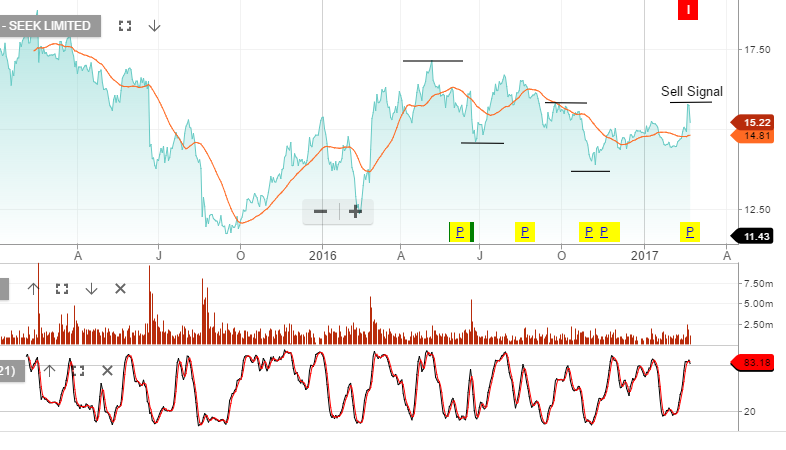
Our Algo Engine has triggered a “short” signal at yesterday’s high of $15.92.


Chart – SEK

Oil Search

Shares of Oil Search are under pressure in early trade as the company reported a 70% drop in annual core profits.

Net profits fell to $106.7 million for calendar year 2016, compared to $359.9 million during 2015. The company cut its full-year dividend to 3.5 cents from 10 cents, which was slightly ahead of analysts’ expectations of 3 cents.

Oil Search reported plans to roughly double capital spending this year to between $360 to $400 million, with exploration and development campaigns underway near a recent find in Papua New Guinea.

The company expects oil production of between 28 to 30 million barrels over the course of 2017, which would be slightly less than 2016 production.

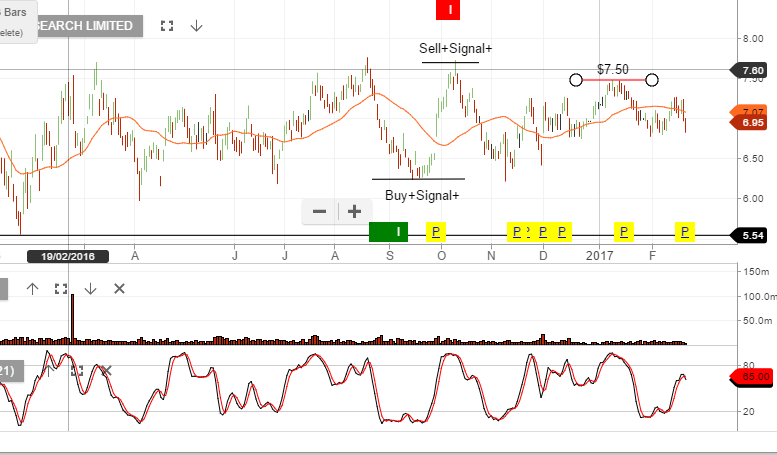
Our Algo Engine triggered a “short” signal back in October at $7.72

Chart – OSH


ANZ – December Quarter Earnings

The headline data from ANZ shows that the bank had a strong start to FY 2017. However, the pick-up in property and trading income are going to be difficult to replicate into H2 2017.

ANZ delivered around $2 billion in cash profit, which was well above the street’s expectations of $1.7 billion. The higher numbers were underpinned by strong trading income and a $283 million bad debt charge versus an expected $446 million charge.

We note that historically ANZ has had higher Q2 bad debt charges compared to Q1

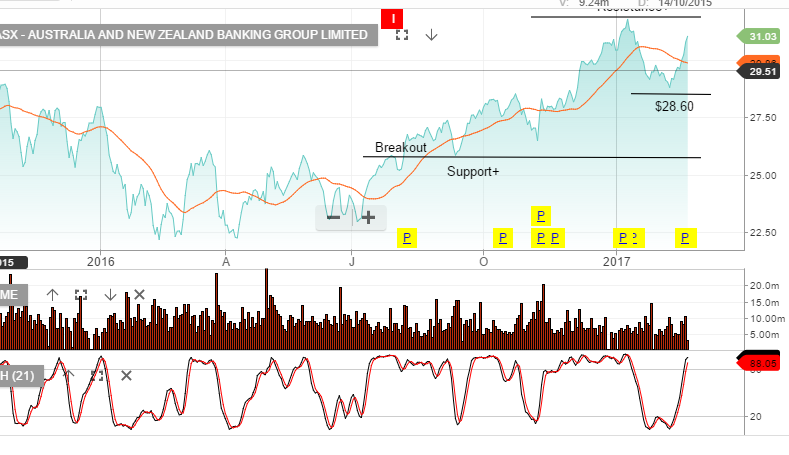
We would expect price resistance to emerge at or around the January 9th high of $31.80.

Chart – ANZ

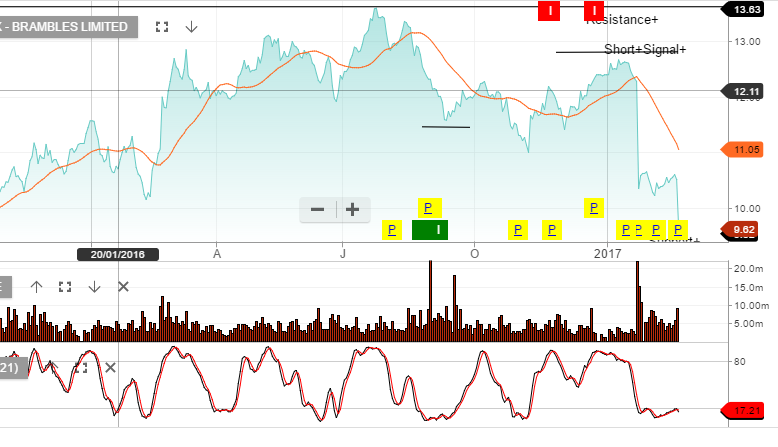
Brambles Down Sharply

Shares of Brambles are trading over 8% lower in early trade as the pallet maker announced profits will fall well short of their original guidance.

For the first 6 months of the fiscal year, the company reported a 26% fall in net profit to USD 330.4 million. The drop was a largely blamed by a sharp write down on its Hoover Ferguson Group venture, as well as, margin pressure in its US business.

Back in November the company’s guidance suggested constant-currency sales growth in the 7 to 9% range and underlying profit growth in the 9 to 11% range.

Brambles declared an interim dividend of 14.5 cents a share.

Subscribers will remember that the Algo engine gave a sell signal on January 4th at $12.50. Brambles shares hit an 18-month low  $9.54 earlier today.

Chart – BXB

ETF UPDATE: The Aussie Dollar

The Reserve Bank of Australia (RBA) has maintained a fairly neutral bias when it comes to the value of the AUD.

That said, they also always seem to add a sentence or two in their monthly statement which describes how a higher AUD will act as a headwind to the domestic economy as it transitions to a non-mining base.

In short, it may not be an official RBA policy to engineer a lower AUD price trajectory, but it is clear that their policy goals would be much easier to achieve with the AUD/USD trading below .7000, than above .8000.

The AUD/USD has pushed through the .7700 level this week for the first time in over 3 months. The pair is struggling to sustain this potential breakout after a disappointing jobs report on Thursday.

The Australian Bureau of Statistics (ABS) announced 13,500 new jobs for the month of January, but they were all part-time positions. The participation rate slipped to 64.6% from 64.7%, which accounts for the decline in the unemployment rate to 5.7% from 5.8%.

It seems clear from these statistics that the RBA may have to ramp-up their discussions about further rate cuts to lower the AUD going into Q2 of 2017.

Technically, the AUD/USD has rallied from .7165 on January 2nd, to .7730 during yesterday’s NY session. The nearly 8% advance against the Greenback has led all the major pairs over that time.

As the corrective forces unfold, the Aussie looks vulnerable. A move back toward .7600 seems likely and a break of .7665 would signal a near-term top is in place.

BetaShares offers two Exchange Traded Funds (ETFs) which allow investors to profit from the AUD trading lower against the USD.

The USD and YANK are both traded in a unit trust structure on the ASX.

The value of the units increase as the price of the AUD/USD trades lower. The USD is unweighted, which means a 5% drop in the AUD/USD will realise a 5% increase in the unit price.

The YANK has an approximate 2.5 X times weighting, which means a 5% drop in the AUD/USD will see a gain of roughly 12.5% in the price of the shares.
Santos

After taking  a US$ 1.1 billion write-down on its GLNG project in Queensland, Santos posted a full-year loss of US$ 1.05 billion. No interim dividend was paid.

The oil and gas producer claims their free cash flow is at a Crude Oil price of US$36.50 per barrel, which is considerably lower than current levels.

The share price is essentially unchanged on the day. Longer-term investors can look for buy interest to return near the November lows at $3.50.

ASX Limited

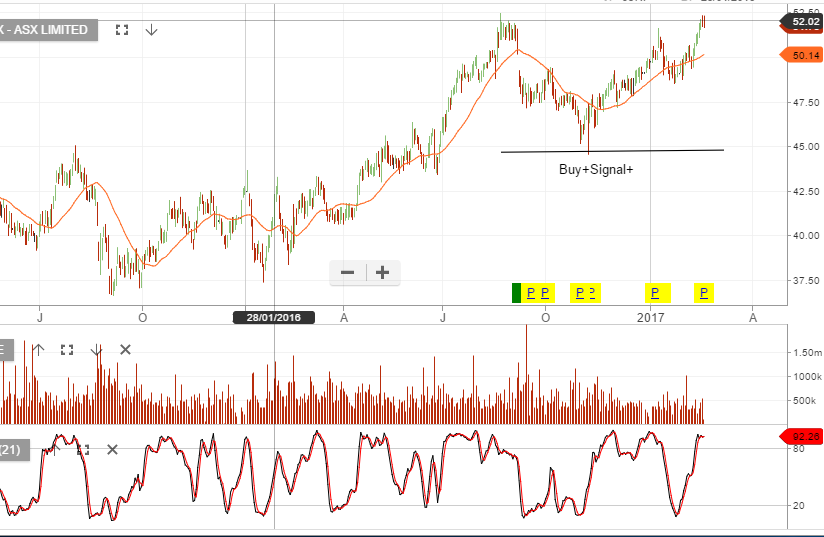
ASX Limited reported continued profit growth for H1 2017, up 3% to $219 million. Earnings per share was posted at $1.13 per share, which is 2.9% higher than a year ago.

The exchange operator declared a fully franked dividend of $1.02 per share, which pencils out to a 90% pay out ratio.

ASX also announced a 2.8% increase in operating revenue to $386.6 million, which is a 10.4 million increase from the previous reporting period.

Solid growth in Derivatives, OTC products and the sharp increase in ETF interest has underpinned the company’s  forward guidance.

However, we see a potential “double top” pattern on the daily charts dating back to the August highs of $52.40 and would look for a pull back in the share price.

Chart – ASX