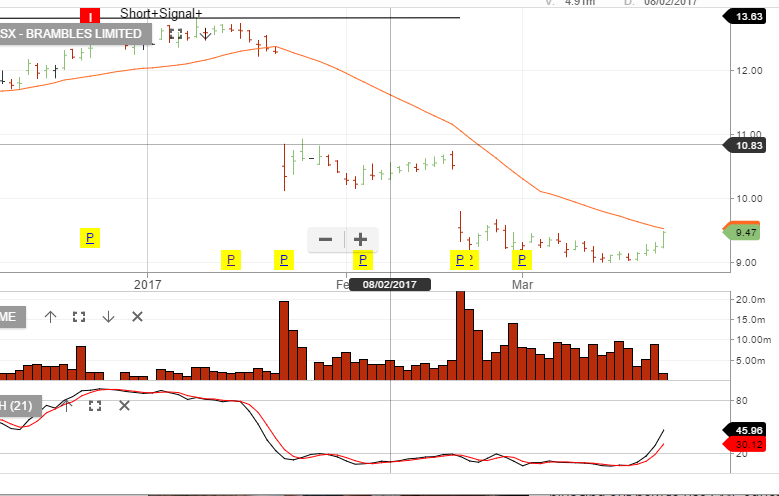
Our Long TCL – SYD Position Update

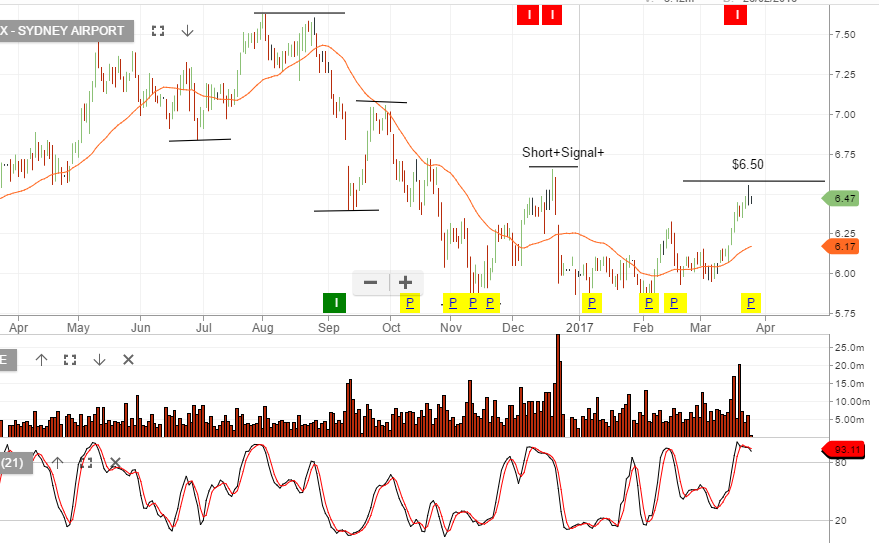
Over the past month, we’ve been long TCL and SYD , as we felt US interest rates would not push beyond levels already priced in by the market, therefore creating value in yield sensitive names.

Out of the potential basket of yield sensitive names to consider, our preference was TCL and SYD coming into their June dividends.

With the above stocks now trading up 15%+ and 10%+, (respectively), from their recent lows and the yields now compressing below 5%, we feel potential capital gains from here are limited and it’s time to sell covered calls to enhance the return.

Chart – TCL
Chart – SYD


US Update: Trump Puts Healthcare Reform On Hold

US Stock Indexes finished the week mixed as many investors were focused on how the House of Representatives would vote on the administration’s bill to repeal major parts of the current health care program, referred to as Obamacare.

As the day progressed, the DOW and SP 500 swung between positive and negative territory as news reports gave conflicting stories about whether the bill would pass, or even be voted upon.

In the end, after Mr Trump’s ultimatum failed to yield more “yes” votes , the embattled bill seeking to start the healthcare reform process, and free up almost a trillion dollars in tax dollars, was pulled from the floor.

As a result, Mr Trump suffered a second consecutive blow from within his own Republican party. This party dissension will likely cast doubts on the President’s ability to deliver on other policy measures including; tax reform, infrastructure spending and the debt ceiling legislation.

The announcement that the vote was cancelled happened too late in the day to have any material impact on today’s trade.

However, going into next week, investors will have to address the question of how Mr Trump can now unify his own party behind his administration; and whether this legislative defeat will “deflate” the “reflation” trade, which was triggered after he was elected?
Strong Rally In Caltex

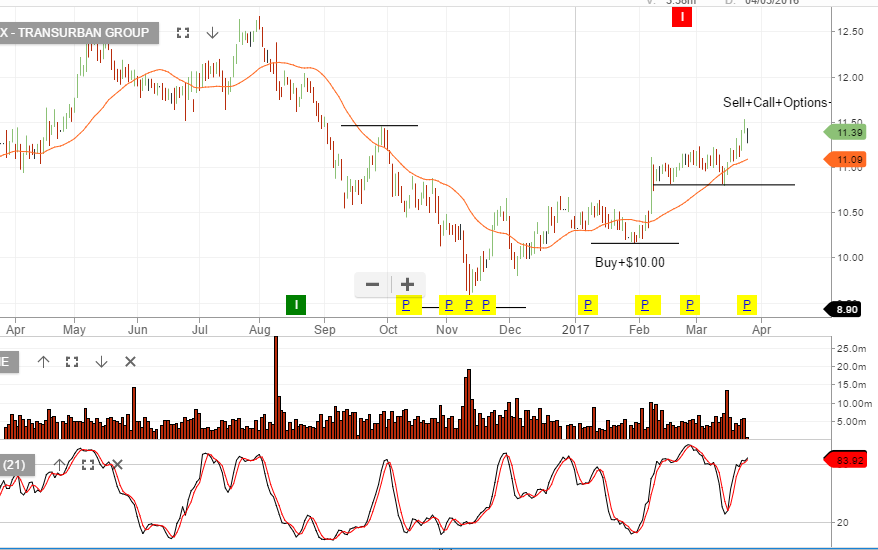
Despite a generally weak Crude Oil market, shares of Caltex have rallied almost $2.00 this week.

The shares were lifted off a 3-year low after the company announced a stronger-than-expected refiner margin of USD 12.71 per barrel for the month of February.

This is an increase from last year’s refiner margin of USD 12.43 per barrel and well ahead of the street’s estimates of USD 9.74 per barrel.

The increase in the margins has had a knock-on effect and lifted the calendar year EPS forecasts by 1.3% to the $2.40 range.

We now see chart resistance for Caltex at, or near, the February highs of $31.00.

BOQ: Caution In Front of Results

After trading as high as $12.50 on January 12th, shares of BOQ have followed the same “sideways-to-lower” pattern as the rest of the Australian banking names.

With first-half 2017 results due on March 30th, this pattern could continue and even breach the February low price of $11.30.

The headwinds of negative loan growth and falling margins don’t appear to be fully priced-in at current levels.

The trading multiples of BOQ are not cheap, and with 2017 EPS growth estimated at under 3%, we believe an $11.00 price is more likely than a $12.00 price over the medium-term.

ALGO Buy Signal: ASX

The ALGO engine generated a buy signal for shares of ASX at $49.00.

Many investors were able to write covered calls or exit long positions of ASX around the $52.50 level, last traded in early February.

We are cautious of the general market sentiment , but still like the longer-term growth prospects and a move back at least to the 30-day moving average near $51.10.

A tight stop-loss metric should be employed on long positions of ASX at, or near, the January 2nd low of $49.15.

ETF UPDATE: Aussie Dollar Pointing Lower

Since early January, the AUD/USD  has traded in a 250 point range between .7500 and .7750.

Now that the FED has raised rates this year (and has given guidance for more tightening) the yield differential between the overnight rates between Australia and the USA has narrowed to just 50 basis points.

This compares to 200 basis points this time last year.

In addition, with domestic employment growth sputtering and lower inflation readings, the RBA has maintained an easing bias for overnight rates in Australia.

This strengthens the case for the AUD/USD to trade lower and return to the December lows of .7150.

Investors looking to profit from a falling AUD/USD have been buying the BetaShare YANK Exchange Traded Fund (ETF). The current unit price of YANK is $14.10.

We estimate that a move back to the December low of .7150 would increase the unit value of YANK to approximately $16.75.

ALGO Signal- Ansell

The Algo engine generated a sell signal for Ansell at the close of trade yesterday.

From a technical perspective, Ansell’s closing price of just under $23.00 is very close to the 50% retracement  of the high of $25.65 traded on January 9th and the low price of $20.60 posted on February 20th.

While we still like the longer-term growth prospects of the company, we are seeing signs that the general market may be rotating lower over the medium term.

As such, we believe its reasonable to expect that investors will be able to buy Ansell back below the $22.00 handle.

The current price of $23.35 offers a good opportunity to sell close-to-the-money call options to enhance portfolio returns.

Algo Signal – US Financials

With the recent sell-off in US equities, we’re now seeing a number of Algo long signals appear in the US financial names.

We’re mindful of the “peak optimism” that is priced in regarding tax cuts, deregulation & US economic pickup and approach these buy signals with caution.

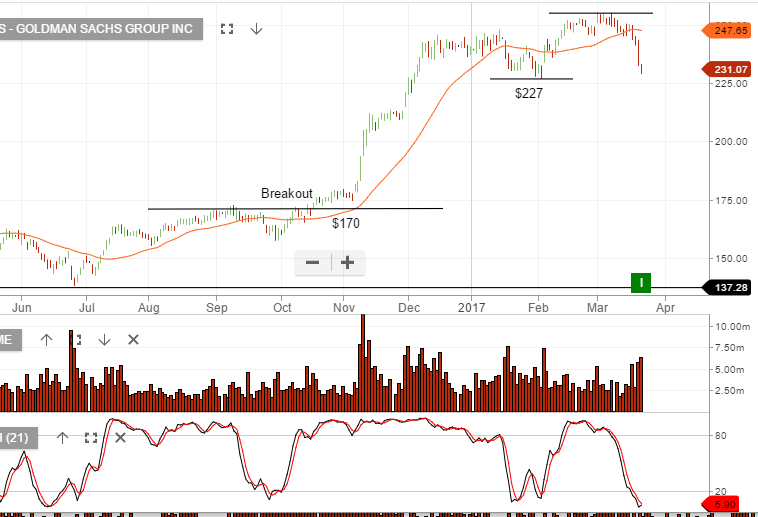
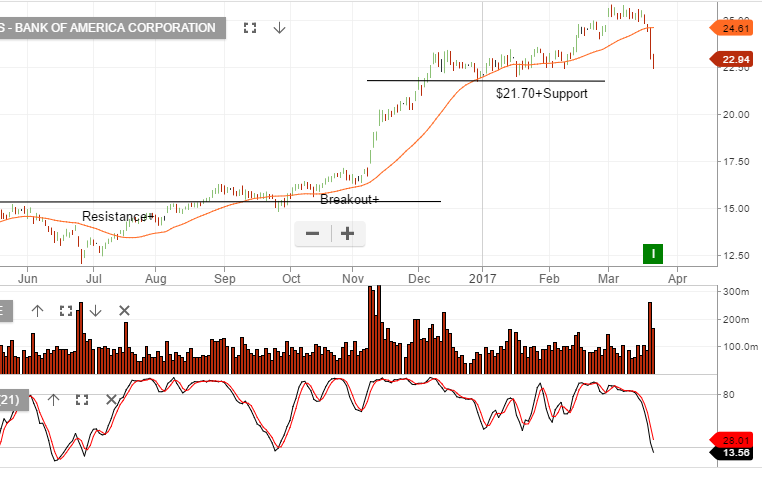
We’ll be tracking the short term momentum indicators in Goldman Sachs and Bank of America as a leading indicator to market sentiment.


Chart – GS
Chart – Bank of America


Heavy Losses On Wall Street

Both the DOW Jones 30 and SP 500 index fell over 1% today during the worst trading session for 2017 for US Blue-Chip stocks.

Banking names led the hefty losses, with the DJ Banking Index trading back below the 50-day moving average.

Dow/SP component Goldman Sachs lost almost $10.00 on the day and is now 10% lower than the March 1st close of $253.00.

A confluence of lower loan growth, political uncertainty and extended valuations pressured the banks, as well as the general market, lower on very high trading volume.

Technically, both the DOW Jones and the SP 500 have posted their first close below the 30-day moving average since November 7th.

The unwinding of the overbought conditions in many of the index components will likely be a process more than an event.

With the banking sector very heavily weighted in the ASX 100, this process will likely pressure Australian names lower, as well.

Investors who are looking to hedge their portfolios or profit from a down move in the ASX can trade either the BetaShare  BBOZ  or BEAR Exchange Traded Funds.

These are inverse funds which gain value as the ASX index trade lower. Please call for more information.