European Central Bank (ECB) Meeting

US and European equities pushed higher as investors showed confidence ahead of today’s key European Central Bank (ECB) meeting in Frankfurt, Germany. All the major indices including the FTSE, DAX, CAC, DOW and SP 500 posted gains in excess of 1.5% on the day.

The ECB is widely expected to announce an extension of its massive Quantitative Easing (QE) stimulus program and may even increase, or expand, the scope of the asset pool to include European corporate bonds and equities.

The ECB has been the most aggressive central bank in providing monetary stimulus this year. Since March, it has been buying €80 billion of assets per month, mainly in the form of Government debt. Although the program is scheduled to expire in March 2017, analysts are expecting at least a six-month extension to be announced today.

As a note of caution, it’s important that ECB chief Mario Draghi rejects any talk about an early tapering of the monthly asset purchases. Just the rumor of a “scaling back” of stimulus before the September ECB meeting sparked a sharp sell-off in G-7 equities and credit markets.

However, with the US FOMC meeting scheduled for next week, our base case is that the ECB statement will not mention tapering and, instead, focus on the technical adjustments to the QE program. On balance we expect this scenario to have a neutral to bullish impact on G-7 equity markets.      
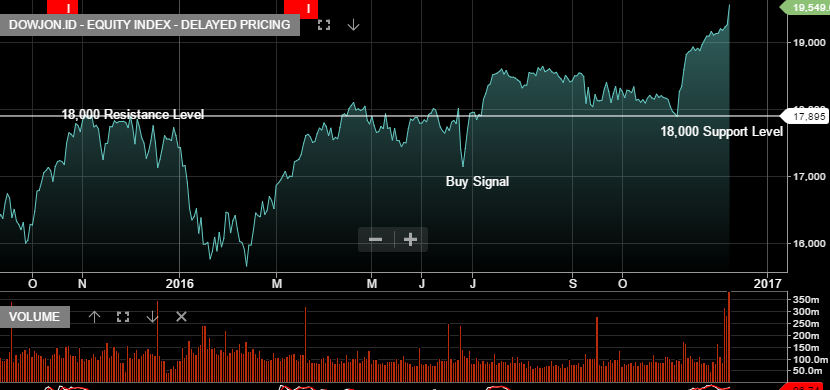
Chart - Dow Jones
Chart – Dow Jones


Origin Energy – Reducing Debt

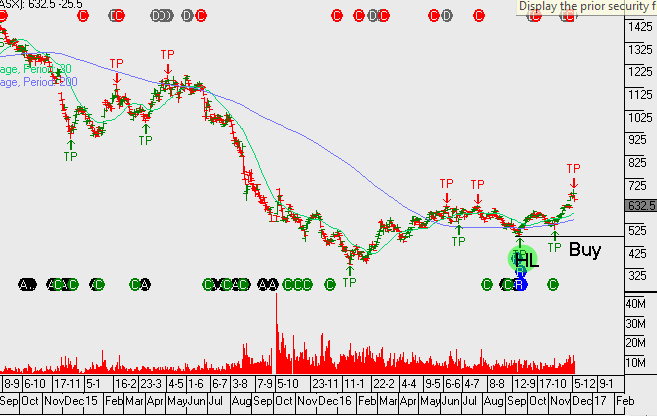
In an effort to streamline its business and reduce debt, Australia’s largest gas and power retailer Origin Energy has announced plans to divest its conventional oil and gas exploration assets through an IPO on the ASX in 2017.

Origin will group these assets into a new listed company called NewCo. These combined assets have an estimated value in the $2.5 to 2.8 billion range, based on a forecast of $50/$70 crude oil prices. At that valuation, proceeds of between $1.8 to $2.0 billion are expected to be allocated back to Origin.

Considering the uncertain outlook for global oil prices going into 2017, Origin’s strategy appears to be reasonable but isn’t a game changer in terms of its share price valuation.

With the current share price trading around the high of the year at $6.58, we consider this news to be neutral to bullish. However, with crude oil prices unlikely to trade above $60.00 in the near-term, the $7.00 level could cap gains over the medium-term.

Chart - ORG
Chart – ORG

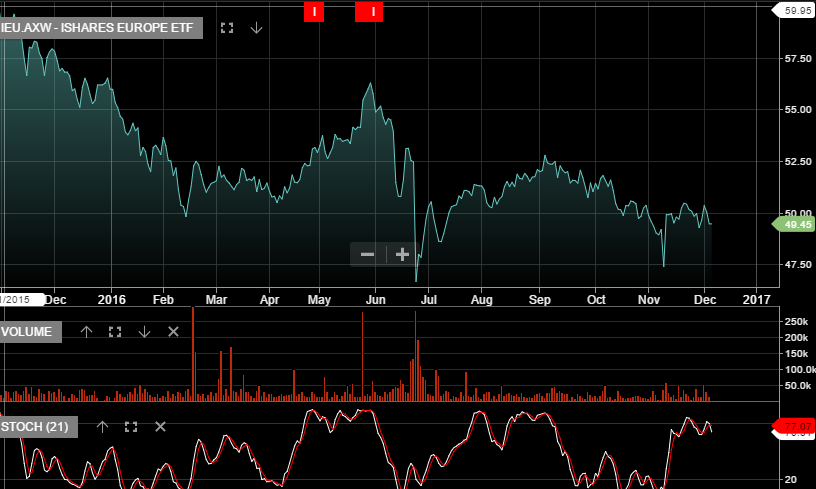
ETF Watch – iShares Europe (Italian Election Outcome)

Without a sitting government, it’s difficult to see how there can be any official help for Italy’s beleaguered banking sector. In short, now that the “No” vote has prevailed, Italy’s banking system is for all intents and purposes insolvent.

In addition, the size of Italy’s government debt is also a concern. Depending on which figures you look at, the total outstanding Italian debt is more than €2 trillion, which will have to be serviced even if the Italian voters someday choose to leave the European Union.

On balance we feel that the brunt of the market fallout will be felt across the European Union. However, after the sharp rally in global stocks during the month of November, this referendum news could very well trigger some re-balancing of of financial positions going into the upcoming ECB and the FOMC meetings.

Chart - iShares Europe
Chart – iShares Europe

RBA Meeting – Rate Decision

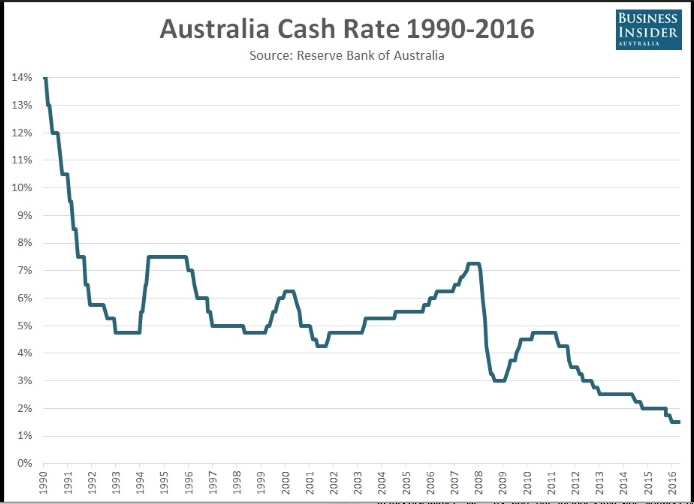
The RBA will hold it final meeting of 2016 today with their announcement scheduled for 2:30 pm Sydney time. All 26 economists polled by Bloomberg have the cash rate remaining unchanged at 1.5%, while the financial markets reflect only a 2% chance for a 25 basis point cut.

Given these expectations, any market moving news will come from the wording of the of the accompanying monetary policy statement which could provide clues as to the policy bias of the RBA board.

In particular, financial markets will be focusing on the language used towards the housing and labour markets, as well as the board’s outlook on inflation.

Of these three areas, housing and labour have shown mixed results since the last RBA meeting: there has been a noticeable acceleration of housing loans, but a sharp fall in building approvals. Similarly, New Job ads have increased, but employment growth is heading in the opposite direction.

The recent wage price index report, which recorded its slowest increase on record for Q3, will likely keep inflation expectations in the lower end of the RBA’s target band.

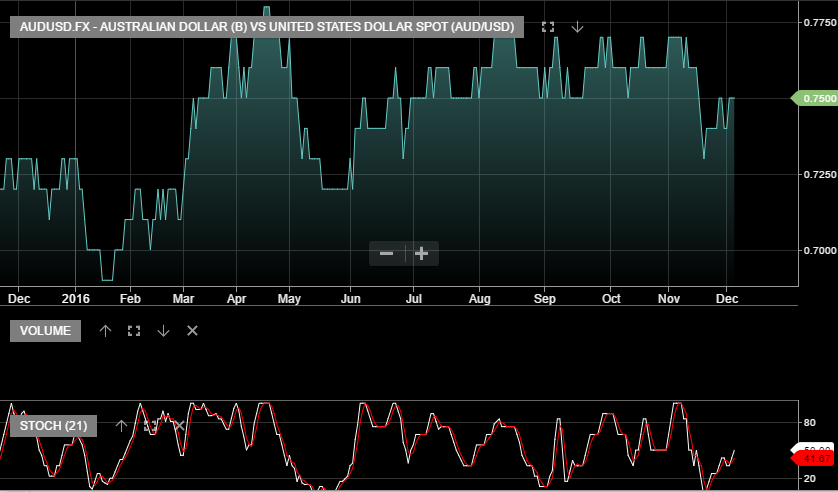
On balance, we expect the RBA to remain unchanged with a slight shift to a more “Dovish” bias going into next year. This stance should be supportive for stocks, in general, and slightly negative for the Australian dollar.

Chart - AUD
Chart – AUD
Chart  - RBA Rates
Chart – RBA Rates

Italian Exit Poll

Early results from Italian exit polls suggest voters have overwhelmingly rejected the constitutional reforms proposed by PM Matteo Renzi. He has pledged to resign if the referendum failed to get a “Yes” majority.

Polls from both leading national broadcasters show the “No” vote beating the “Yes” vote by an average of 56% to 43%.

If verified, a defeat of this magnitude could prompt fresh market volatility, especially in the banking sector which has lost almost half its value this year on the Milan bourse, hit by fears over its huge exposure to bad loans accumulated during years of economic downturn.

In early Asian trade, the EUR/USD is over 1% lower at 1.0540 and the local XJO Index has opened fractionally lower.


Dow Jones 30 Review – Video Update

In the following recording we provide a review of the top 30 stocks that make-up the Dow Jones 30 Index.

This is a great way to familiarise yourself with the largest US companies by market capitalisation.

If you’re a subscriber to our professional algo trading service you’ll now be able to tie-in the daily US signals with some of the charting and analysis covered in the following recording

Algo Engine – Suncorp

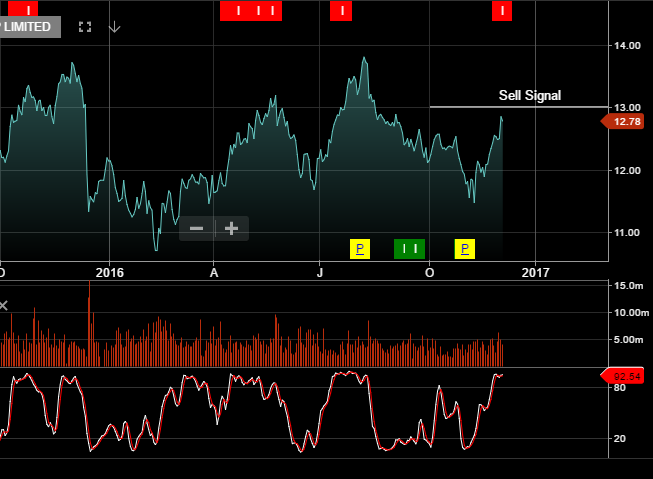
We note the algo short signal that occurred Friday on Suncorp. The stock is making a lower low and lower high pattern and resistance is at or near $13.00.

Given the backdrop of equities looking extended, in particular the financials, we’re willing to look at SUN on the short side with stops above $13.00. Downside price target will not extend past $12.25 as the 6% yield remains well supported. This is a trade that will be driven by index selling rather than company specific weakness.

For our portfolio clients holding SUN, we use this as an opportunity to enhance the yield and sell $13 calls into June 17 for a $0.50 credit, whilst keeping exposure to the $0.30 February dividend. This enhances the annualised cash flow to over 10%.

Chart - Suncorp
Chart – Suncorp


Global Macro

At this point, the FED Funds futures market is pricing in a 95% certainty of an upward adjustment to the Fed Funds target and a 40% chance of another adjustment by May of 2017.

Sunday will be the Presidential elections in Austria and the Parliamentary referendum in Italy. Between these two events, it’s more likely to expect a market moving result from the elections in Austria. If the Italian people vote “No” to the constitutional changes proposed on the ballot, the worst case result is that PM Matteo Renzi will be replaced by some other non-elected technocrat designated by the EU.

However, if the Freedom Party leader, Norbert Hofer, is elected as the next president of Austria, his promises to hold a “Brexit” style referendum, combined with his general disdain for EU policymakers in Brussels, could pressure G-7 equity markets lower.

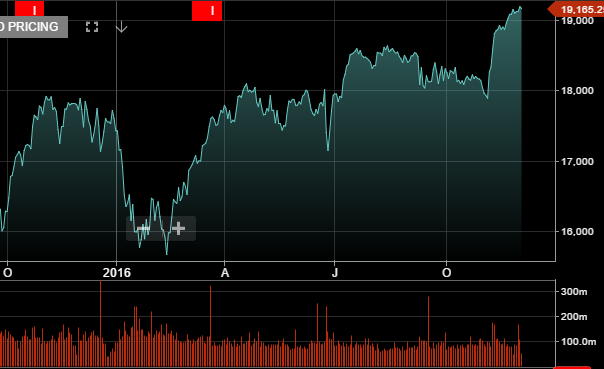
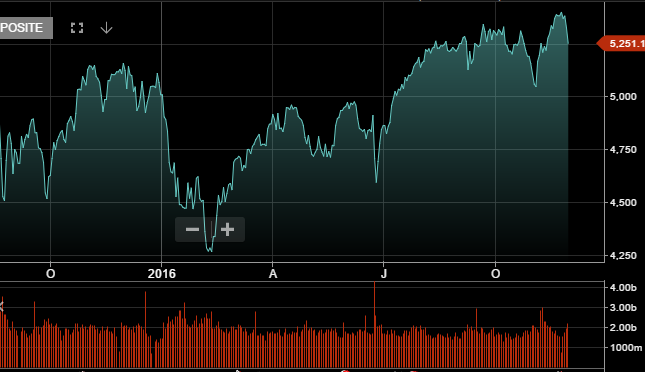
USD and US Stock indexes look technically stretched; internal volume and “breadth of market” indicators are showing signs of rolling over. It seems the slightest fundamental disruption to the current expansionary theme could trigger a pullback.

Chart - Dow Jones Index
Chart – Dow Jones Index
Chart - NASDAQ Index
Chart – NASDAQ Index

US Banks vs Technolgy

Over the last five years, one of the least important concerns for US Corporate Treasurers has been the forward cost of funding. However, over the last two months, the sharp rise across the US Treasury curve has exposed some notable differences in how banks perform versus technology companies perform in a rising interest rate environment.

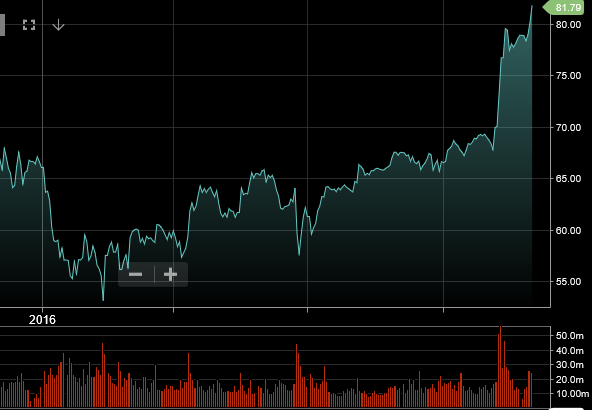
Since October 1st, the yield on the US 10-year note has surged close to 90 basis points from 1.55% to 2.44%. This is nearly a 60% increase and has helped US banking stocks, while hurting some big technology names.

For example, Since October 1st, shares of J.P.Morgan have climbed over 20% from $67.00 per share to over $81.00 per share. During that same period of time, shares of Facebook have dropped from $133.00 per share to just under $115.00 per share; a 13.5% drop.

Chart - JP Morgan
Chart – JP Morgan