Medibank Private

Medibank Private announced its net profit rose 1.9% in the half-year ending December 31st. The profit of $231.9 million compared to the $227.6 million earned in the year-ago period.

Directors reported an interim dividend of 5.25 cents per share out of earnings per share of 8.4 cents.

However, Medibank shares are down over 3.5% today as the company announced operating profits fell 6.4% to $250 million.

Higher claims by members and amortization on a new information technology system pushed health insurance operating profits down 8.2% to $249.4 million.

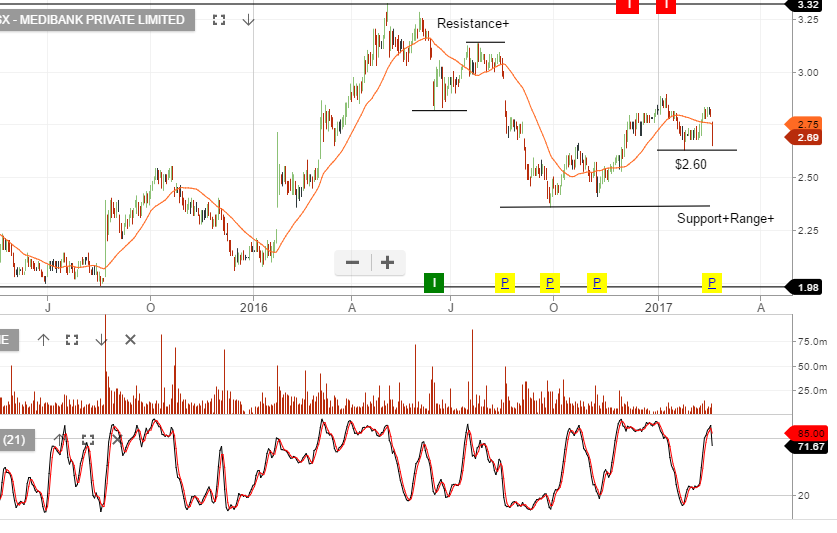
Initial chart support for the stock will be found in the $2.60 area, which will place MPL on a 4% forward yield. We own the stock in client portfolio’s and we’ve sold covered calls to enhance the yield.

Chart – MPL

Origin Energy

Shares of Origin Energy continue to slide after announcing yesterday that the company will take a $1.031 billion impairment charge on the APLNG gas export project in Queensland. This was the largest part of a broader $1.9 billion post-tax write-down.

Origin raised the bottom end of its forecast range for annual EBITDA by 3% to $2.45 billion, but kept the top end of the forecast at $2.62 billion.

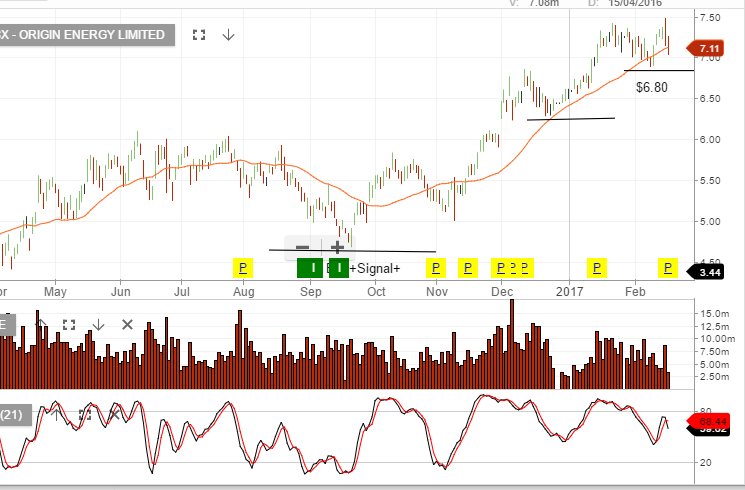
Origin shares are down over 2% so far today at $7.10. We see initial support coming in at or near the $6.88 level.

Our Algo Engine created a buy signal in September 2016 at $5.00

Chart – ORG

Sydney Airport

Stronger retail revenues helped Sydney Airports lift its 2017 guidance as 2016 annual profits were reported up 13.2% to $320.9 million.

The company announced that it will pay a full-year dividend of 31 cents per share for 2016 as total revenue climbed 11% in the year ended December 31st.

Total 2016 revenue was announced at $1.365 billion from $1.229 billion during the year ago period.

Forward guidance was higher, but slightly negative as the company forecast a 2017 dividend of 33.5 cents per share versus the street’s expectation of 34 cents per share. EBITDA rose 8.2% to $1.08 billion, and operating margins are running at 8.2%.

Total passenger numbers increased 5.6% to 41.9 million , with international passenger numbers rising 8.8% to 14.9 million.

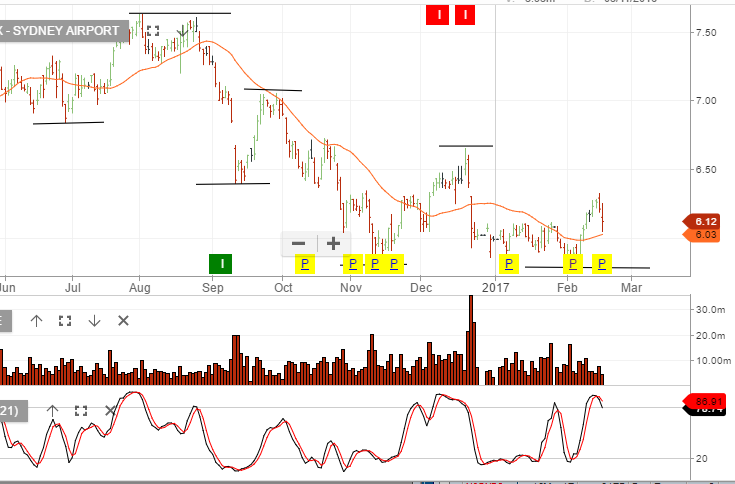
Technically, the share price should find support at the $6.00 area, which is also the 30-day moving average.

Our Algo Engine created a short signal in December at $6.70.

Chart – SYD

Telstra Disappoints

Telstra shares are down over 4% in early trade as Australia’s largest telecommunication company announce half-yearly profits down 14.2% and revenue 3.6% lower.

The company reported half-yearly profits of $1.79 billion compared to $2.09 billion this time last year. Revenue fell to $12.8 billion from $13.3 billion over the same period of time.

Their EBITDA of $5.18 billion was at the low end of earlier guidance, which is a sign that Telstra is undergoing a difficult transition to the post-NBN world.

The company announced an interim dividend of 15.5 cents per share, fully franked, which returns $1.8 billion to shareholders.

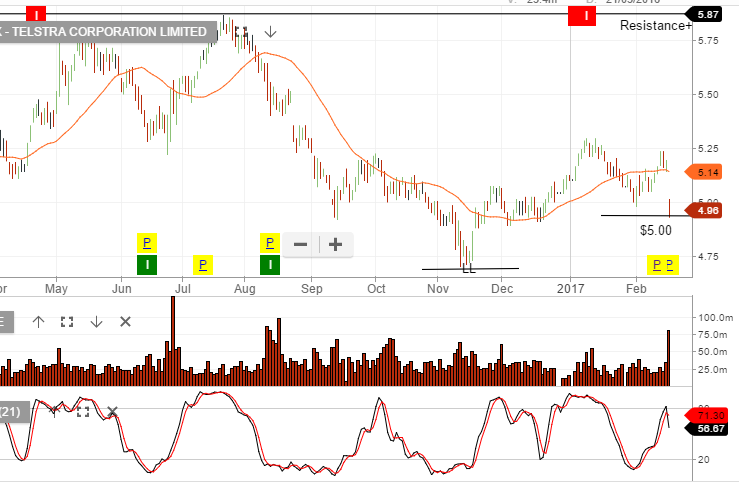
Our Algo Engine created a short signal in January at $5.27

Chart -TLS

Wesfarmers

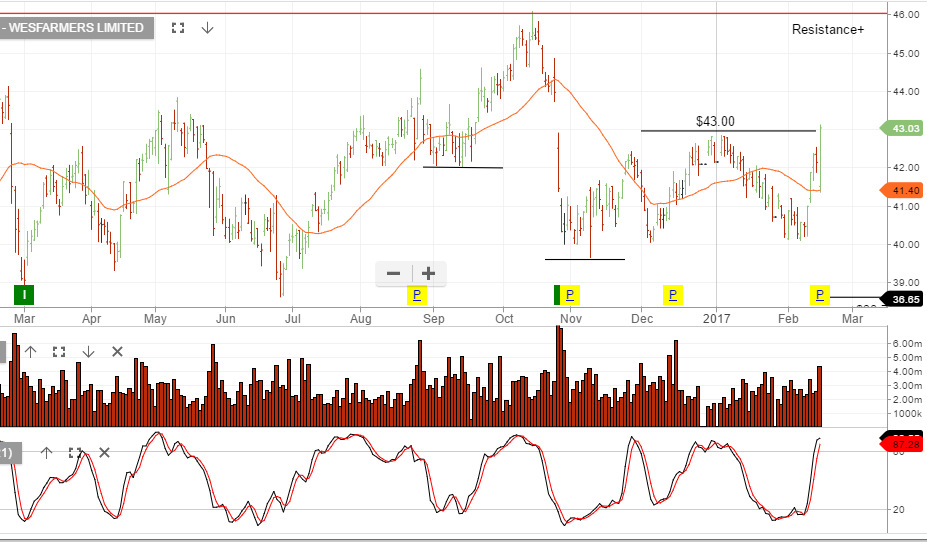
Wesfarmers‘ officials have credited their conglomerate structure for a 13.2% increase in half-year net profits to $1.57 billion. This result was well above the street’s expectation of $1.47 billion.

The company announced it will increase its interim dividend to $1.03 from 91 cents, payable on March 28th. Wesfarmers’ revenue grew by 4.3% to $34.9 billion, and EBIT were up 15.1% to 2.42 billion.

The strongest results from the conglomerate came from the industrial division, where earnings rose from $22 million to $377 million, largely from the $256 million turnaround in resources as coal prices moved higher during the quarter.

On the other side of the ledger, Coles’ same store sales grew by 1.3%, but lower prices meant revenue from the supermarket remained steady and earnings fell 6.8% .

Chart – WES

Commonwealth Bank

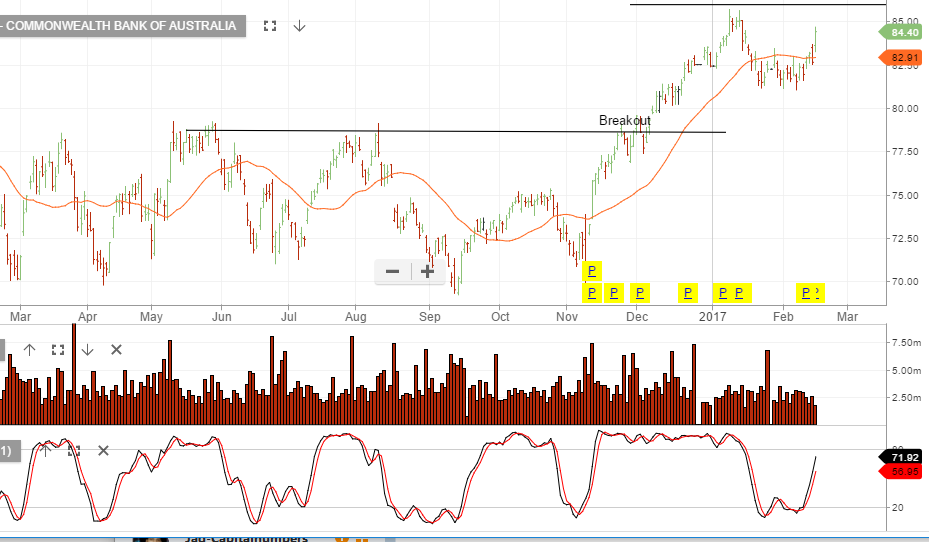
Shares of Commonwealth bank have opened 2% higher to $84.50 after reporting a record first-half profit of $4.9 billion.

The result was 6% higher than the previous record reported in the first half of last year. An interim fully franked dividend of $1.99 was declared, which was 1 cent higher than expected.

Upside price momentum could be tempered as the bank announced net interest margin was lowered to 2.11% from 2.15% and their wealth management division saw a net profit drop of 34% compared to the same period last year.

Chart – CBA

Bendigo Bank

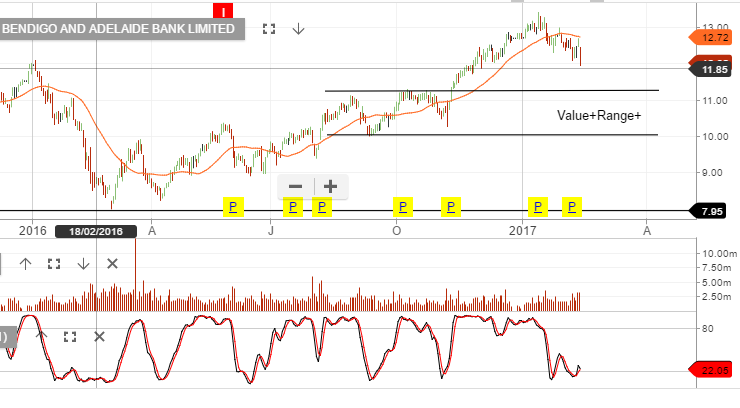
Bendigo Bank announced that they will keep its dividend steady at 34 cents per share, but a rise in bad and doubtful debts has pressured the stock 4% lower at the open of trade.

The bank posted a net profit of $209 million , up 0.1% from the previous period, and cash earnings were up 0.4% to $224.7 million. These results were pretty much inline with expectations.

However, after the bank reported bad and doubtful debts increased by $16.3 million to $39.8 million, the share price broke down through the recent support level at $12.25.

We believe that increased bad debts and loan provisions may be a recurring theme in the banking sector and limit share price appreciation across the big four banks.

Chart – BEN

AMCOR

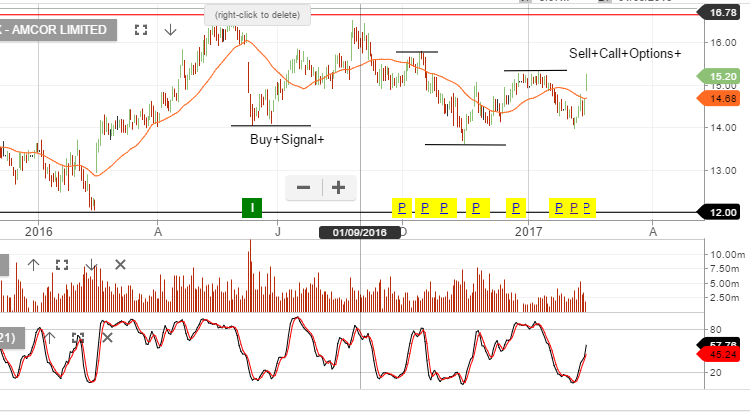
Shares of AMCOR are trading over 4% higher, to one-month high of $15.22, as the company reported a 3.8% rise in underlying net profit to USD 308 million.

The street had been expecting an underlying profit of USD 290 million.

Revenue rose 1.8% to USD 4.5 billion. AMCOR declared an interim dividend of USD 19.5 cents per share, compared to a USD 19 cent dividend during the same period last year.

AMCOR shares are up over 11% since trading as low as 13.65 in mid-November. Technical resistance will now be found in the $15.50 area.

Chart – AMC

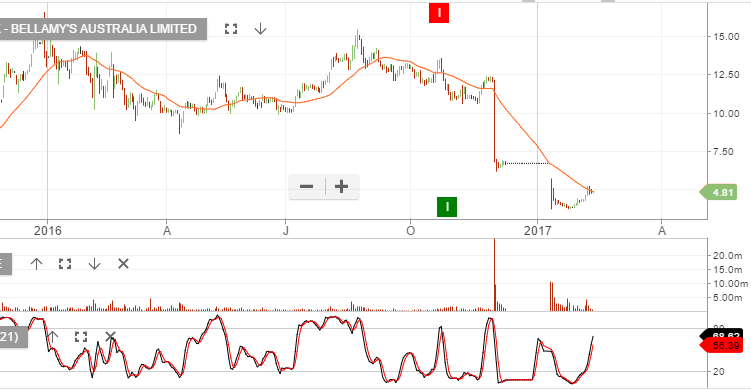
Bellamy’s

Shareholders of Bellamy’s have a had a pretty rough ride over the last couple of months.

The company is scheduled to report 1H17 results on February 27th, but rumors suggest they could release the report earlier.

The consensus forecast is for sales of $116 million, which would be 11% higher versus a year ago with EBITDA of $17 million, which would be down 11% on a year-on-year basis.

On balance, we feel that Bellamy’s is facing many company and industry specific issues, which may act as headwinds against a material rise in their share price.

However, should their planned restructuring strategy show evidence of working, the possibility of a  takeover is a real possibility in the medium-term.

Investors with an interest in the company should focus on the Extraordinary General meeting on February 28th to see what ,if any, changes to the board will be announced.

Chart – Bellamy’s

Bond Market Stress

Since the the beginning of 2015, there have only been two periods of time when the SP 500 has corrected lower by over 10%.

The first was from August 18 to the 24th, 2015. During these 5 trading days, the SP 500 fell from 2103 to 1831, 272 points, or 13%.

The second time was from December 30th, 2015 to January 20th, 2016. During these 18 trading days, the SP 500 dropped from 2074 to 1804, 270 points, or 13%

Of the many complex components that make up equity market pricing, and the fundamental events which can trigger widespread selling of global equities, it’s worthwhile to note that both of these periods of extreme stock market pressure were preceded by credit stress in regional bonds markets: The Greek bond market in 2015 and the Chinese bond market in early 2016.

Over the last three weeks, there have been early signs that these two bond markets may be in trouble again.

On January 20th, Greek 2-yr bond yields were trading at 6%. Last week they traded over 10% as negotiations with the EU creditors and the IMF are showing familiar acrimony and lack of progress.

This 400 basis point increase in yield reflects growing scepticism that any refinancing agreements will be reached at the EU finance minister’s meeting on February 20th.

As a point of reference, Greek  2-yr bonds were yielding over 25% when the contagion fears unsettled the market in 2015.

In China, the 2-yr yields have traded 40 basis points higher since the beginning of the year to just over 3%.

But more importantly, trading volumes in China’s bond futures market have exploded over the last two months as investors look to hedge the growing risks of rising rates and potential defaults. Turnover in the 2-yr to 10-yr Chinese bond curve has quadrupled since October as bond prices have dropped.

In early 2016, stress in China’s bond market caused investors to dump the Chinese Yuan, which lost over 7.5% during the broad global equity market correction.

It’s not our base case that global equity markets are drawing close to a sharp correction lower.

However, we feel it’s important that investors are cognizant about the state of markets which have triggered such events in the past. In short, the time to make a plan for a market sell off is before it happens, not while it’s happening.

As such, Investor Signals can offer investors trading access to local and global bond markets, International stocks and credit markets, In addition to ASX equities and derivatives.