ASX- Valuation Review

Following the recent 1H17 earnings update, we will take  a look at establishing fair value for the ASX.

1H17 NPAT of A$219m represented 3% underlying earnings growth. Moderate revenue growth occurred across most major ASX activities.

Here is the issue: the stock trades at 22x forward earnings on a 3.9% dividend yield. The earnings are stable but the stock is expensive. And whilst ASX delivered 3% revenue growth in 1H17, this is down on the 6% average level achieved over the last 3 years.

Our conclusion on fair value is; buy ASX on a pullback to $47 or a 4.5% dividend yield.

Chart – ASX


Australian Jobs Growth Data

Full-time jobs growth has slowed since 2013.

Slowing in full-time jobs growth is primarily due to job losses in the mining and manufacturing sectors with full-time job losses concentrated in the mining-dominated states of WA and Qld.

More recently though, full-time jobs growth has also reportedly stalled in NSW.

The latest employment data reported a loss of 44.8k full-time jobs in January, offset by a 58.3k rise in part-time jobs.

Chart – AUD vs USD


China & Our “Risk” Scenario

Chinese foreign exchange reserves dropped below $3 trillion in January for the first time almost 6 years. That’s down from $4 trillion in 2014.  The drop is largely caused by the Chinese central bank  intervening in the FX market as they buy yuan to prop-up the currency against the US dollar.

Overseas direct investment from China fell by 35% in January, compared to a year ago & Chinese investment in overseas property dropped by 84%.

Over-inflated Chinese property prices and the risk of their property bubble bursting, is a concern. We’re tracking resale data in the major cities and there’s evidence of price declines emerging since November of last year.

These are trends we’re watching closely as they form the basis of our “risk” scenario for global equities, especially given the gap between forward PE valuations and probable 2017 earnings growth.

China – iShares China Large CAP ETF


Boral – Chart Review

Boral has created a negative pricing structure following the stock making a lower low and then a lower high at $6.35 in last week’s trading.

With our general concerns around both domestic and US housing construction trends, combined with Boral’s  high valuation and moderate underlying earnings growth, we think this is worth keeping on your “short signal” list.

Chart – BLD


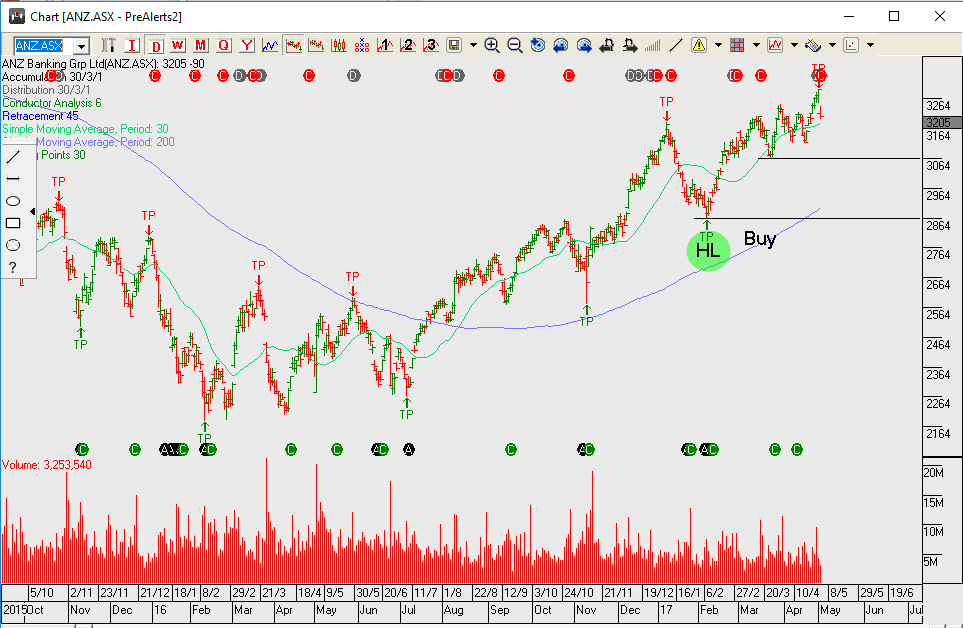
ANZ – December Quarter Earnings

The headline data from ANZ shows that the bank had a strong start to FY 2017. However, the pick-up in property and trading income are going to be difficult to replicate into H2 2017.

ANZ delivered around $2 billion in cash profit, which was well above the street’s expectations of $1.7 billion. The higher numbers were underpinned by strong trading income and a $283 million bad debt charge versus an expected $446 million charge.

We note that historically ANZ has had higher Q2 bad debt charges compared to Q1

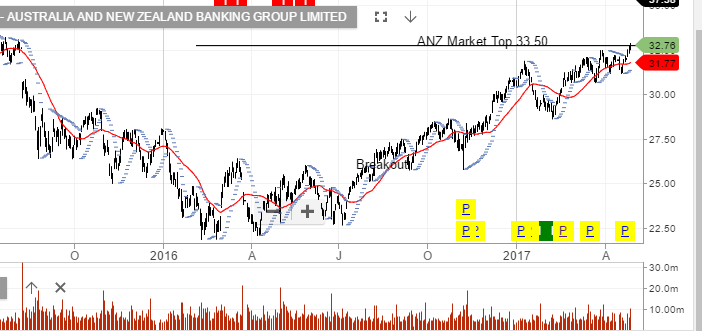
We would expect price resistance to emerge at or around the January 9th high of $31.80.

Chart – ANZ

Brambles Down Sharply

Shares of Brambles are trading over 8% lower in early trade as the pallet maker announced profits will fall well short of their original guidance.

For the first 6 months of the fiscal year, the company reported a 26% fall in net profit to USD 330.4 million. The drop was a largely blamed by a sharp write down on its Hoover Ferguson Group venture, as well as, margin pressure in its US business.

Back in November the company’s guidance suggested constant-currency sales growth in the 7 to 9% range and underlying profit growth in the 9 to 11% range.

Brambles declared an interim dividend of 14.5 cents a share.

Subscribers will remember that the Algo engine gave a sell signal on January 4th at $12.50. Brambles shares hit an 18-month low  $9.54 earlier today.

Chart – BXB

Banks – Chart Update

US banks, (see chart below of JP Morgan), are breaking to the upside of their recent consolidation range, and this is likely driving the rebound in the share price of the Australian banks.

NAB reported a 1% fall in earnings following weak revenue growth and a pickup in expense growth. Bendigo Bank failed to deliver growth at the top or bottom line.

CBA reported slightly ahead of expectations with underlying profit growth of 2.8% or $4.9b for the half. ANZ’s quarterly update, (released Friday), reported a 31% rise in profits to $2b for the 3 months to December.

Across all banking results, the NIM or net interest margins, remain under pressure, as does top line revenue growth. These are the same concerns which caused the 10% sell off in banks at the start of this year.

We’ll watch with interest how prices behaves in both the XJO and our major banks this week, as we commence trading with price levels similar to the peak of early January.

Chart – CBA
Chart – ANZ
Chart – WBC
Chart – NAB
CHART – JPM


XJO – Chart Update

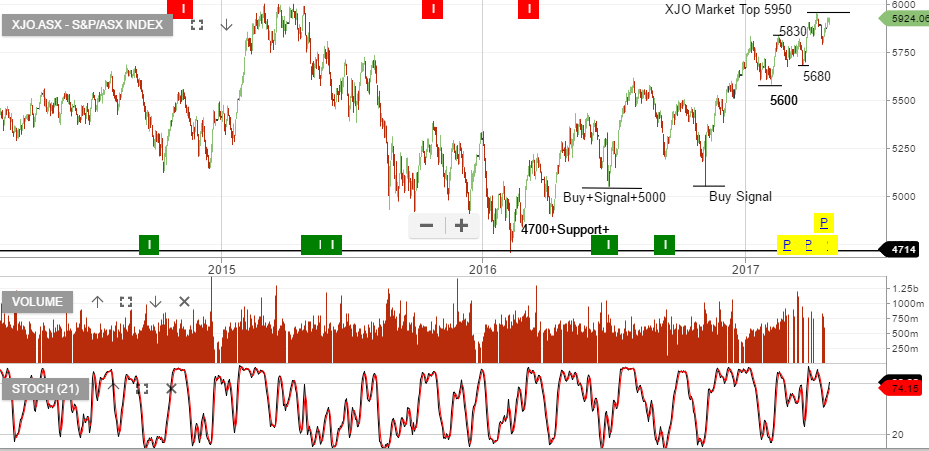
On the 7th of February the XJO index created a new higher low formation as buying support returned and the index rallied from the 5582 low, back to retest the trend high on Friday, when the index closed at 5805.

Currently, ASX 200 stocks which have reported, show an average revenue growth of 3.2% and underlying earnings per share growth of 6.5%. This is the first return to earnings growth in 3 years.

Chart – XJO

Sydney Airports FY16 Earnings

SYD’s FY16 results were in line with market forecasts.

EBITDA of $1.1b and DPS at $0.31. The company has flagged a
higher than expected FY17 distribution of $0.33

FY18 we assume EBITDA increasing to $1.2 billion  and based on DPS of $0.35 the stock trades on a forward yield of 5.6%.

Our preference remains TCL over SYD.

Chart – SYD