China Lowers Their GDP Growth Target

While addressing the 3,000 members of the National People’s Congress (NPC) in Beijing, Premier Li Keqiang announced that China’s economic growth target has been cut to around 6.5% from last year’s estimate of 7%.

China’s GDP grew at the slowest rate in 26 years last year, and Mr Li pledged he would address the state sponsored “zombie enterprises” which produce more coal and steel than the market needed.

Similar pledges have proved hard to fulfill in the past.

However,  it appears that NPC leaders are more committed to slower growth to deal with the painful reforms triggered by the rapid build-up in debt from both the official and shadow banking sectors.

Against the backdrop of last week’s disappointing Australian trade balance numbers, it will be worth watching to see if the RBA makes reference to this development during their monthly statement tomorrow.

A contracting Chinese economy would increase the likelihood of another RBA rate cut and a lower Australian Dollar.


Aussie Dollar Falls Hard On Trade Data

The Aussie Dollar fell hard last night breaking the key support area of .7600 versus the US Dollar and closing the NY session down almost 1.5% for the day.

After consolidating for several weeks above .7650, the AUD/USD finally broke down. Although recent economic reports have been fairly good, yesterday’s weaker trade balance figures were a sharp reminder of the damage a stronger currency can do to an export dependent economy.

Analysts were looking for the January trade surplus to increase to 3.8 billion, but instead it shrank to 1.3 billion; less than a third of the expected level. The main draw on the trade balance were exports, which fell over 3% for the month.

The RBA has been clear that a stronger AUD will act as an economic headwind as Australia moves away from a mining-based economy.

Over the last 18 months, the AUD/USD has traded in a broad range between .7000 and .7750. Technically, last week’s high of .7740 could stand as a medium-term top as US Dollar strength pushes the AUD toward the bottom end of the range.

Investors looking to benefit from a move lower in the AUD/USD can consider the BetaShares AUD-based Exchange Traded Funds.

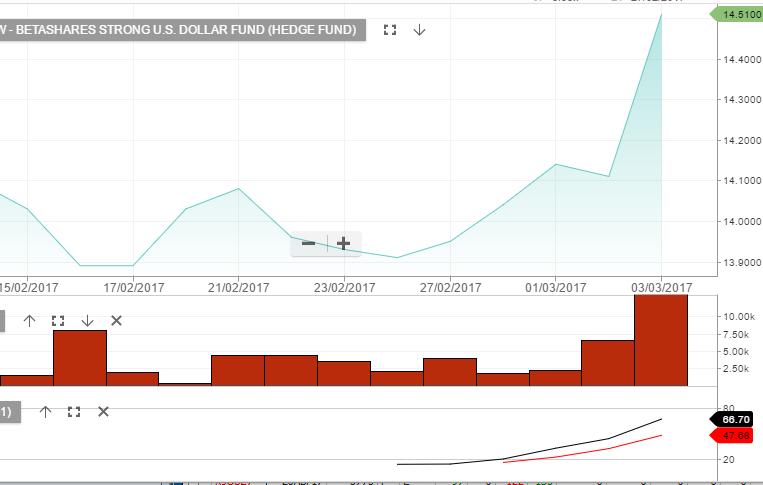
BetaShares offers two ASX-listed ETFs which increase in value as the AUD trades lower against the USD.

These two ETFs are called: USD, which is unweighted, and YANK, which has an approximate weighting of 2.5 to 1.

Contact us for more information about these AUD-based ETFs.

Chart – YANK