JP Morgan & General Electric

The following charts of Dow Jones’ large caps General Electric and JP Morgan, provide an interesting technical perspective of one of the world’s largest industrial conglomerates and one of America’s largest financial institutions.

GE reported late in the week and at first glance the headline number looked okay, but after digging deeper the free cash flow provided a concern and the stock sold off.

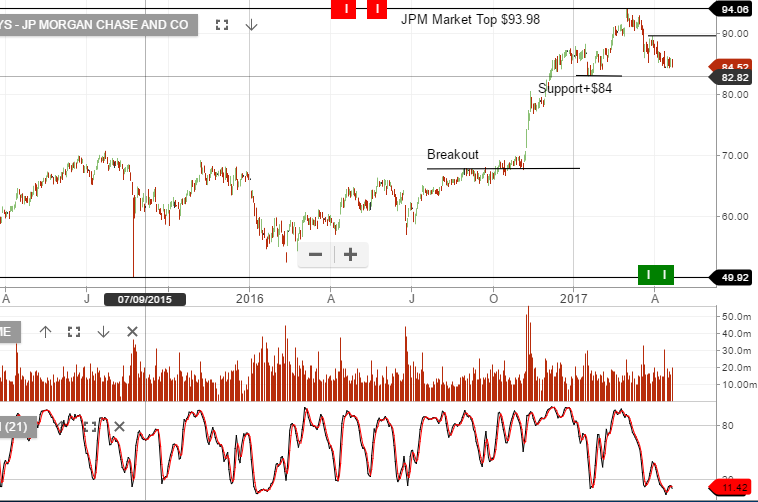
In the case of JP Morgan and other US banks, we’ve watched their share prices sell-off from the March highs as the long end of the yield curve flattens. The implication for banks is, a flattening yield curve will reduce their net interest margins.

US banks have now retraced on average 10%+ from their recent highs.
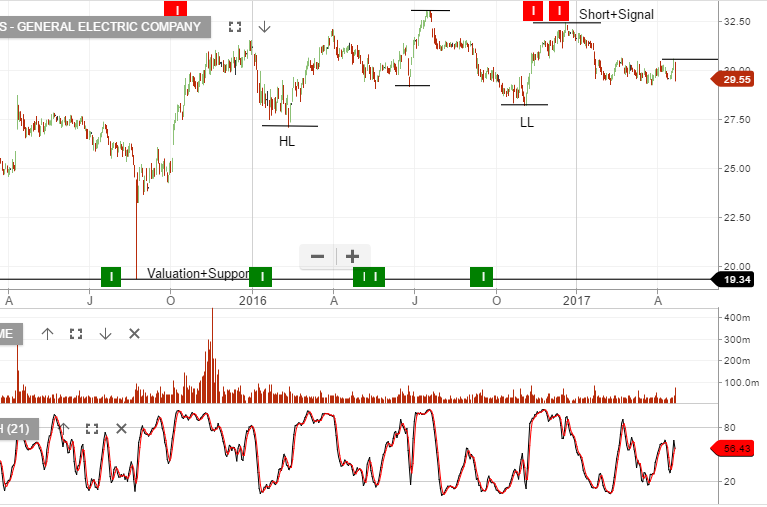
Chart – GE
Charts – JPM


The French Election

By the time the ASX starts trading on Monday, the results of the first round of the French Presidential election should be confirmed.

At 4pm Sydney time today, French citizens will begin casting their ballots in what has been one of the most contentious elections in its history, and where the future direction of the European Union could be in the balance.

From a market volatility perspective, the most positive result would be a large turnout for centrist Emmanuel Macron against any of the other three leading candidates.

The worst case scenario for the markets would be if Mr Macron doesn’t get enough votes to qualify for the second round of voting scheduled for May 7th.

Current polling shows that the most likely outcome will be Mr Macron running against the anti-EU candidate, Marine Le Pen, in the second round of voting.

In this case, the market reaction will be determined by the size of the margin between these two candidates.

Crunch Time For US Earnings

US earnings season will go into full swing next week with several DOW components and high-capitalization  S&P 500 companies reporting Q1 earnings.

Thus far, the results have been mixed with IBM missing badly and forward guidance on the major US banks showing concerns for future revenue growth.

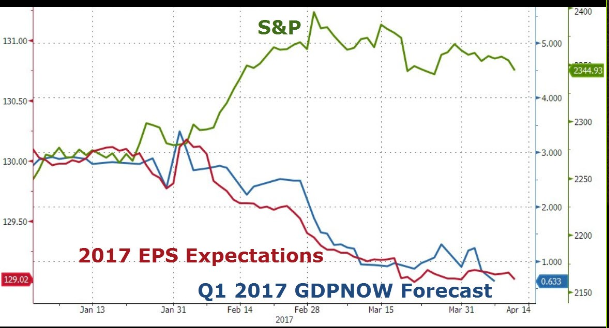
The chart below shows that the expectations of S&P earnings, relative to the current pricing of the S&P 500 index, are very much out of line.

If next week’s earnings reports don’t exceed expectations, we could see further downside range extension on the SP 500 index, which could pressure the XJO index lower.

We have been looking at the May 5800 XJO puts as a short-term portfolio hedging instrument for a move lower in the local market.

We have also been buying the BetaShare BBOZ inverse exchange traded fund. Shares in BBOZ gain value as the local market trades lower.

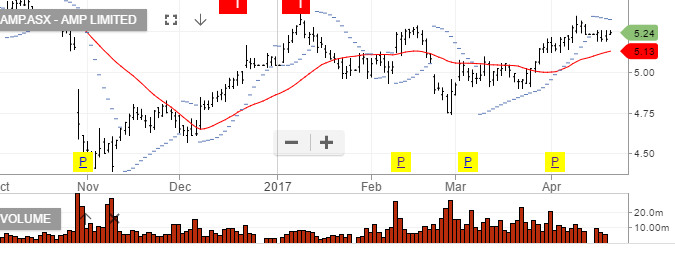
A Triple-Top Formation In AMP

Shares of AMP have been carving out a triple-top pattern since October of last year. Since then, the share price has topped out around the $5.30 level on January 9th, and again on April 4th.

Regular readers will recall that AMP posted a loss of $344 million back in February. This was the company’s first full year loss since 2003 and exposed ongoing concerns about their life insurance and wealth protection divisions.

We are currently holding a $5.00/4.60 put spread into June and suggest investors look at downside opportunities from AMP.

Our near-term target is $4.60, but see scope for a move back to the November low of $4.30.

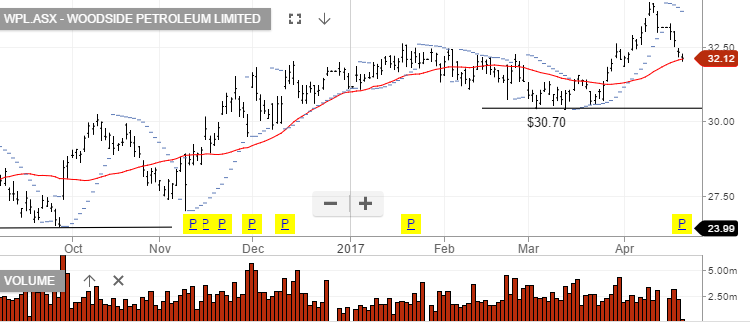
WPL – Q1-17 Production

Woodside’s 1Q-17 quarterly production was impacted by weather, with sales revenue down to US$895 vs US$1b in the December quarter of 2016.

Woodside is working on advancing Scarborough & Browse LNG projects. With the market assigning a minimal current value to these projects, they could provide longer term material upside to Woodside should it be successful in demonstrating the viability of the projects.

FY18 forecast EPS is likely to be similar to FY17 placing the stock on a forward yield of 4%.


A Yield Play For Telstra

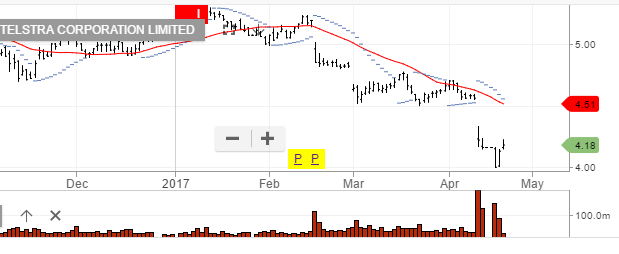
Shares of Telstra have dropped close to 15% over the last month. When the shares traded at $4.00 on Tuesday, this was the lowest price since October 2012.

While some of the pricing fundamentals may be unclear going forward, from a pure yield perspective, we see the potential for value.

At current prices, if TLS matches it’s previous dividend of 15.5 cents in September, this puts the stock on a forward yield of over 8%; plus franking credits.

We consider this good value and like the long side of TLS for a move back over $4.50 in the medium-term.

 Telstra

Drop In Crude Oil Puts CTX back In The Buy Zone

WTI Crude Oil prices posted their largest one-day loss in six weeks, as the US Energy Information Administration reported a smaller than expected draw down on crude supplies.

The Spot crude price fell $1.97, or 3.8% to settle at a 4-week low of $52.90. The next level of support will be found at $52.50.

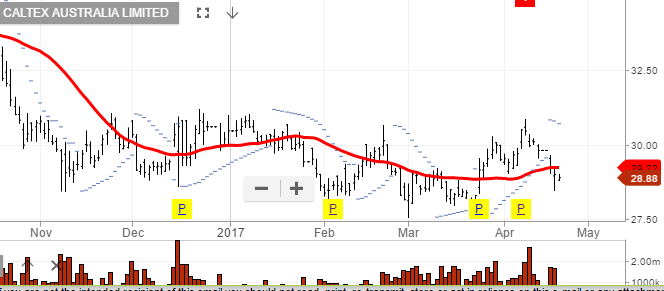
We expect the overnight fall to put shares of Caltex (CTX) back into the buy zone around the $28.80 level.

Regular readers will recall that we sold our long positions in CTX early last week in the $30.50 area.

The Daily chart pattern is showing a trading range of $28.30 to $30.50, we are looking to trade this range over the near-term.

Chart Caltex

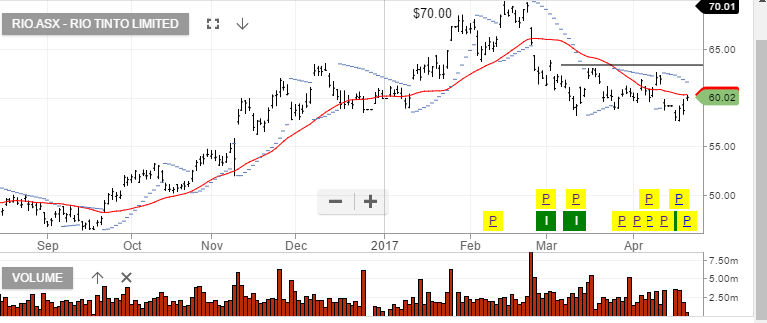
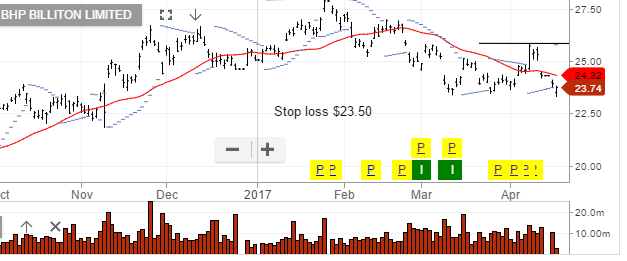
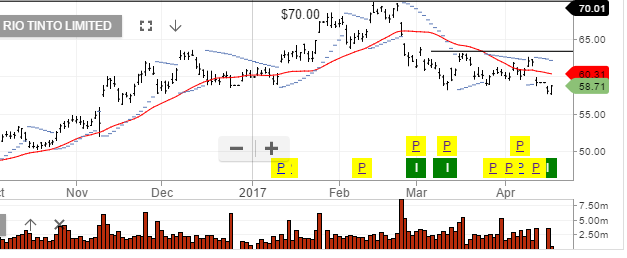
BHP And RIO Trade Lower As Iron Ore Continues To Unravel

The Spot Iron Ore price continued to trade lower overnight, losing 4.6% to reach a 6-month low of $63.20 per dry tonne. This is a 33.5% drop from the high of $95.00 last traded on February 21st.

It’s worth noting that the sharp selloff is picking up pace just weeks away from the delivery of the Australian Federal Budget.

Since Iron Ore remains the country’s single biggest export, Federal revenue projections are highly sensitive to the outlook for Iron Ore prices.

Both RIO and BHP have traded lower on the open,  reaching new 5-month lows of $57.60 and $23.30, respectively.

Unless Iron Ore stages a dramatic rebound, we look for the the next key support level in RIO at $56.20, and at $22.60 for BHP. 


Goldman Sachs – Q1 17 Earnings Result

Goldman shares dropped more than 5 percent overnight to trade at their lowest since the end of November and are down 10 percent for the year so far. The US financials sector is about 1 percent lower year to date

Goldman Sachs reported 1Q earnings per share of $5.15 a share, missing a consensus estimate by 16 cents. Revenue came in short by about $420 million at $8.026 billion.

The last time Goldman reported a miss on earnings per share was the fourth quarter of 2015.

Technical buying support may start to build at or near $200.

Chart – Goldman Sachs