reported its Q1 2026 financial results on May 5, 2026, delivering a beat on both top and bottom lines as the company continues its transition away from peak pandemic-era revenues. Operational revenue from “launched and acquired products” surged 22%, driven by strong performance in the oncology and specialty care portfolios.
Q1 2026 Earnings Summary
Adjusted EPS: $0.75 (Beat consensus estimate of $0.72 by $0.03).
Total Revenue: $14.45 billion (Beat estimate of ~$13.84 billion; up 5% year-over-year).
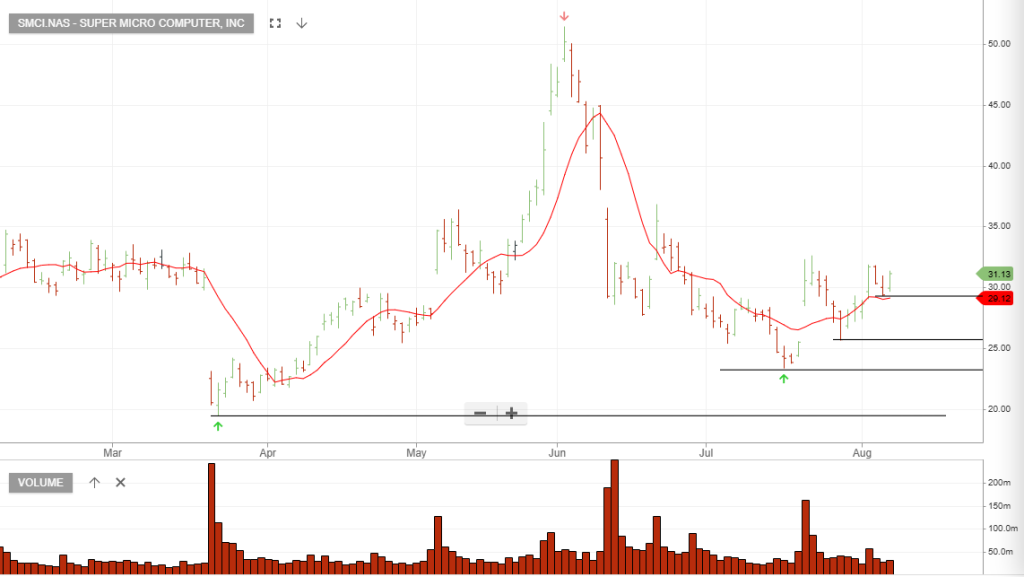
Super Micro Computer, reported its Q3 Fiscal Year 2026 results on May 5, 2026. While the stock saw a massive surge (up ~18-25%) immediately following the announcement, the report was a “beat and miss” that shifted investor focus toward profitability and long-term guidance.
Revenue:$10.24 billion, representing 123% year-over-year growth. However, this missed the analyst estimate of $12.4 billion
Full Year 2026 Revenue: Raised to a range of $38.9 billion to $40.4 billion (up from previous targets of ~$36B).
Key Growth Drivers
AI Infrastructure Dominance: AI GPU-related platforms (NVIDIA, AMD, Intel-based) contributed over 80% of total revenue.
Supply Chain & Deferred Revenue: The revenue miss was attributed to temporary supply chain constraints and “customer readiness” (data centers lacking sufficient power/networking to accept immediate delivery). Management noted a record-high backlog, suggesting that the missed revenue is deferred to future quarters rather than lost.
Direct Liquid Cooling (DLC): SMCI highlighted its leadership in liquid-cooled rack solutions, which are increasingly required for the latest high-power AI chips (like NVIDIA’s Blackwell).
Balance Sheet & Risks
Negative Cash Flow: The company reported negative operating cash flow of $6.6 billion for the quarter, driven by aggressive inventory build-up ($11.1 billion) to support future deliveries.
Leverage: Net debt rose to roughly $7.5 billion as the company utilized convertible notes and credit lines to fund its massive working capital needs.
Legal Overhang: Investors remain cautious regarding an ongoing independent review of export-control matters and a class-action lawsuit (lead plaintiff deadline May 26, 2026), though management stated they do not currently expect a financial restatement.
NAS:SEstrong Q1 2026 earnings report, which featured a significant revenue beat and record-breaking performance across its core business segments.
Despite an EPS miss ($0.67 vs. $0.77 expected), investors prioritized the massive top-line growth and evidence that Sea’s strategic investments in logistics and AI are improving unit economics. The company demonstrated its ability to scale rapidly while maintaining financial discipline in a competitive Southeast Asian and Latin American landscape.
Significant Revenue Beat: Sea reported GAAP revenue of $7.1 billion, a 46.6% year-over-year increase, comfortably exceeding the analyst consensus of $6.45 billion.
EBITDA Milestone: The company achieved a quarterly adjusted EBITDA of $1.0 billion for the first time, representing a 9.3% increase.
Shopee Dominance: The e-commerce segment reached record highs with Gross Merchandise Value (GMV) of $37.3 billion (+30.2% YoY) and revenue of $4.5 billion (+44.4% YoY).
Garena Recovery: The gaming division, Garena, delivered its strongest quarter since 2021, with bookings rising 20.1% to $931.4 million, fueled by the continued popularity of Free Fire*.
Fintech Growth: Its digital financial services arm, Monee, saw revenue surge 57.8% to $1.2 billion, with its loan book growing 71% while maintaining stable asset quality.
Inghams Group shares rose 6.2% to $1.80 following a trading update that reassured investors about the company’s full-year outlook despite significant external headwinds.
Although Inghams has struggled over the past 12 months (with the share price down over 50% in that period), the market reacted positively to signs of “stabilising” trading conditions and the company’s ability to maintain its earnings forecast despite the spike in diesel and logistics costs.
FY26 Guidance & Financials
EBITDA Reaffirmed: Inghams maintained its FY26 underlying EBITDA (pre-AASB 16) guidance of $180 million to $200 million.
Previous Cut: This guidance had been revised downward in February 2026 (from a previous $215M–$230M range), so the reaffirmation provided the market with much-needed stability.
Operational Momentum: For the first nine months of FY26, group poultry volumes rose 1.1%, and net selling prices also increased by 1.1% compared to the prior corresponding period (PCP).
Strategic & Defensive Measures To protect its margins against fuel and packaging inflation, Inghams is executing several key initiatives:
Cost-Cutting Program: Targeting $60 million to $80 million in annualised savings.
Inventory Management: Reduced frozen inventory by $25 million, improving cash flow and system balance.
Capital Expenditure: Revised FY26 CapEx guidance to approximately $80 million.
The upcoming week will be dominated by central bank policy and the tail-end of the US earnings season. Investors should focus on the following key events:
1. Macro Data and Central Banks
RBA Interest Rate Decision: The market is bracing for a possible 25 basis point (bps) rate hike from the Reserve Bank next week. Persistent cost pressures and the March inflation print of 4.6% have led analysts to forecast that rates could rise to 4.60% by September 2026.
US Fed Watch: With the Fed Funds Interest Rate currently at 3.75%, any commentary following the recent PCE data will be scrutinized for signs of a pivot or continued pause.
2. Company Events and Earnings
ASX Resource Reports: Following BHP’s recent Quarterly Activities Report, market participants will be looking for production guidance updates from mid-tier miners as commodity price volatility continues.
US Earnings: The earnings season continues with key players in the energy and consumer discretionary sectors scheduled to report. The focus will remain on whether corporate margins can continue to withstand higher interest costs.
CSL is navigating a period of significant structural transition and market re-evaluation. The stock recently hit a nine-year low, primarily driven by a sharp earnings reset in its half-year results and broader regulatory headwinds.
Valuation: The price-to-earnings (P/E) ratio has compressed to approximately 15x (TTM) on an underlying basis.
Recent Financial Performance (H1 FY26) The company’s February 2026 earnings report was a major catalyst for the recent sell-off:
Net Profit Plunge: Reported Net Profit After Tax (NPAT) fell 81% to US$401 million, largely due to ~US$1.1 billion in one-off restructuring charges and asset impairments.
Underlying Performance: Underlying NPATA fell 7% to US$1.9 billion.
Revenue: Declined 4% to US$8.3 billion (constant currency). The core CSL Behring plasma division saw a 7% sales contraction, driven by U.S. Medicare reimbursement reforms and policy changes in China affecting pricing.
Impairments: Significant write-downs were taken on CSL Vifor (primarily due to generic competition for its iron therapy, Venofer®) and intellectual property within CSL Seqirus.
Strategic Developments & Recovery Plan Despite the earnings volatility, management is aggressively deploying capital to stabilize margins:
Capacity Expansion: In March 2026, CSL broke ground on a US$1.5 billion expansion of its Kankakee, Illinois facility. This project will utilize “Horizon 2” technology designed to increase protein yield from plasma.
Share Buy-back: CSL is currently active in an on-market share buy-back program. As of today, April 27, 2026, the company has repurchased nearly 6 million shares to support shareholder value.
Cost Savings: CSL has targeted US$500M+ in annual pre-tax savings by FY28 through organizational simplification.
Vaccine Pipeline: CSL Seqirus recently secured new long-term contracts with the Pan American Health Organization (PAHO) and Canada for pandemic influenza preparedness.
Dividends & Guidance
Dividends: The interim dividend of US$1.30 per share (unfranked) was paid on April 8, 2026. The current annual yield sits at approximately 3.3%.
FY26 Outlook: Management has maintained guidance for the full year 2026, expecting 2–3% revenue growth and 4–7% NPATA growth (excluding one-offs). However, the market remains cautious about the “structural” nature of margin pressures through FY28.
Investor Outlook The current market sentiment is a battle between value seekers (pointing to “oversold” technical indicators and a 15-year low multiple) and skeptics concerned about the long-term impact of U.S. Medicare drug price negotiations and competition in the iron deficiency market.
Snowflake remains one of the highest-quality data + AI infrastructure platforms globally, positioned at the centre of enterprise data workflows.
The investment case is simple:
Structural tailwind: Explosion in data + AI workloads
Platform leverage: Usage-based model scales with customer success
Margin expansion: Strong operating leverage as revenue scales
👉 The market is pricing Snowflake as a ~25–30% revenue compounder with accelerating earnings power
📊 Revenue Growth Profile
Metric
Current
Forward View
Revenue Growth
~30% YoY
~25–27% YoY
FY2026 Revenue
~$4.7B
—
Medium-Term Target
—
~$8–9B (next ~3–4 yrs)
Key Drivers
Enterprise data migration to cloud
AI / machine learning workloads
Expansion within existing customers (land → expand model)
👉 Takeaway: Revenue growth is high but normalising, still well above most large-cap software peers.
Based on current market estimates as of April 30, 2026, Snowflake (SNOW) is expected to report its fiscal first quarter 2027 results in late May.
Estimated Earnings Date
Primary Estimate:Wednesday, May 27, 2026 (After market close).
Secondary Estimate: Some analysts project the release could occur as early as Wednesday, May 20, 2026.
Official Confirmation: Snowflake typically issues a press release confirming the exact date and time in early May (last year, the announcement was made on May 1st).
Q1 FY2027 Analyst Expectations Analysts are currently forecasting the following metrics for the quarter ending April 30, 2026:
Implied Growth: This would represent approximately 27% year-over-year revenue growth.
Consensus EPS Forecast: ~$0.32 (estimates range from $0.14 to $0.32 depending on the source).
CSL is navigating a period of significant structural transition and market re-evaluation. The stock recently hit a nine-year low, primarily driven by a sharp earnings reset in its half-year results and broader regulatory headwinds.
Valuation: The price-to-earnings (P/E) ratio has compressed to approximately 15x (TTM) on an underlying basis.
Recent Financial Performance (H1 FY26) The company’s February 2026 earnings report was a major catalyst for the recent sell-off:
Net Profit Plunge: Reported Net Profit After Tax (NPAT) fell 81% to US$401 million, largely due to ~US$1.1 billion in one-off restructuring charges and asset impairments.
Underlying Performance: Underlying NPATA fell 7% to US$1.9 billion.
Revenue: Declined 4% to US$8.3 billion (constant currency). The core CSL Behring plasma division saw a 7% sales contraction, driven by U.S. Medicare reimbursement reforms and policy changes in China affecting pricing.
Impairments: Significant write-downs were taken on CSL Vifor (primarily due to generic competition for its iron therapy, Venofer®) and intellectual property within CSL Seqirus.
Strategic Developments & Recovery Plan Despite the earnings volatility, management is aggressively deploying capital to stabilize margins:
Capacity Expansion: In March 2026, CSL broke ground on a US$1.5 billion expansion of its Kankakee, Illinois facility. This project will utilize “Horizon 2” technology designed to increase protein yield from plasma.
Share Buy-back: CSL is currently active in an on-market share buy-back program. As of today, April 27, 2026, the company has repurchased nearly 6 million shares to support shareholder value.
Cost Savings: CSL has targeted US$500M+ in annual pre-tax savings by FY28 through organizational simplification.
Vaccine Pipeline: CSL Seqirus recently secured new long-term contracts with the Pan American Health Organization (PAHO) and Canada for pandemic influenza preparedness.
Dividends & Guidance
Dividends: The interim dividend of US$1.30 per share (unfranked) was paid on April 8, 2026. The current annual yield sits at approximately 3.3%.
FY26 Outlook: Management has maintained guidance for the full year 2026, expecting 2–3% revenue growth and 4–7% NPATA growth (excluding one-offs). However, the market remains cautious about the “structural” nature of margin pressures through FY28.
Investor Outlook The current market sentiment is a battle between value seekers (pointing to “oversold” technical indicators and a 15-year low multiple) and skeptics concerned about the long-term impact of U.S. Medicare drug price negotiations and competition in the iron deficiency market.
Zscaler, Inc. – Common is expected to report its fiscal third quarter (Q3) 2026 earnings on 28 May. Investors will likely focus onwhether the company can maintain its record-high non-GAAP operating margins (22.4% in Q2).
AI Security Growth: Updates on the “AI-driven security moat” and transaction volume. Acquisition Integration: Performance of the recently acquired Red Canary.
Analyst Expectations
Estimated EPS: ~$1.00 – $1.01
Estimated Revenue: ~$831 million – $836 million
Last Earnings Recap (Q2 FY2026)
Report Date: February 26, 2026
Results: Zscaler reported a strong beat with an EPS of $1.01 (vs. $0.89 expected) and revenue of $815.75 million (vs. $798.33 million expected).
Guidance: Following the Q2 report, the company raised its full-year fiscal 2026 revenue guidance to approximately $3.32 billion.
Honeywell International Inc. – Common is currently a “transformation play.” While near-term revenue headwinds and supply chain issues are weighing on the stock, the June 29 Aerospace spin-off is the primary catalyst we’re watching.
Q1 2026 Earnings Highlights (Released April 23, 2026) Honeywell reported mixed results for the first quarter of 2026:
Adjusted EPS:$2.45, beating the analyst consensus of $2.32 (up 11% year-over-year).
Revenue:$9.14 billion, missing the estimated $9.30 billion. Organic sales growth was 2%, slowed by mechanical supply chain constraints in Aerospace and geopolitical disruptions in the Middle East.
Margins: Segment margins expanded 90 basis points to 23.3%, driven by strong pricing discipline and cost removals.
Backlog: Rose 15% to a robust $38 billion, indicating strong future demand.
Strategic Catalyst: The Aerospace Spin-Off The biggest upcoming driver for HON is the planned separation of its Aerospace business:
Spin-Off Date: Scheduled for June 29, 2026.
Objective: To create two “pure-play” companies: one focused on Aerospace Technologies and the other (RemainCo) on Industrial/Building Automation and Energy.
Divestitures: Honeywell also recently announced the sale of its Warehouse and Workflow Solutions (WWS) and Productivity Solutions and Services (PSS) businesses, expected to close in the second half of 2026.
Consensus:“Moderate Buy” with 13 Buy ratings and 8 Hold ratings.
Price Targets: Analysts have a median target of $245.00 – $250.21, implying a potential upside of roughly 15-20% from current levels.
Recent Changes: Following the revenue miss, firms like Citigroup and Barclays slightly lowered their price targets (e.g., Citi from $265 to $257) but maintained “Buy/Overweight” ratings, citing long-term value in the portfolio breakup.
Sophisticated Investor?
We have special opportunities available for Sophisticated Investors. If you're interested, and qualify, please provide your details below.