Aussie Dollar Falls Hard On Trade Data

The Aussie Dollar fell hard last night breaking the key support area of .7600 versus the US Dollar and closing the NY session down almost 1.5% for the day.

After consolidating for several weeks above .7650, the AUD/USD finally broke down. Although recent economic reports have been fairly good, yesterday’s weaker trade balance figures were a sharp reminder of the damage a stronger currency can do to an export dependent economy.

Analysts were looking for the January trade surplus to increase to 3.8 billion, but instead it shrank to 1.3 billion; less than a third of the expected level. The main draw on the trade balance were exports, which fell over 3% for the month.

The RBA has been clear that a stronger AUD will act as an economic headwind as Australia moves away from a mining-based economy.

Over the last 18 months, the AUD/USD has traded in a broad range between .7000 and .7750. Technically, last week’s high of .7740 could stand as a medium-term top as US Dollar strength pushes the AUD toward the bottom end of the range.

Investors looking to benefit from a move lower in the AUD/USD can consider the BetaShares AUD-based Exchange Traded Funds.

BetaShares offers two ASX-listed ETFs which increase in value as the AUD trades lower against the USD.

These two ETFs are called: USD, which is unweighted, and YANK, which has an approximate weighting of 2.5 to 1.

Contact us for more information about these AUD-based ETFs.
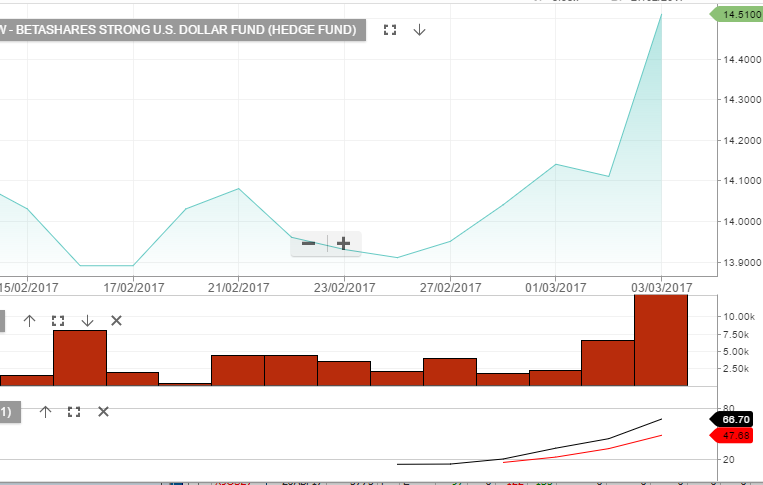
Chart – YANK


Four Stocks Driving The DOW

Since February 2nd, when the DOW Jones 30 index crossed above 20,000, four individual DOW components have been responsible for over 500 points of the gains which lifted the index up to today’s close of 21, 115.

These four shares are Goldman Sachs (160 DOW points), Boeing (150 points), 3M (110 points) and Apple (80 points)

Not surprisingly, these four companies stand to benefit from the three most broad policy measures from the Trump administration: Infrastructure expansion, tax reform and financial deregulation.

However, against the backdrop of today’s stock market rally, US interest rate markets are beginning to aggressively price in an increase in the Fed Funds rates at this month’s FOMC meeting.

As of last Friday, the odds that the FED would lift rates on March 15th were 30%. At the close of trade today, the odds have soared to 82% with the yields on the US 2-year notes reaching a 9-year high of 1.30%.

Much of this price increase has been prompted by comments from voting FED Governors; who have been uncharacteristically direct in their concern about waiting too long to normalise rates.

Mr Trump’s Speech

On February 9th, President Trump jarred the US stock market by saying he was going to make a “phenomenal” tax announcement in a few weeks.

A few weeks are up, and Mr Trump will be speaking to a joint session of Congress at around 1pm Sydney time today.

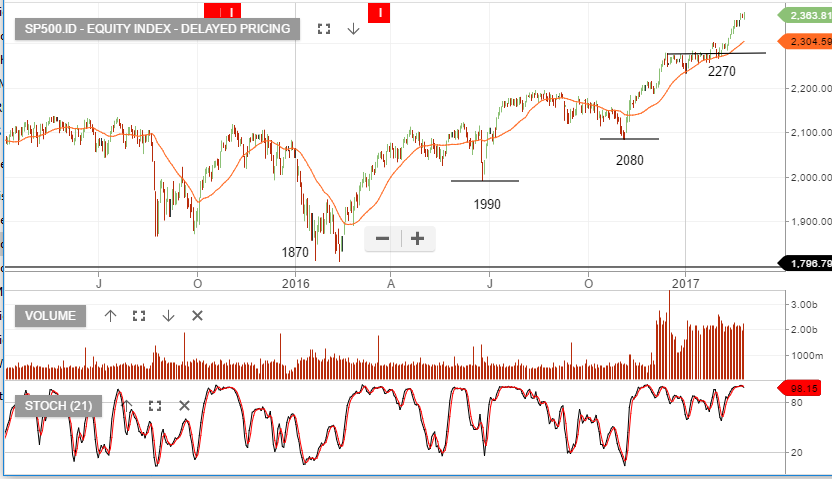
Since Mr Trump’s original announcement , the SP 500 has gained over 60 points , or close to 3.5%, largely on three key policy expectations:  tax reform, aggressive infrastructure spending and a more business-friendly approach to market regulation.

Considering the unprecedented nature of today’s speech, it’s difficult to precisely gauge the amount of time Mr Trump will spend on these economic policy initiatives and the level of detail he will provide.

It is very likely that the market will react sharply to any comments on the timing of tax reform. This includes comments about the Border Adjustment Tax (BAT); which has not been popular with retail and banking stocks.

In the lead up to today’s speech, administration officials have watered down some of the dynamics of these three  policy measures. Despite this lowering of expectations, the US stock market has still traded at elevated levels relative to earnings valuations.

On balance, we believe that Mr Trump’s speech will fall short of “phenomenal” with respect to the specific details of tax reform for US corporations and individuals. Technically, the DOW, SP 500 and the NASDAQ are all overdue for a correction.

Whether today’s speech marks the beginning of this correction depends on the degree of detail that Mr Trump provides about these three key policy measures.

Harvey Norman

Harvey Norman announced a record H1 result after property valuations and strong furniture and appliance sales lifted the company’s net profit by 39% to $257.3 million.

Underlying pre-tax profit rose 20.6% to 290.49 million, which is the highest first-half result in the retailer’s 30-year history.

The company declared an interim dividend of 14 cents (fully franked), which is up 1 cent on the same time last year.

Construction Arm Boosts Lendlease

Shares of property group Lendlease popped to an 18-month high of $15.84 in early trade as the company announced a sharp increase in after tax profit.

For the six months ending December 31st, Lendlease posted a 12% rise in net profit to $394.8 million.

The stronger result was largely based on the 40% increase in earnings for their construction division, with their investment and development divisions posting pretty much unchanged results from last year.

The company announced an interim dividend of 33 cents per share (fully franked), which was slightly higher than the street’s expectation of 30 cents per share.

The company’s return on equity for the last six months reached 13.7%, which is at the upper end of their 10 to 14% target guidance.

QBE Announces A Share Buy Back Plan

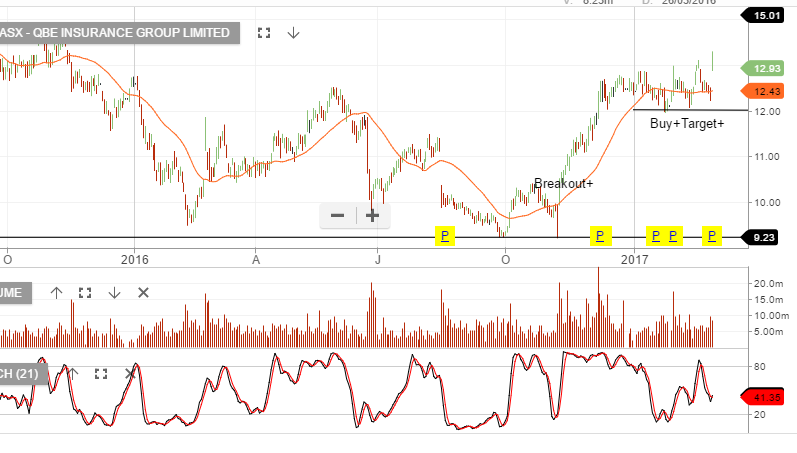
Shares of QBE are up over 5.5% in early trade as the insurance giant reported a 5% jump in net profit, as well as, a $1 billion share buyback scheme.

In the year up to December 31st, the  company announced net profit after tax of $844 million, which is up from $807 million over the previous year. Return on equity also improved from 7.5% to 8.1%.

QBE declared it will pay a 33 cent dividend, compared to 30 cents last year.

QBE is fully valued and we recommend selling covered call options to enhance the investment return.

Chart – QBE

US Stock Market Outlook

A late push on Wall Street helped US Stocks recover and allow the DOW JONES 30 Index to extend its winning streak to an 11th day.

For the week, the DOW rose 1%, the SP 500 picked up 0.7% and the NASDAQ closed out the week pretty much unchanged.

Looking ahead to next week, President Trump will deliver a speech before a joint session of Congress, when he is expected to give more details about his tax plan, trade policies and the direction of health care in the USA.

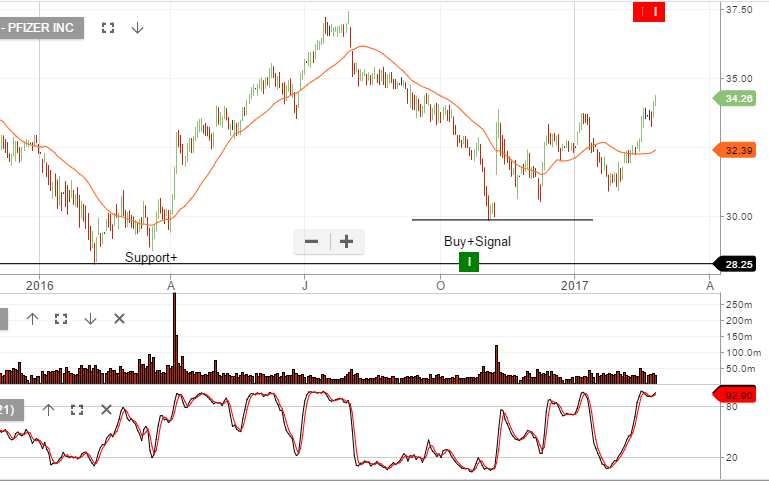
It’s interesting to see that the Investor Signals ALGO engine gave a sell signal for 2 pharmaceutical companies  today: Eli Lilly (LLY) and Pfizer (PFE). Those sell signals were posted at $82.85 and $34.25, respectfully.

US Drug companies have shown weakness on Mr Trump’s comments about health care reform in the past and investors will be listening closely to his speech on Tuesday.

Chart – Pfizer


US Equity Markets

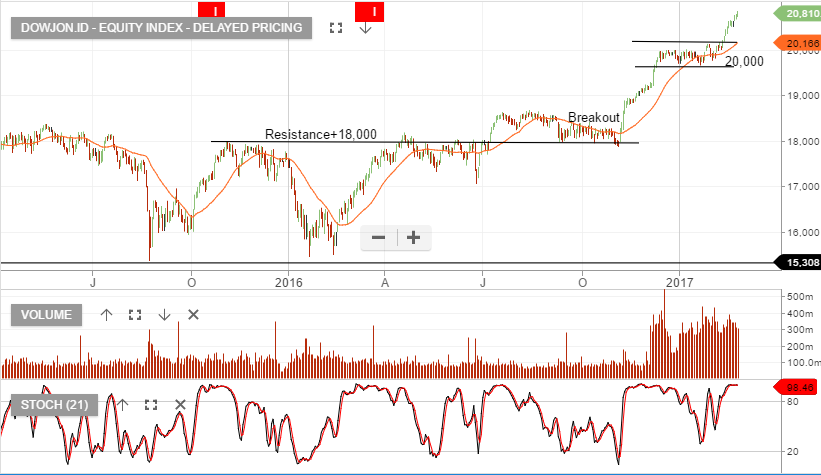
The DOW Jones 30 Index posted its 10th straight winning day in a row overnight. The fact that each one of those 10 winning days was a new record high has not been achieved since 1987.

This most recent leg higher in Dow started on November 8th, after the result of the US election. Since then, the DOW has gained 2,515 points, or 13.75%.

A widely held theme for the US equity rally has been the reflation of the US economy under a more business-friendly administration. This reflation theme was largely based on across the board tax cuts and a country-wide infrastructure construction plan.

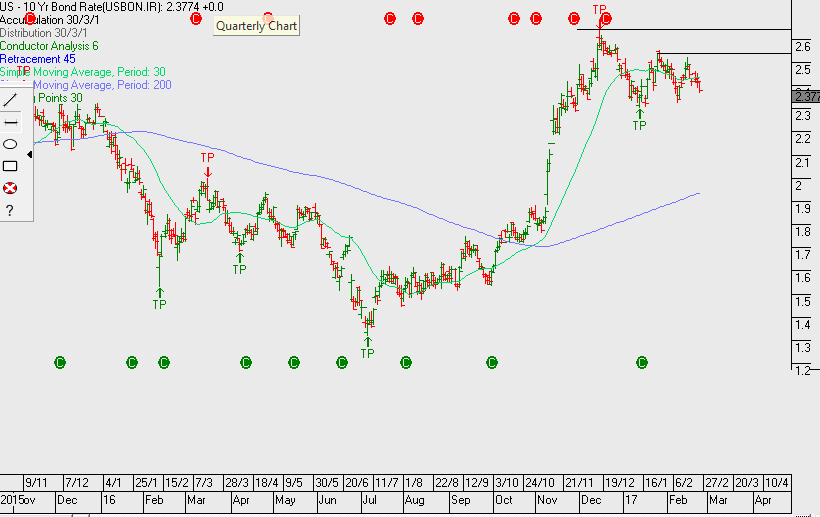
The idea being that these new policy measures would stimulate growth and push inflation, interest rates and stock prices higher. Along these lines, the yield on the US 10-year note climbed over 83 basis points, or 6%, from mid-November to late December.

However, over the last several weeks, the US yields have stopped moving higher and the Treasury curve has stopped steepening. In fact, over the last 10 day rally in the DOW, yields on the 10-year notes have actually dropped from 2.48% to 2.37%.

In short, while the DOW has firmed to new highs over the last 10 sessions, the inflation part of the reflation trade is beginning to fade.

From a traditional value-metric point of view, if the recent move higher in US stocks were signalling a new leg higher in valuations, we would have expected the 10-year yields to have traded higher, not lower.

Chart – Dow Jones
S&P500
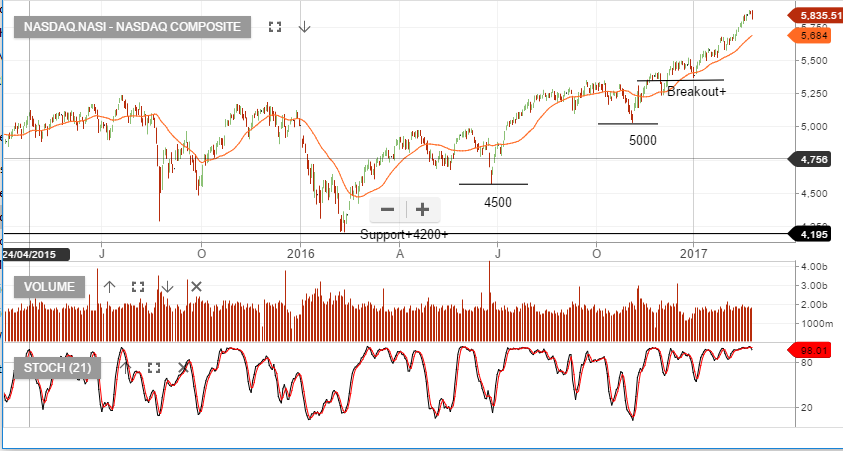
Chart – NASDAQ
Chart – US10YR


Insurance Group Australia (IAG)

Insurance Australia Group (IAG) reported a 4.3% drop in first-half profits to $446 million, which was down from $466 million from the previous corresponding period but slightly higher than the street’s expectations.

Amid an atmosphere of increased claim pressures, Australia’s largest insurer by market share announced its gross written premium grew by 4.7% to $5.8 billion.

IAG declared an interim, fully franked, dividend of 13 cents per share to be paid on March 30th. This dividend represents a cash payout ratio of 64.3 %.

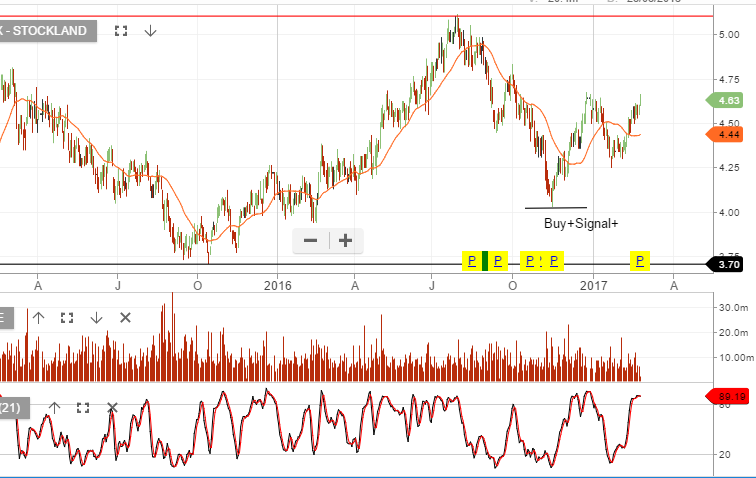
Stockland – 1H17 Earnings Release

Diversified REIT, Stockland Corporation, announced a 7.8% rise in its underlying earnings after posting record turnover in its residential division; primarily from the East coast of the country.

Stockland said revenue from operations reached $369 million, which is is tracking toward the upper end of its guidance for 5 to 7% revenue growth in 2017.

The company announced an interim dividend of 12.6 cents per share, compared to a 12.2 cent dividend for the same period last year.


Chart – SGP