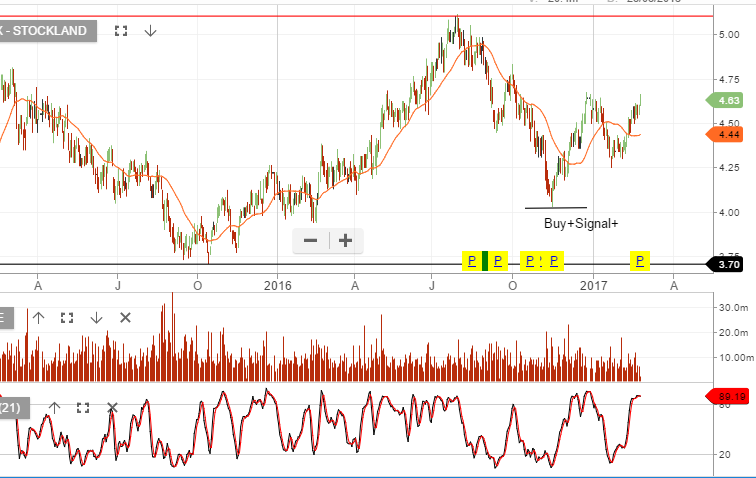
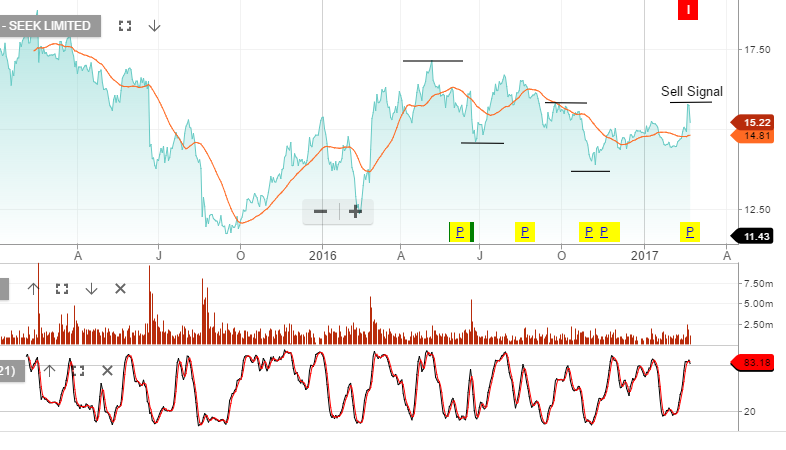
Diversified REIT, Stockland Corporation, announced a 7.8% rise in its underlying earnings after posting record turnover in its residential division; primarily from the East coast of the country.
Stockland said revenue from operations reached $369 million, which is is tracking toward the upper end of its guidance for 5 to 7% revenue growth in 2017.
The company announced an interim dividend of 12.6 cents per share, compared to a 12.2 cent dividend for the same period last year.
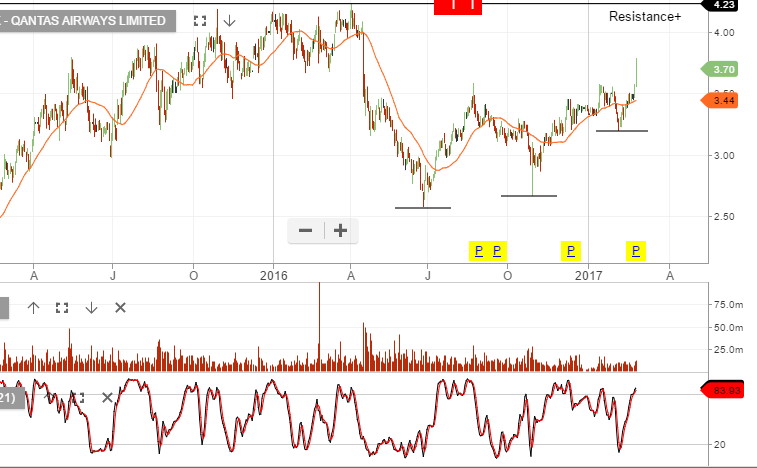
QANTAS announced first-half net profits fell to $515 million from $688 million during the same period last year.
A restructuring cost of $137 million was largely responsible for the profit miss, but the company also pointed to increased competition on international routes as a source of profit stress.
Underlying profit before tax fell 7.5% to $852 million for the six months to December 31st, which was higher than the company’s guidance range of $800 to $850 million.
That compares to the record profit of $921 million announced over the same period last year. Company officials didn’t provide any profit guidance for the 2016/17 period.
Qantas declared an interim dividend of 7 cents per shares (50% franked)
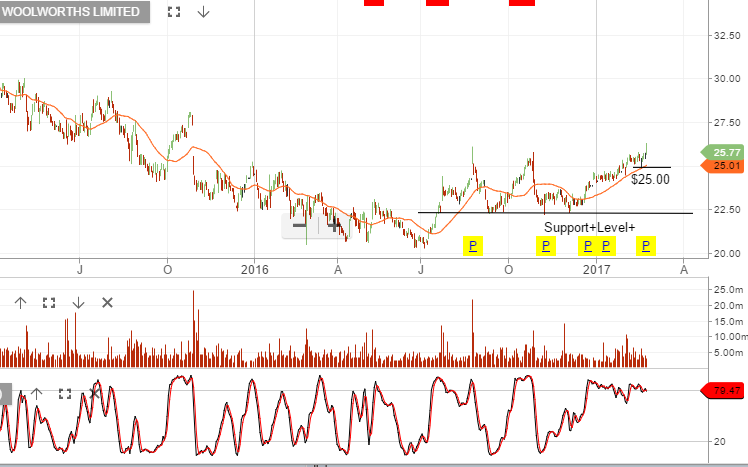
Even though Woolworth’s first-half profit outperformed rival Coles for the first time in seven years, the group’s earnings fell short of the street’s expectations.
For the six months ending December 31st, the group announced a profit of $725 million, up from a $972 million loss during the same time last year. market analysts were expecting a profit number of over $800 million.
Despite the solid earnings growth, the company cut its dividend to 34 cents per share, compared to 44 cents in the corresponding period last year. The street was expecting a dividend of 45 cents per share.
We’ve been selling European covered calls over WOW for an additional $0.72 per share credit, lifting the annualized yield to over 10%.
The rebound in Iron ore prices helped BHP post a first-half profit of AUD 4.2 billion. The resource giant announced its underlying profit for the six months to December 31st surged to USD 3.24 billion from USD 412 million during the same period a year ago.
The result was slightly better than the street’s forecast of USD 3.1 billion.
The company declared an interim dividend of 40 US cents per share, which is much better than the 16 US cents it paid a year ago. This takes into account the USD 155 million charge in relation to the Samarco dam failure in Brazil.
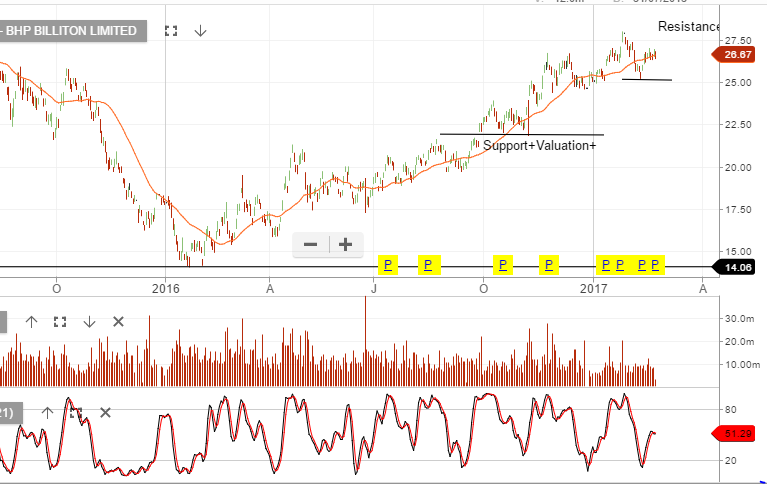
BHP’s bottom line has benefited from strong gains in commodity prices during H2 2016. Prices of Iron Ore more than doubled during 2016 on improved demand from China, while Crude Oil prices have recovered more than 40% from the multi-year lows hit in February last year.
The price correlation between BHP and Iron ore is very strong. Since posting a low of $14.10 in late January 2016, the share price has followed Iron Ore higher and almost doubled; reaching a high of $27.50 on January 25th.
We’ve been selling $27 calls over BHP for an additional $1.00 credit per share.
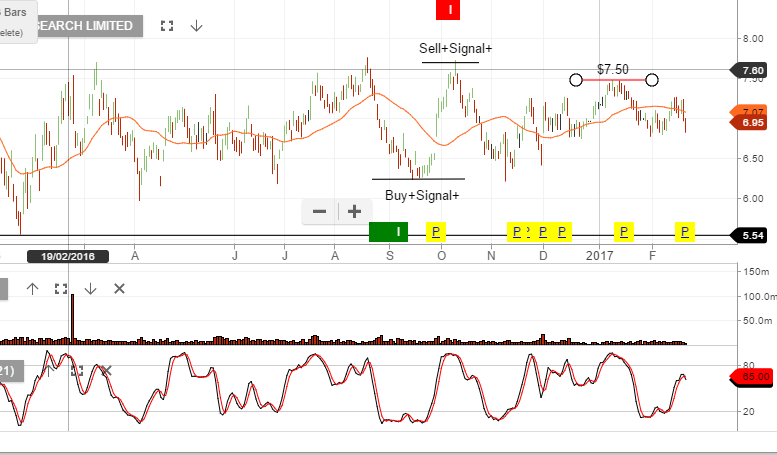
Shares of Oil Search are under pressure in early trade as the company reported a 70% drop in annual core profits.
Net profits fell to $106.7 million for calendar year 2016, compared to $359.9 million during 2015. The company cut its full-year dividend to 3.5 cents from 10 cents, which was slightly ahead of analysts’ expectations of 3 cents.
Oil Search reported plans to roughly double capital spending this year to between $360 to $400 million, with exploration and development campaigns underway near a recent find in Papua New Guinea.
The company expects oil production of between 28 to 30 million barrels over the course of 2017, which would be slightly less than 2016 production.
Our Algo Engine triggered a “short” signal back in October at $7.72
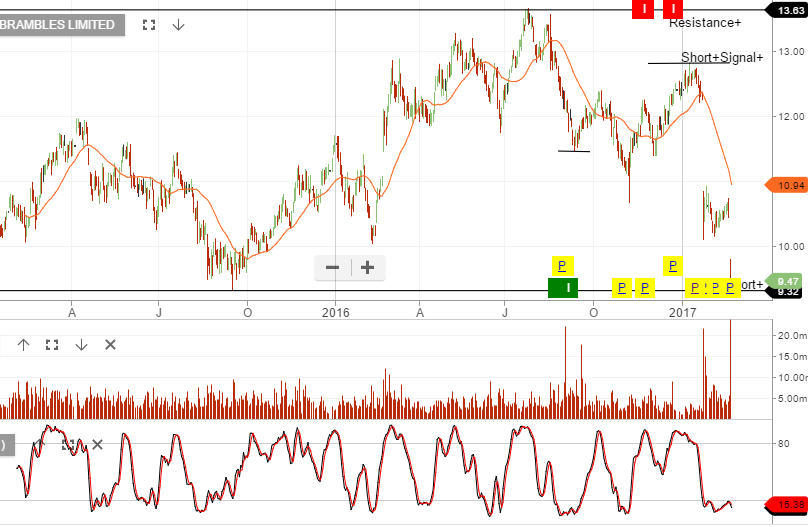
While BXB’s 1H17 result overall was below market expectations, the outlook for flat earnings growth in FY17 was much weaker than expected. FY17F EBIT was down 6% to US$950m.
The market was looking for stable EPS growth supporting an EBIT range of $1b – 1.1B over the next 12 to 24 months. The $950 million figure is a substantial miss and the new consolidating share price range for BXB is now $9.25 to $11.00.
Setting the covered call strategy at a more aggressive level will help to drive returns here, we look to lower the call strike and see $10.25 calls as an effective level.
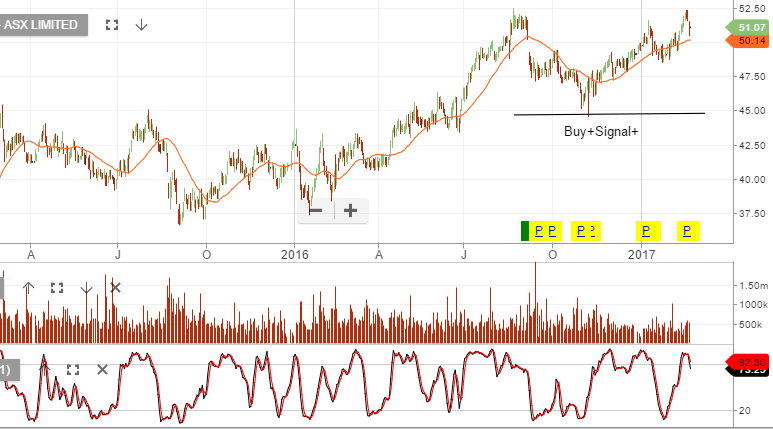
Following the recent 1H17 earnings update, we will take a look at establishing fair value for the ASX.
1H17 NPAT of A$219m represented 3% underlying earnings growth. Moderate revenue growth occurred across most major ASX activities.
Here is the issue: the stock trades at 22x forward earnings on a 3.9% dividend yield. The earnings are stable but the stock is expensive. And whilst ASX delivered 3% revenue growth in 1H17, this is down on the 6% average level achieved over the last 3 years.
Our conclusion on fair value is; buy ASX on a pullback to $47 or a 4.5% dividend yield.
Slowing in full-time jobs growth is primarily due to job losses in the mining and manufacturing sectors with full-time job losses concentrated in the mining-dominated states of WA and Qld.
More recently though, full-time jobs growth has also reportedly stalled in NSW.
The latest employment data reported a loss of 44.8k full-time jobs in January, offset by a 58.3k rise in part-time jobs.
Chinese foreign exchange reserves dropped below $3 trillion in January for the first time almost 6 years. That’s down from $4 trillion in 2014. The drop is largely caused by the Chinese central bank intervening in the FX market as they buy yuan to prop-up the currency against the US dollar.
Overseas direct investment from China fell by 35% in January, compared to a year ago & Chinese investment in overseas property dropped by 84%.
Over-inflated Chinese property prices and the risk of their property bubble bursting, is a concern. We’re tracking resale data in the major cities and there’s evidence of price declines emerging since November of last year.
These are trends we’re watching closely as they form the basis of our “risk” scenario for global equities, especially given the gap between forward PE valuations and probable 2017 earnings growth.
China – iShares China Large CAP ETF
Sophisticated Investor?
We have special opportunities available for Sophisticated Investors. If you're interested, and qualify, please provide your details below.