Cisco

Cisco Systems, Inc. – Common recently reported strong results for its second fiscal quarter (ended January 2024, reported Feb 2026):

Earnings Beat: Reported record revenue of $15.3 billion (+10% YoY) and non-GAAP EPS of $1.04, exceeding analyst expectations.

Guidance: For the full fiscal year 2026, Cisco raised its revenue outlook to $61.2B–$61.7B.
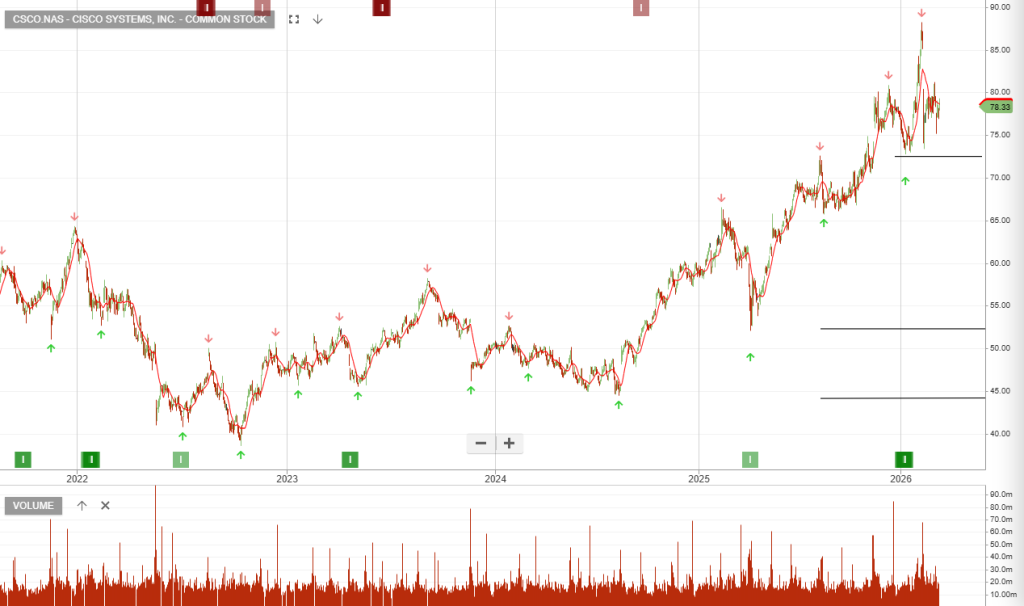
As of March 2026, Cisco (CSCO) is undergoing a major transition from a traditional hardware-focused networking company into an AI-infrastructure and cybersecurity powerhouse.

Here are the key takeaways you should know:

### 1. Recent Financial Performance (Q2 FY2026)
Cisco recently reported strong results for its second fiscal quarter (ended January 2024, reported Feb 2026):

  • Earnings Beat: Reported record revenue of $15.3 billion (+10% YoY) and non-GAAP EPS of $1.04, exceeding analyst expectations.
  • Market Reaction: Despite the beat, the stock saw a ~9% post-earnings dip (trading around $75–$78) as investors weighed short-term margin pressures against long-term AI growth.
  • Guidance: For the full fiscal year 2026, Cisco raised its revenue outlook to $61.2B–$61.7B.

### 2. The AI Growth Engine
AI is currently the most significant driver for Cisco.

  • AI Orders: The company took $2.1 billion in AI infrastructure orders from hyperscalers (like Amazon, Google, Meta) in Q2 alone.
  • Raised Targets: Cisco now expects total AI orders to exceed $5 billion for FY2026.
  • New Silicon: They recently unveiled the Silicon One G300 chip, designed specifically for massive AI clusters, positioning them as a direct competitor to Broadcom in the high-end networking space.

### 3. Strategic Shift: Cybersecurity & Splunk
Cisco is aggressively moving toward a software-subscription model to reduce “lumpy” hardware revenue.

  • Splunk Integration: Following its $28 billion acquisition, Splunk is being deeply integrated. Security is now viewed as a “native function” of the network rather than an add-on.
  • Recurring Revenue: Annual Recurring Revenue (ARR) has reached $31.4 billion, with software and services now making up a significant portion of the business.
  • Backlog (RPO): Cisco has a massive backlog of $43.4 billion in Remaining Performance Obligations, providing high visibility for future revenue.

### 4. Valuation and Dividends
For income-focused investors, Cisco remains a “Dividend Aristocrat” in the making:

  • Dividend: Recently increased to $0.42 per quarter (approx. 2.2% yield).
  • Capital Returns: The company returned $3 billion to shareholders last quarter ($1.6B dividends, $1.4B buybacks) and still has $10.8 billion authorized for further buybacks.
  • P/E Ratio: Currently trades at a forward P/E of roughly 25x–27x, which is slightly below the sector median, leading many analysts to view it as undervalued relative to its AI growth potential.

### 5. Analyst Outlook

  • Consensus: Most analysts hold a “Moderate Buy” rating.
  • Price Targets: Average targets range between $89 and $96, suggesting a potential upside of 15% to 24% from current levels.
  • Key Risks: Watch for margin pressure from rising component costs (like memory) and the speed of enterprise AI adoption beyond just the giant “hyperscalers.”

Summary for Investors: Cisco is no longer just “the router company.” It is a massive play on the plumbing required to run AI models and the security required to protect them. The current valuation reflects a transition phase that may offer a more conservative entry point into the AI trade compared to high-flyers like Nvidia.
Atlassian

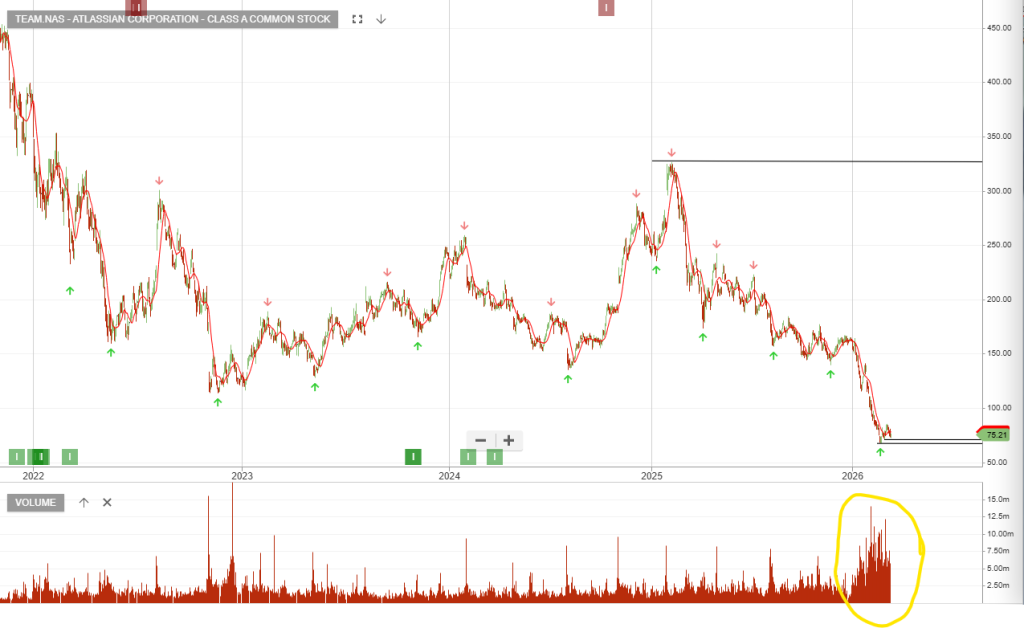
Atlassian Corporation – Class A Common is currently exhibiting a “bottom bounce” technical pattern, with recent volume support helping the stock stabilise after falling nearly 48% year-to-date and 84% from its all-time high.

The trading volume for Atlassian (TEAM) has seen significant increases since January, characterized by three primary waves of activity linked to earnings milestones, institutional conferences, and a broader sector rotation.

### 1. February Earnings Spike (The Primary Surge)
The most substantial increase in volume occurred in early February following the company’s Q2 fiscal 2026 earnings report on February 5.

  • Volume Peak: Trading reached approximately 14 million shares on February 6, nearly double the session volume of the preceding days and significantly higher than the ~3 million daily average seen in early January.
  • Driver: While Atlassian surpassed $1 billion in quarterly Cloud revenue for the first time, high GAAP operating losses (driven by share-based compensation) led to a sharp -6.3% price dip, triggering high-volume sell-offs and re-positioning.

### 2. March “Relief Rally” & Conference Surge
A second wave of elevated volume occurred in the first week of March, specifically around March 5.

  • Volume Spike: The stock saw a high-volume session of 12.19 million shares as it jumped +7.4% in a single day.
  • Driver:

* Morgan Stanley TMT Conference: Management presented on March 5, highlighting their AI product (Rovo) and its 5 million monthly active users.
* Sector Rotation: A broader “relief rally” swept the software sector as investors rotated back into beaten-down SaaS names, leading to high turnover in TEAM.

### 3. Overall Trend Comparison
The average daily volume (ADV) has shifted higher throughout the quarter:

  • Early January: ~3.0M – 4.5M shares per day.
  • February Average: Elevated by volatility, often hitting 8M+ on high-activity days.
  • March Status: Currently averaging between 7.0M and 7.5M shares, indicating a sustained increase in market interest as the stock tests multi-year lows.

### Summary of Drivers

Institutional Flows: Large-scale positioning updates from firms like Morgan Stanley and DNB Asset Management (which grew its stake by 266% recently) have contributed to the increased liquidity and trade frequency since the start of the year.

AI Narrative Shift: Market sentiment transitioned from “AI fears” (concerns that AI would disrupt software) to “AI adoption” (viewing Rovo as a monetization catalyst).

Boeing

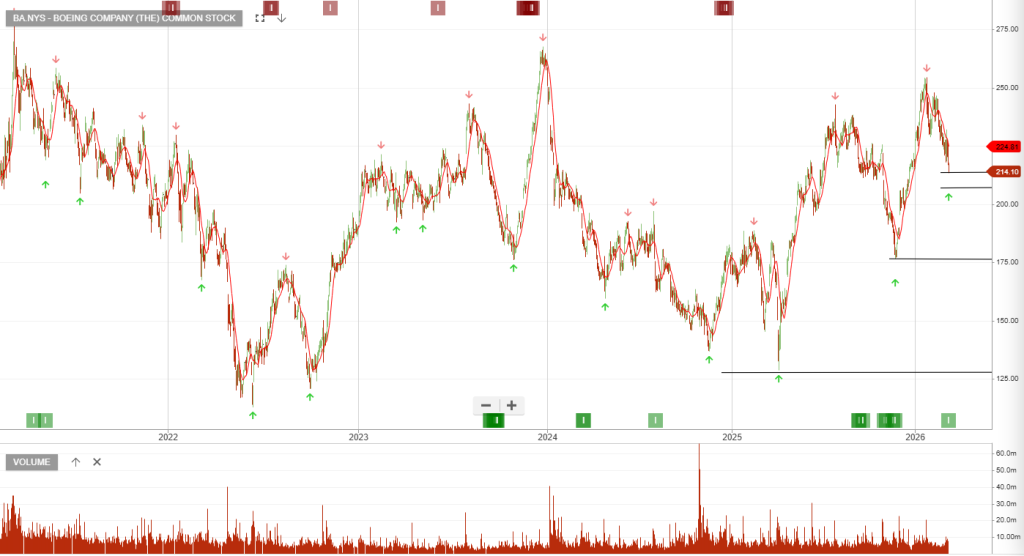
Boeing Company (The) Common is under Algo Engine buy conditions.

Based on the latest fundamental data for Boeing (BA.NYS), the outlook for EPS growth is characterized by a significant projected recovery following recent challenges.

EPS Growth Outlook

  • Significant Forward Growth: Analysts are projecting a substantial jump in earnings. The EPS Current Year stands at 0.3863, while the EPS Forward estimate is 4.7037. This indicates a massive expected rebound in profitability over the next 12 months.
  • Trailing Performance: The EPS for the Trailing Twelve Months (TTM) is 2.48, suggesting that while the company has returned to positive territory, the next year is expected to see a more aggressive acceleration in earnings.

Valuation Metrics

Forward P/E Ratio: 45.52. This suggests that while the stock is trading at a high multiple of expected earnings, investors are pricing in the transition from a recovery phase back to normalized operations.

Megacap Tech Spend in 2026

Tech’s megacaps announced major increases in capex for 2026, with the four hyperscalers now expecting combined spending of close to $700 billion.

Reaching those numbers is going to mean a big drop in free cash flow, with Amazon projected to turn negative this year.

The four hyperscalers are now projected to increase capital expenditures by more than 60% from the historic levels reached in 2025, as they load up on high-priced chips, build new mammoth facilities and buy the networking technology to connect it all.

Getting to those kinds of numbers is going to require sacrifice in the form of free cash flow. Last year, the four biggest U.S. internet companies generated a combined $200 billion in free cash flow, down from $237 billion in 2024.

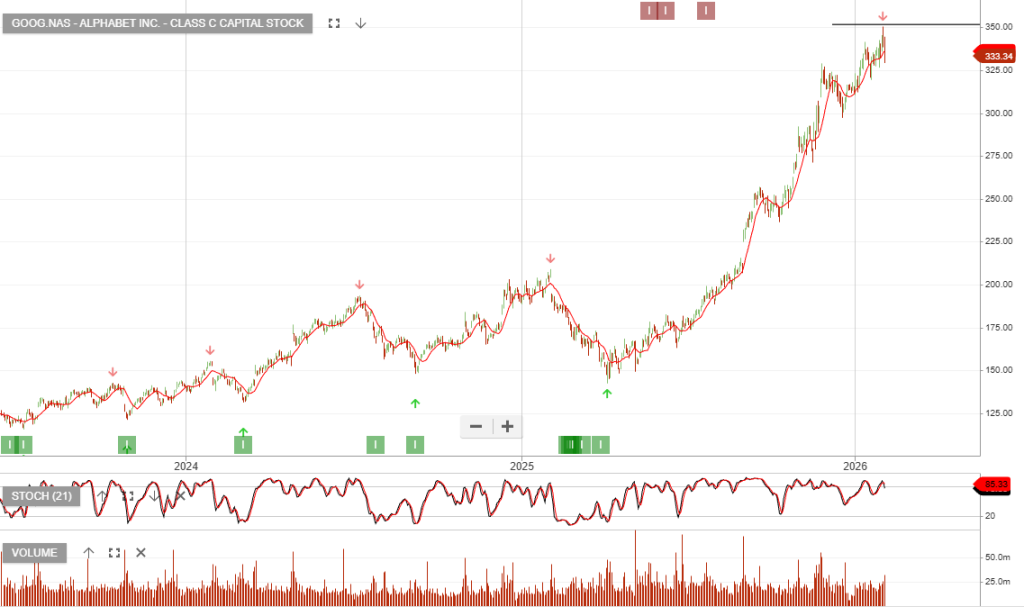
While Amazon laid out the most aggressive spending plan among the megacaps, Alphabet wasn’t far behind. Pivotal Research projects Alphabet’s free cash flow to plummet almost 90% this year to $8.2 billion from $73.3 billion in 2025.

Analysts at Barclays now see a drop of almost 90% in Meta’s free cash flow, after the social media company said last week that capex this year will reach as high as $135 billion.