US Credit Card Defaults On The Rise

US media reports suggest the US economy is flashing a warning sign that could mean US is headed for a downturn.

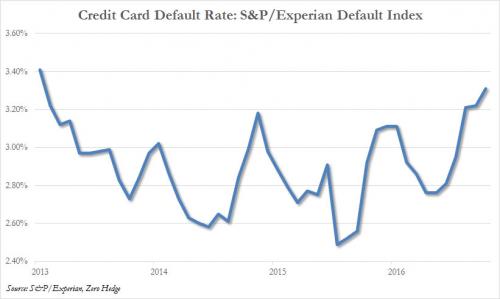
Credit card companies are starting to grow nervous as the net charge-off rate, or the percentage of loans that credit card issuers write off as a loss, has just hit its highest level in four years, a continuation of several quarters of the rate rising.

The trend hit all major card issuers and is starting to eat into bank earnings. The current rate is 3.29%, but it is still a long way from the peak hit in 2010 of 10%.

The rate had dropped for 24 straight quarters during the recovery, until a reversal in recent quarters.

The “cause and effect” logic is that once credit card defaults begin to rise, the default rate on mortgages also begins to rise, which is a much bigger problem for the US economy.
Credit Card Default Rate  


Boeing Lifts The Dow In July

The Dow Jones 30 Index posted its 5th consecutive new record high close today at 21,891.

During the month of July, the Index gained 570 points, or 2.6%.

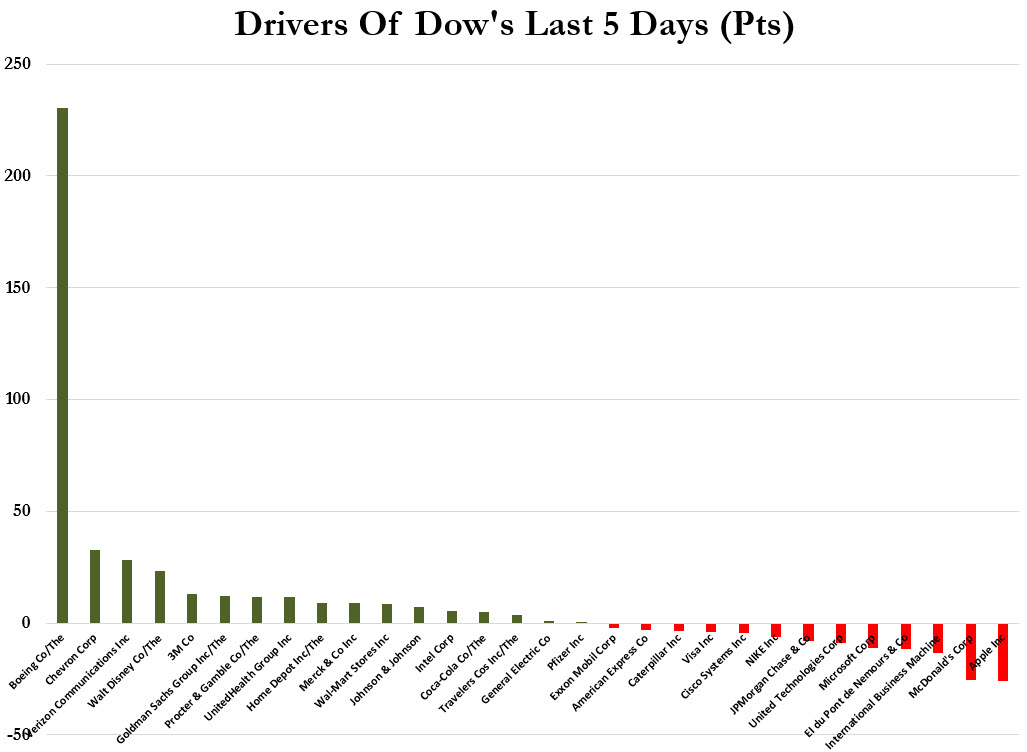
As the chart below illustrates, 310 of those 570 Dow points were generated by one stock: Boeing.

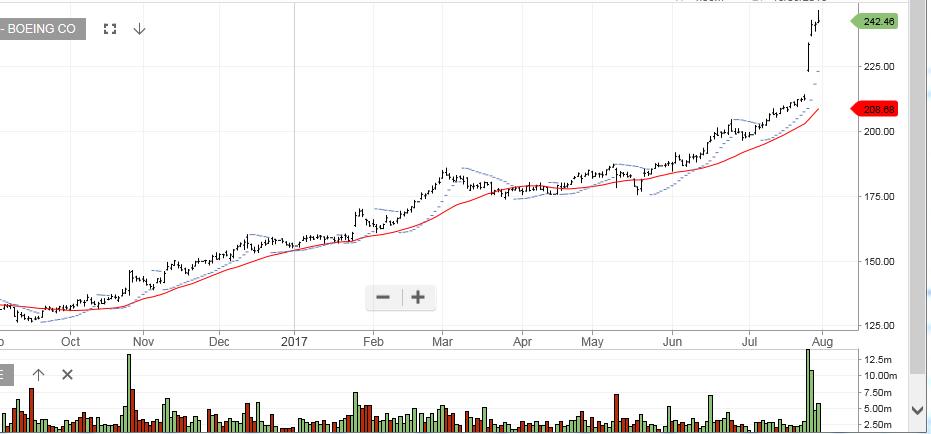
Boeing shares climbed over 24% during the month of July from $197.75 to $246.00. In just the last 5 trading sessions, Boeing shares rose 16% from $212.50 to $246.00.

Since the Dow is a price-weighted Index, a higher point value, or Beta, is assigned to higher priced stocks.

Boeing

A Busy Data Week In Australian Markets

The AUD/USD reached a 2.5 year high of .8065 last week.

Comments from RBA chief, Philip Lowe, that the central bank is not compelled to follow the USA’s higher interest rate policy only had a temporary effect on the Aussie.

This week’s data calendar has several potentially market moving reports.

The RBA is not expected to adjust interest rates on Tuesday.  However, if the board re-affirms their neutral-to-easing bias, the AUD/USD could retreat from recent highs.

Wednesday’s building approval data is usually a second-tier report but will be closely watched this month.

Thursday’s trade balance numbers are expected to remain in surplus, but the $1.77 billion consensus number is half of last month’s amount. This release would not have included the recent rally in the AUD, which would have a dampening effect on exports.

Friday’s Retail Sales data will have more impact on ASX stocks than the AUD. The forecast is an increase of .2%, which will keep the yearly sales pace barely in positive territory.

On balance, we expect the RBA and trade balance numbers to weigh on the AUD/USD,  and potentially turn the trend back to the downside.

Investors looking to profit from the AUD/USD trading lower can look to buy the BetaShare ETF with the symbol: YANK.

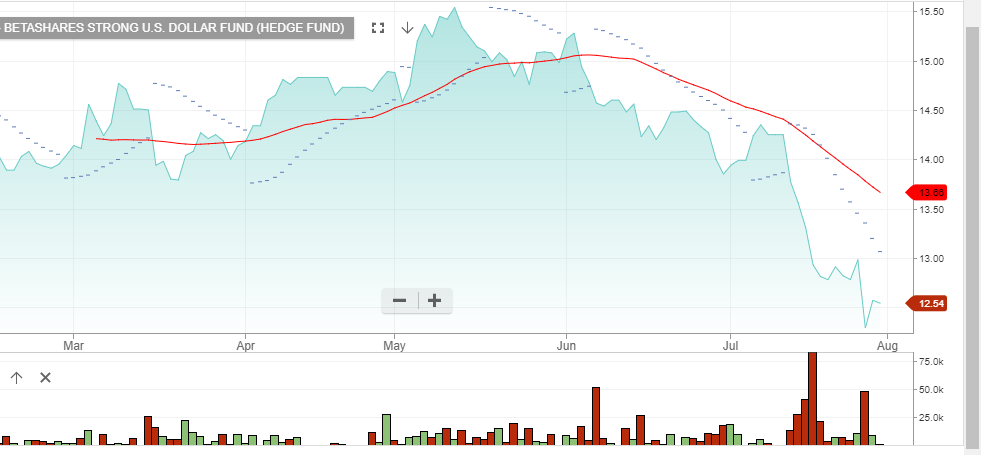
YANK is an inverse ETF, which means the unit price increases as the price of the AUD/USD decreases. YANK also has a 2.5% weighting, which means a 1% change in the AUD/USD will correspond to a 2.5% move in the unit price.

The current price of YANK is $12.60. We calculate that when the AUD/USD trades back to the January low near .7300, the unit price will trade at $16.75.

BetaShare ETF: YANK

Gold Continues To Climb

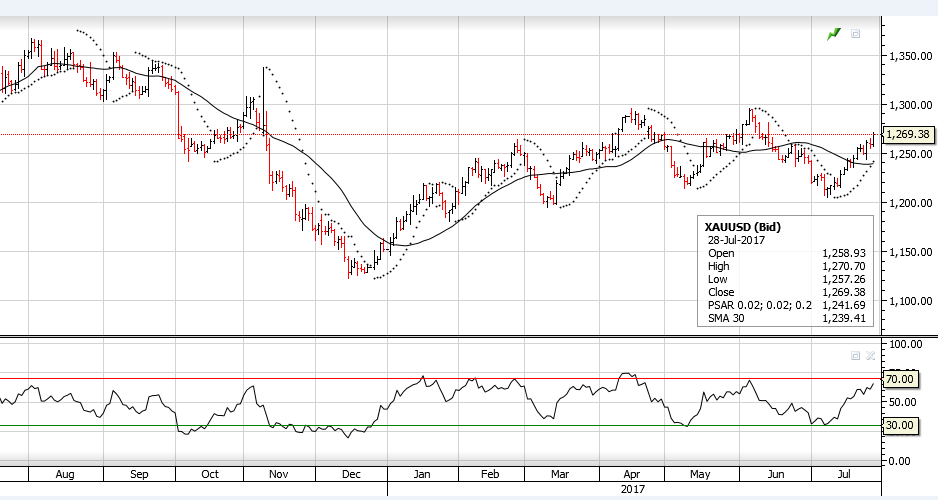
Gold posted a low of $1204.50 on July 10th. Since then, the yellow metal has rallied over 5% and hit an intra-day high of $1270.70 in last night’s New York trade.

This marks the 3rd straight week of higher prices and internal momentum indicators are now pointing to the June high of $1295.75.

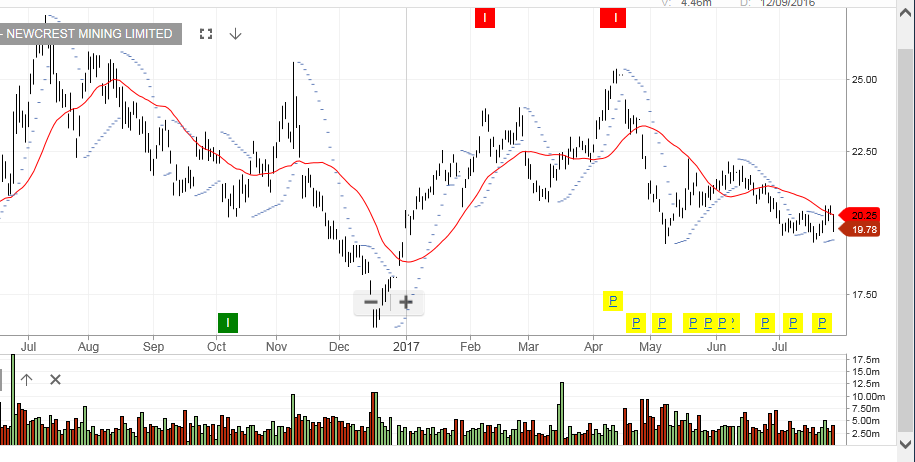
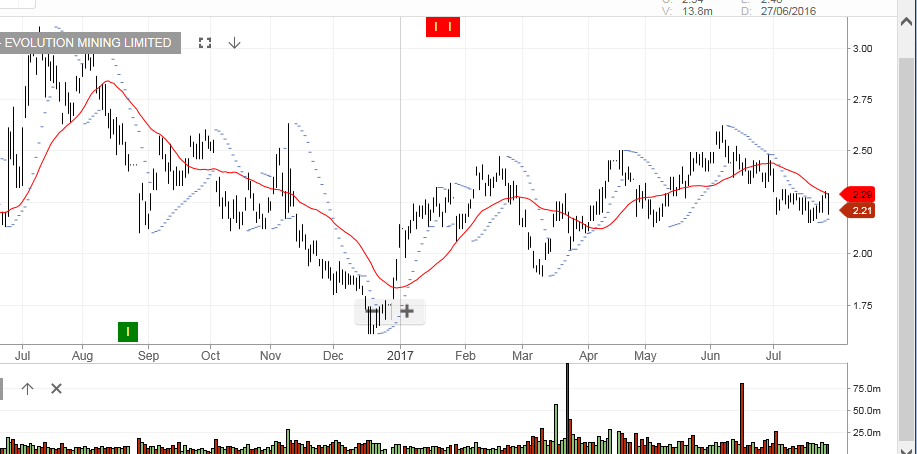
However, share prices of local gold miners NCM and EVN have not reflected this stronger trade in the spot Gold price.

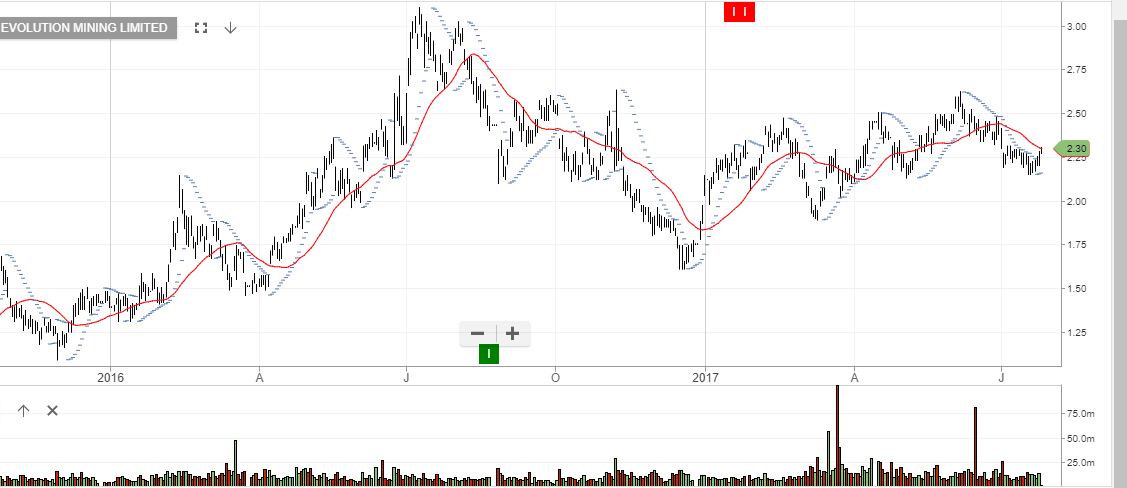
Both NCM and EVN announced positive quarterly production numbers last week, and we expect both names will break out their recent ranges on the topside.

Over the medium-term, we have price targets of $22.10 for NCM and $2.60 for EVN.Gold

Newcrest.

Evolution Mining

Amazon Falls 2% On Lower Earnings

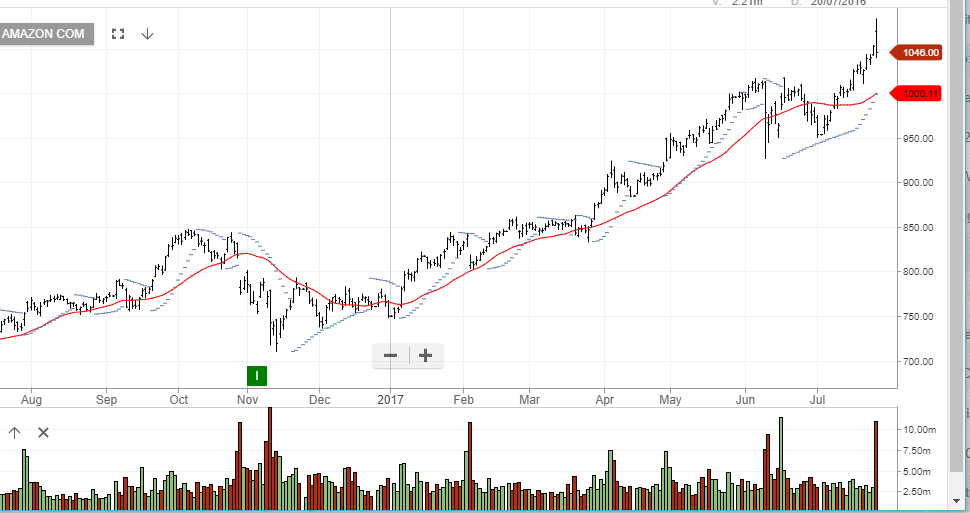
Amazon reported much lower earnings than expected and shares declined more than 2% in late trading.

The e-commerce giant reported net income of $197 million, or 40 cents a share, on sales of $38 billion, a profit decline of 77% from the same quarter a year ago. Analysts on average expected Amazon to report earnings of $1.41 a share on sales of $37.2 billion.

The company’s spending cut into profit, as fulfilment costs — the amount Amazon spends to fill customers’ orders on its e-commerce platform — rose about 33% from a year ago and spending on technology and content increased by about 43%. Amazon stock traded at all-time highs of $1083.00 before settling at $1046.00.

The next key support level will  be found at $975.00. A break of that price could extend down to the June low of $920.00.

Amazon


How Long Will The XJO Range Trade?

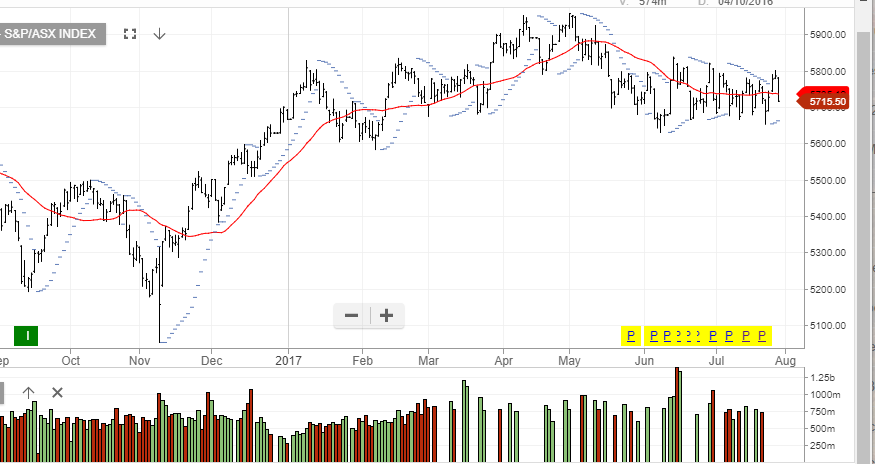
Over the last 12 weeks, the XJO index has traded in a range bound, pennant formation.

In technical terms, this is known as an “indecision” pattern and is usually resolved by a measured move through the top of the range, or broken through the bottom of the range.

The current price set-up has been bound by the June 8th low of 5606 and capped by the June 15th high of 5850.

After one of these levels are breached, the measured move would be expected to reach the May 2nd high of 5950, or drop down through the low price of 5606 posted on February 6th.

The banking sector is the heaviest weighted group of stocks in the XJO. As such, the direction of the banking shares will largely determine the direction of the XJO index.

Our base case has been that the major banks will face challenges to grow revenue in the current market environment and that pricing risks are skewed to the downside.

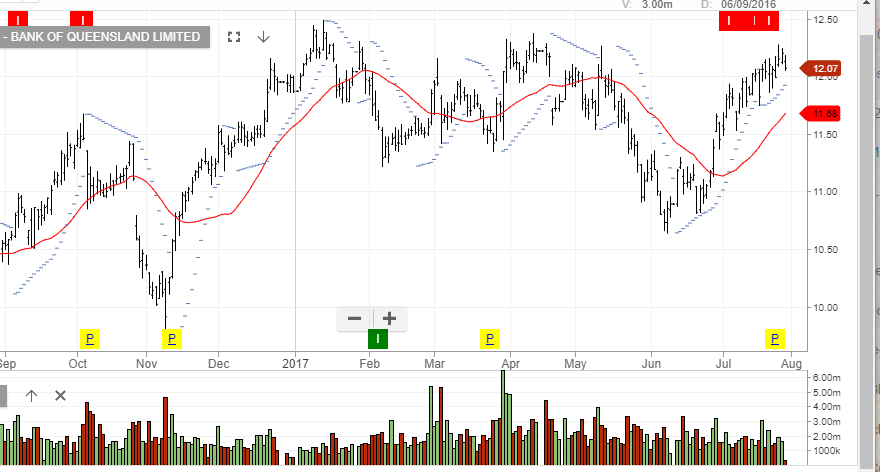
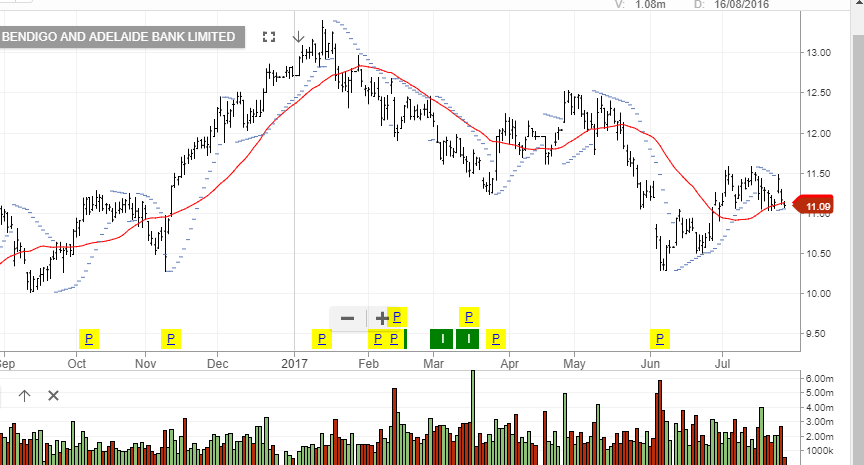
These valuation concerns apply even stronger to the regional banks; BOQ and BEN. After recent price rebounds in these two stocks, we believe that they could trade lower and reach $10.50 and $10.00, respectfully.

XJO

BOQ

Bendigo


Boeing Soars After Strong Earnings Report

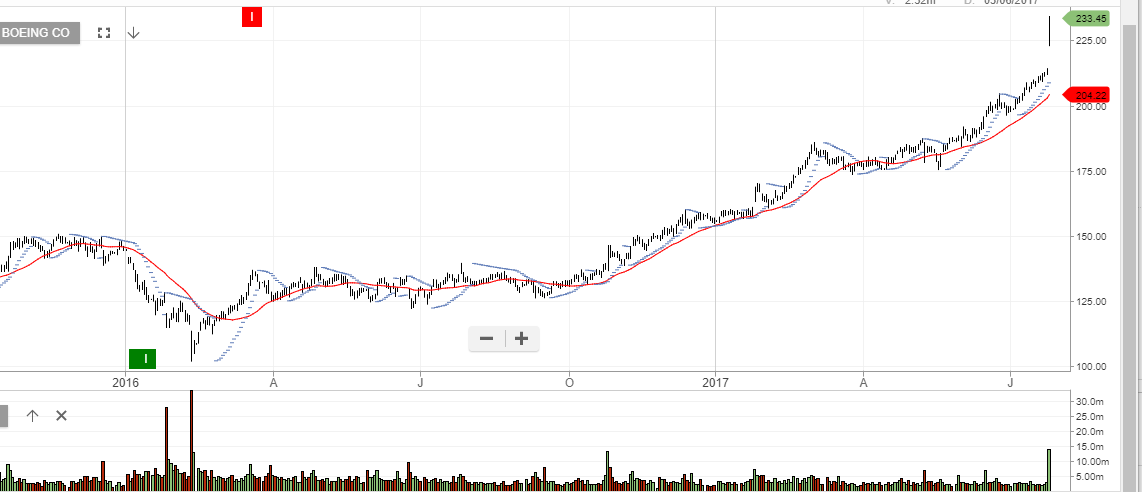
Shares of Boeing  rallied to their highest-ever level Wednesday, contributing 117 points to the Dow Jones 30 Index on the heels of a second-quarter earnings beat and improved profit outlook.

The stock shot up more than 8%, its largest percentage gain since August 2009, to a high of $230.43, its highest intra-day price ever.

The dollar gain of nearly $17 was the best daily point rise on record.

Boeing shares have posted gains in four straight sessions, tacked on nearly 10% over that period and are up more than 45% for the year.

The company reported $2.89 per share, compared with the street’s estimate of $2.58 per share.

Boeing


Evolution Posts Record Production

Evolution Mining (EVN) posted a record quarterly production result of 218,000 ounces at a sustained cost of  AUD$825.00 per ounce.

The strong Q4 number places the FY 2017 production at the upper end of forward guidance near 844,000 ounces, and below the lower end of the cost guidance of AUD$906.00.

We see near-term technical resistance in the $2.48 area with a longer-term price target near $2.60.

However, a stronger AUD/USD above .8000 will have a dampening effect to EVN’s bottom line going forward.

Evolution Mining


Has The AUD Reached The RBA’s Pain Level?

At the start of the year, the market consensus was for the Aussie Dollar to fall against the major currency pairs during 2017. So far this year, the AUD/USD has climbed 10% and almost touched .8000 last week.

At 1pm today, RBA chief Philip Lowe will be giving a speech in Sydney. Since many exporters look at .8000 as a pain level, it’s reasonable to expect Mr Lowe to comment about the level of the Aussie.

The strengthening AUD/USD has created a headwind for domestic companies with earnings exposed to the softening USD.

Four companies that we follow which have seen their share prices dampened due to a stronger Aussie are: BXB, CPU, ANN and JHX.

Australian Dollar

Google Shares Drop On Lower Income

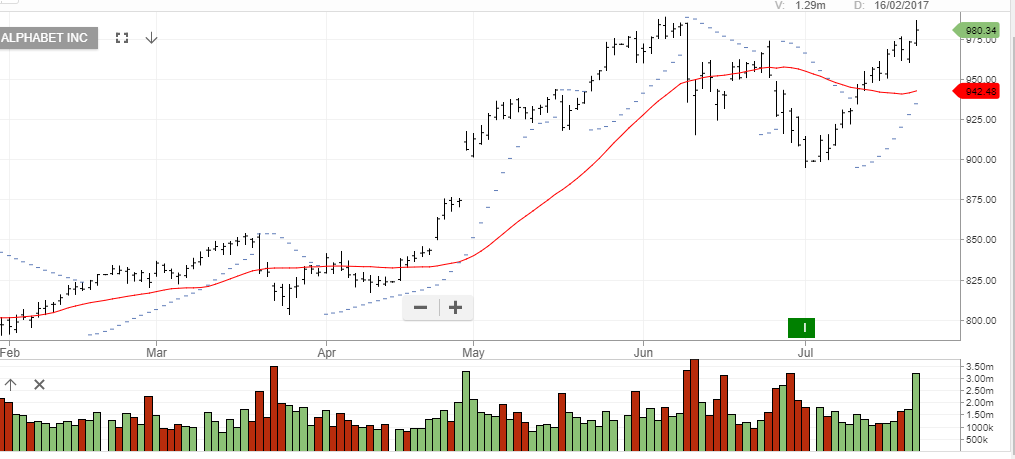
Shares of Alphabet, parent company of Google, are down over 3% to $967.00 in aftermarket trade.

After the close of trade today, the tech giant posted a 27.7% drop in quarterly profit compared to a year ago.

The company beat expectations on both the top and bottom line with earnings of $5.01 per share on $26 billion in revenue, compared to earnings of $4.49 per share on $21.5 billion a year ago.

However, a dip in net income from $4.88 billion a year ago to $3.50 billion this quarter offset the better-than-expected earnings.

Our ALGO engine triggered a buy signals on Alphabet on June 30th at $908.00. We will look for initial support at or near the $945.00 level.

Alphabet (Google)