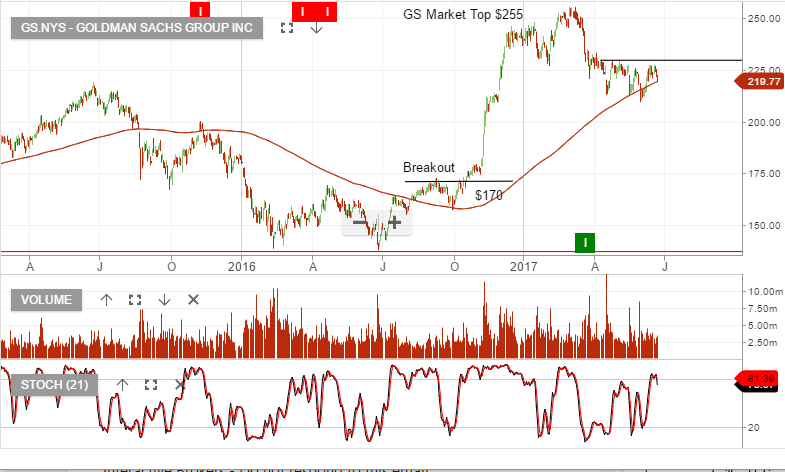
Dow Jones large cap financials JP Morgan & Goldman Sachs were down 3.63% and 3.5% respectively in overnight trade.
The charts below show the price action rolling-over in the past few trading sessions, following the earnings results on Friday that failed to meet market expectations on the revenue front.
This will have ongoing implications for ASX banking stocks. The rally in domestic bank shares were mainly a by-product of the US banking share rally, rather than factors directly related to an earnings pickup within the Australian market.
The share price in Crown Resorts (CWN) has staged a solid rebound since hitting a low of $10.30 in early November. With Jamie Packer re-joining the board and some new capital management initiatives, there could be further upside from the current price of $11.70.
An analyst report yesterday noted that Melco Crown, in which CWN owns a 11.2% stake, has declared a USD 650 million special dividend to be paid in early February.
Aside from this dividend payment, the gaming giant has lowered its VIP revenue projections, adjusted revenues for CWN’s lower equity stake in Melco, resulting in a lowering of its EPS estimates out to 2019 by close to 2%.
The company’s board reshuffle highlights that CWN has yield and near-term capital management appeal with the prospect of further de-leveraging from offshore strategic initiatives.
Taking into account the trimming of its earnings forecast, the group is trading on 9.3 times fiscal EBITDA projections.
Over recent weeks, we’ve highlighted a number of stocks that are overvalued and susceptible to any increase in market volatility or risk-off period.
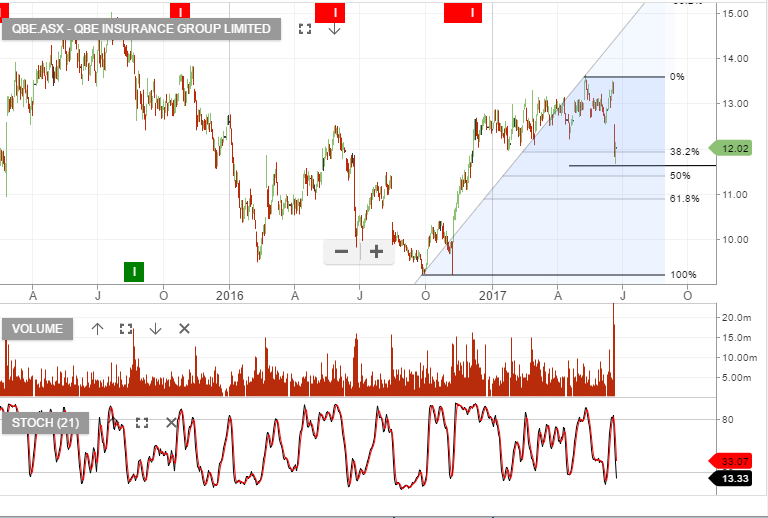
Stocks that have rallied due to higher US interest rates are starting to retreat as the yield on the US10-YR starts to slip lower from the recent 2.64% high. Companies affected in this group include Computershare and QBE.
Australian Banks are beginning their sell-off and our bank hedge is starting to pay-off.
Exiting property plays, especially where there’s development risk will likely prove worthwhile in the coming months. We’re happy to stay exposed to the best-of-the-best only in this space and sell tight covered calls.
The issue we see is that the US bank results out so far, is probably as good as it gets for US 4Q earnings. Over the next two weeks, multinationals, industrial names and then big technology will announcement their results.
If we see an average EPS run rate for the S&P500 that fails to meet the $132 per share expectations, and in fact averages somewhere in the range of $120 – $125, then the Dow Jones will struggle to move higher.
With the above in mind, we’ve been making adjustments to portfolios to hedge an uptick in volatility and deliver returns through an aggressive derivative overlay.
Over recent weeks, our Algo Engine has been flagging a number of short signals. This is indicating there’s a large number of stocks that are at the peak of their counter trend rallies. As the key indices start to struggle, we’ll begin focusing on the short signals with a view towards either taking profit on existing long positions, overlaying a call option on defensive names or positioning on the short side to profit from any sell-off in over valued names.
In the January Video Market Update on the ASX Top 50, which we will release in the coming days, we’ll explain more on the algo short signal patterns emerging and how we’re positioning portfolios for what we think is a period of increased market risk.
We’ve used the chart below of BXB to help illustrate the counter trend pattern referred to in the text above. In the case of BXB, the algo signal has drawn our attention to the recovery BXB has had since November, the compressed forward yield of now only 2.8% and the high PE ratio. In response, we’ve used the signal as a trigger to sell $12.50 at-the-money call options into April for a $0.50 credit, whilst expecting to keep exposure to the March $0.15 dividend.
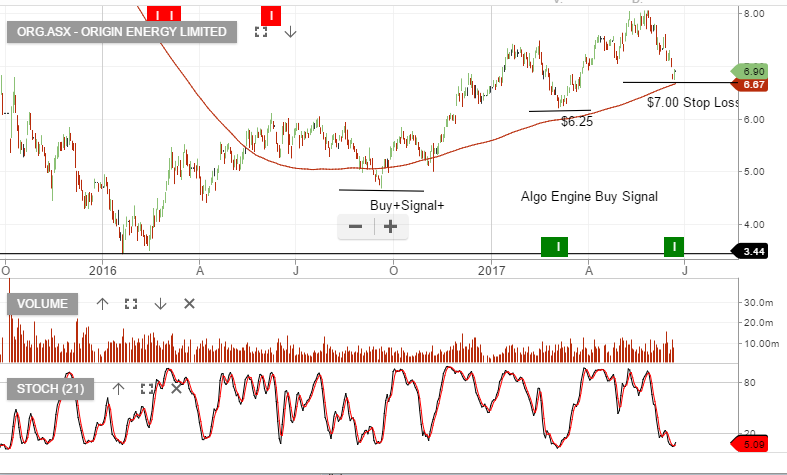
Our long ORG position continues to perform well with Origin being one of the standout recovery stories over the past 6 months. We think this has further to play-out as ORG restructures assets, pays down debt and grows LNG export volumes.
We’ve been running a hedge on the Australian banks; CBA through an in-the-money European March option, NAB using an in-the-money American February option and WBC a longer-term call option. In ANZ our preference has been to exit the trade altogether.
On Friday, our domestic banks started to see some profit taking and the catalyst could’ve been selling ahead of the US banking results and/or the announcement of weaker export data out of China.
JP Morgan and BoA’s results , released last night, were adequate on the bottom line but both companies missed on the revenue front. Increased dividends and share-buybacks helped support what otherwise would’ve been viewed as weak results.
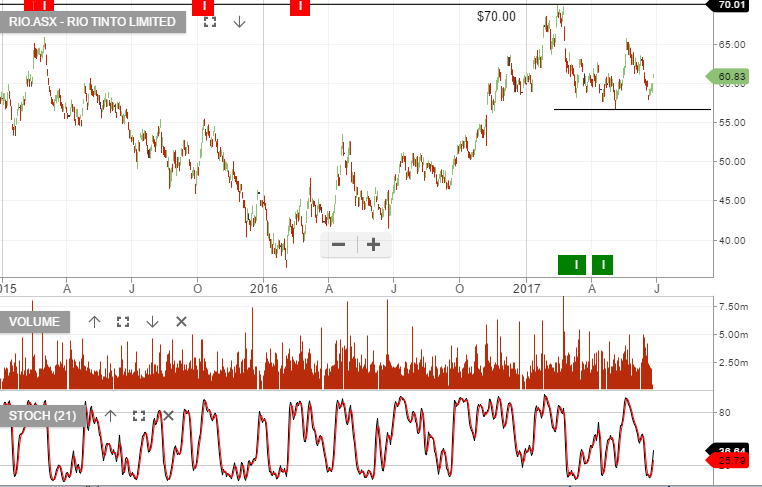
On balance, 2016 wasn’t a bad year for RIO Tinto. After posting a 7-year low at $36.50 on February 1st, shares of the mining giant closed out the year just below the $60.00 mark (a 64% gain).
This impressive turn-around was supported by a broad rebound in Iron Ore, Copper, Coal and Aluminium. Rio has an impressive portfolio of assets. It anticipates solid growth in Iron Ore production in 2017, with a large copper project coming online over the next decade.
The company has a market cap of just under $80 billion.
On Tuesday, RIO will release its Q4 2016 production report. We expect the report to show a modest 1% lift in quarter-to-quarter production, driven primarily by Q4 strength in Iron Ore production and shipments from the Pilbara.
In addition, forecasts expect RIO to have lifted group production by 5% YoY in 2016, with strong gains in Copper (3%), Iron Ore (6%) and Aluminium (10%).
We also expect RIO to lift group production forecast by a further 7% for calendar year 2017.
In FY17, we expect revenue to up 5% to $37b, net profit up from $5.2b in FY16 to $7b in FY18. EPS will increase from $2.90 in FY16 to $4.00 in FY18, helping to push the dividend yield from the current 3% to almost 5% in 2018.
We’re keeping exposure to resources and selling tight covered calls 5% above current market valuations.
As investors we rarely need to take much notice of intra-day graphs. However, I’ve attached the Dow Jones 5-day graph which shows the price behaviour rolling over, heading into tomorrow’s bank results.
Short-term traders and index investors, (both long and short), will find the chart and strategy outline shown below of interest. As too, would someone running a dynamic portfolio hedge using futures, index options, etc.
The chart pattern shows the recent “lower high and lower low” selling pattern as the index hit resistance just below 20,000. This big number has little relevance to us and is of no real interest. What’s more interesting is the pattern leading into tomorrow’s US bank earnings.
Traders may form a view that staying short the index as long as the price pattern stays below the 19,980 level is warranted.
From an investor perspective, we remain cautious of global markets based on current valuations and increasing macro risks. We continue to position defensively and use covered calls to deliver returns without pursuing an overweight “growth” portfolio allocation.
Bank profit announcements start in February with the following key dates worth noting.
SUN 9 February, BEN 13 February, CBA 15 February along with 1Q17 trading updates from ANZ and NAB in February.
Following the recent rally in bank shares, we see the current trading range as full value, therefore, placing the banks at risk of being buffeted by any increase in market volatility. Although net interest margins have improved, the prospects of earnings growth is modest with the outlook between 1% – 4% growth at both top and bottom-line.
We also remain concerned that the cycle for bad debts is likely to rise from the current historic low levels.
Copper prices jumped today as Chinese inflation data picked up last month, sending a reassuring signal about demand from the world’s largest consumer of industrial metals. China’s Producer Price Index rose 5.5% last month, which was better than the market expectation of 3.3%
The forward month red metal was up 2.9% at $2.60 per pound, posting its largest one-day gain in two months on the COMEX exchange in New York. A reduction in copper stocks at the LME will add short-term support to the upside for prices.
We expect to see firm resistance in the $2.74 area, which represents a “double top” chart pattern dating back to November.
A surprise jump in US inventory data extended the recent down move in crude oil prices. We now see solid support around the $50.00 level.
We still like the long side of oil names but feel investors should be adding covered call options to WPL and OSH to enhance the yield.
We’ve allowed upside to $27 in BHP and upside in RIO to $63 before capping out our short term gains.
Chart – BHPChart – RIO
Sophisticated Investor?
We have special opportunities available for Sophisticated Investors. If you're interested, and qualify, please provide your details below.