NAB Posts Mixed Results

NAB announced a 2.3% increase in its H1 cash profit to $3.29 billion, which was largely in line with the street’s expectations, but much better than the $1.74 billion loss for the March 2016 half-year result.

While cash earnings grew, net interest margin fell 11 basis points to 1.82%. Charges for bad debts were up 5.1% to $394 million.

The bank maintained its interim dividend at 99 cents per share, fully franked.

Shares of NAB raced to a high of $33.80 at the open but have now settled back into the low $33.00 handle. Our near-term target is around the January lows of $30.50.


Crude Oil Dips Below $48.00

West Texas Intermediate Crude Oil prices dropped below $48.00 for the first time in over a month as rising output in the USA, Canada and Libya have more than offset the production cuts agreed to by OPEC members last November.

At one point in the NY session Crude prices were over 3% lower to $47.40 before weekly US inventory data lifted the market back over $47.90.

we have been following the BetaShare Oil ETF called OOO. It has traded in a wide range between $17.50 and $13.80 this year as crude prices have fluctuated.

Woolworths – 3Q17 Earnings

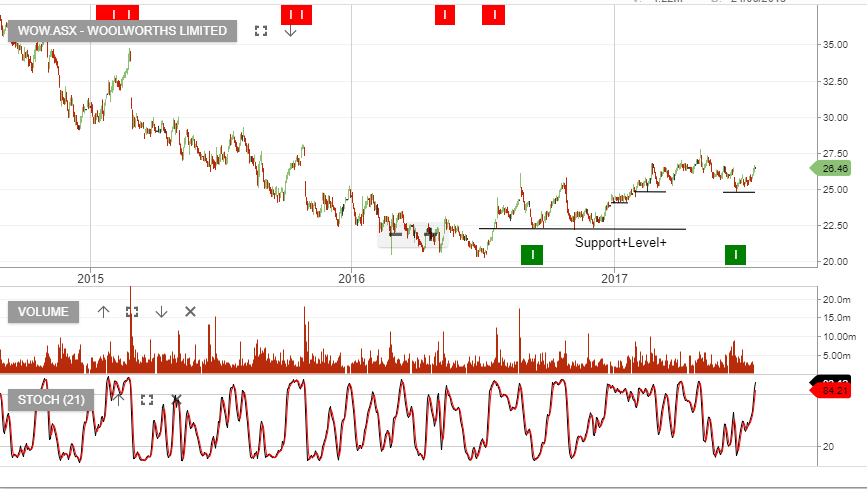
WOW has reported very strong Aust Food sales for the 3Q17.

If we assume FY18 revenue of $57b, EBITDA $3.5b, Net Profit $1.55b and dividends increasing from $0.70 in FY17 to $0.80 cents in FY18, it places WOW on a forward yield of 3%.

Based on the above metric, we think WOW is now fully valued and investors should add a covered call above the market to enhance the return.

Chart – WOW


RBA Preview: Aussie Dollar Still Trending Lower

The Reserve Bank is expected to keep the official cash rate unchanged tomorrow, ahead of the federal government’s budget next week. Over the weekend, fresh concerns emerged that China’s economic recovery might not be as strong as expected, which may also be included in the RBA’s statement.

The consensus is that the 1.5 per cent benchmark interest rate will remain on hold, but some analysts believe it could be raised in the next few months with the domestic economy more resilient than ­expected.

However, renewed signs appeared yesterday that China’s economic growth trajectory could prove more volatile in 2017 than first thought after a surprising fall in manufacturing output.

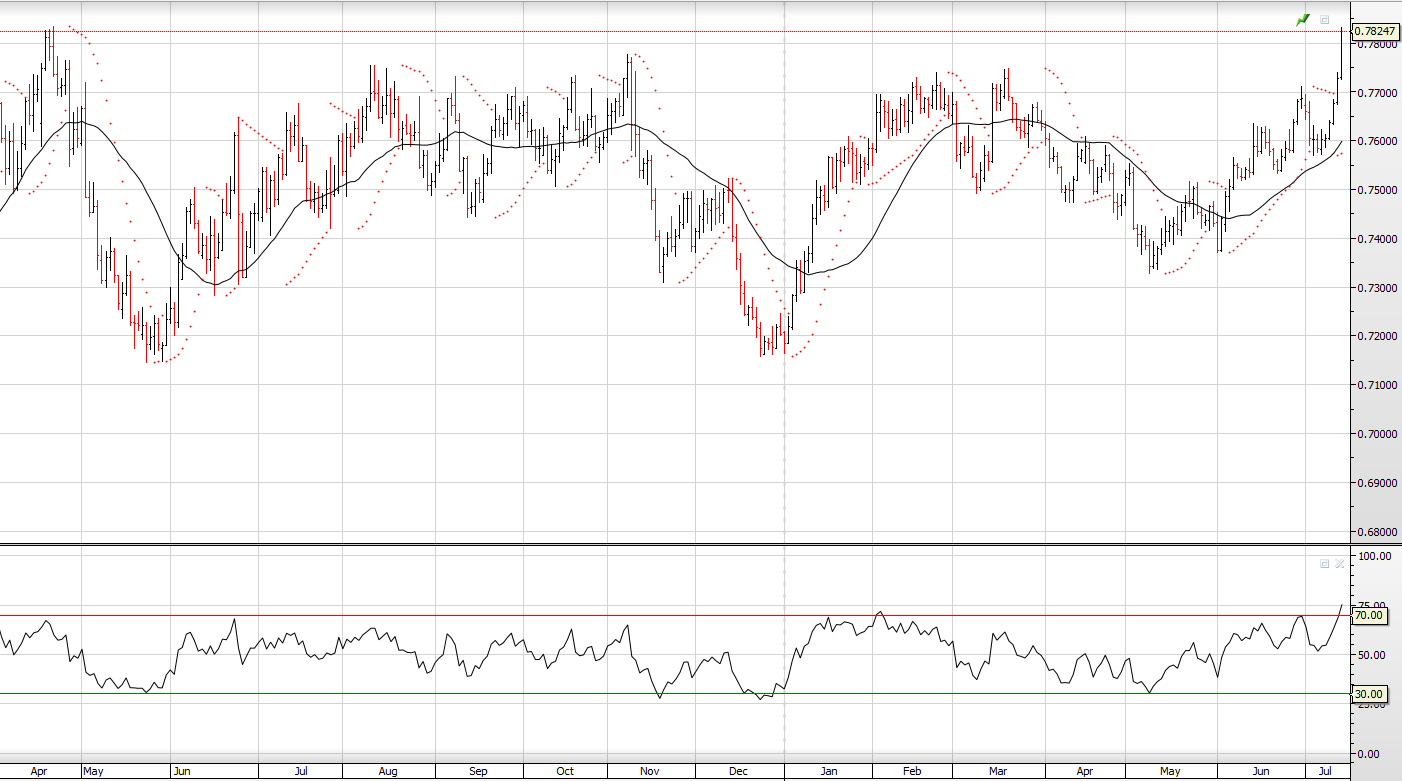
It’s our base case that the RBA still maintains an easing-bias, and that the next move on rates will be lower. As such, we expect to see a protracted move lower in the AUD/USD, with a medium-term target near the January low of .7150.

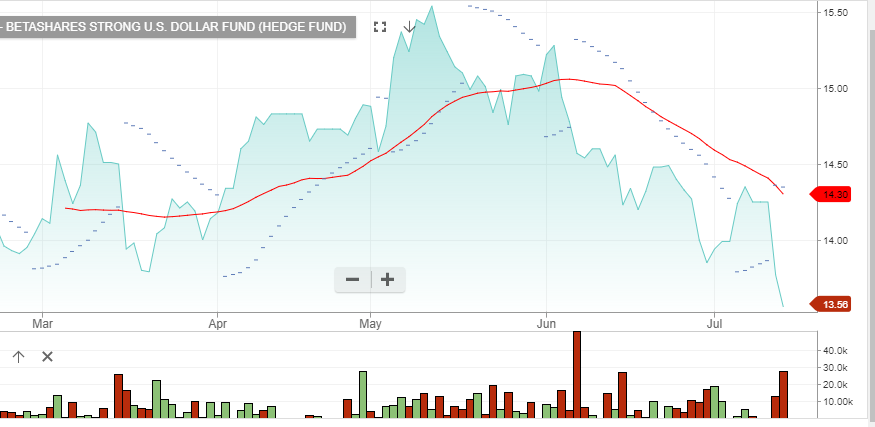
We have suggested that investors looking to profit from a lower AUD/USD can buy the BetaShare YANK ETF. This an an inverse ETF, with a 2.5% weighting, which gains value as the AUD/USD trades lower.

Chart – YANK ETF

The Next Recession – US March GDP

The next recession will be difficult for Central Banks as already low interest rates, inflated balance sheets & high deficits will likely result in a diminishing effect of policy tools to fight off deflation.

Economy

US GDP has slipped from 2.5% to 0.7% in the March quarter. A long way from the 3.5 or 4% the Trump administration says is achievable. More worrying is GDP appears to be trending lower and now showing only 0.2% growth. The March employment numbers were unexpectedly low, auto sales are dropping due to rising defaults and lenders tightening lending standards. Student loan defaults are rising and mortgage applications are no longer growing.

Many market commentators are dismissing the negative GDP trend as “seasonal issues” and are forecasting a sharp rebound in the June numbers. We’re not so sure and continue to feel that risk assets will soon come under pressure &  portfolios should be defensively positioned.

Markets

The bulls will say, yeah but that doesn’t matter, stock prices are rising S&P500 earnings are growing at an average rate of 6%, (ex-energy), and 11% including the rebound in energy related profits, as oil prices recover from this time last year.

Technology giants Microsoft, Google, Apple, Facebook & Amazon are all delivering tremendous earnings growth and this can’t be denied, however, we’ve seen these names suffer during past recessions. They’re not infallible

Conclusion

With the bulk of the S&P500 delivering minimal top line revenue growth, PE’s expanding in a backdrop of falling GDP and rising bad debts, we feel caution is justified.

Local ASX Instruments to consider BEAR, BBOZ, YANK, BBUS & GOLD ETF’s along with Index XJO Puts . Overweight, healthcare, consumer staples, technology & yield sensitive names.

Chart – US GDP Trend

ALGO Signal Update: Take Profits In ANZ

The ALGO engine gave a buy signal for ANZ on February 7th at $28.80. During yesterday’s session, the stock traded up to $32.85; within 20 cents of the $33.03 high posted on August 4th, 2015.

Looking back at that price action, after ANZ traded over $33.00 in August of 2015, the share price fell to $26.40 during the next three weeks.

That type of sell off is not our based case. However, with almost a $4.00 profit since the ALGO buy signal at $28.80, investors may want to consider taking profits or write covered calls on ANZ above $33.25.

The ALGO engine has given many profitable signals in the market, in general, and in the banking sector, specifically. We will look for the next buy signal to enter ANZ on the long side again.

Based on internal momentum indicators, $30.00 is the initial level of price support.

ANZ