US Earnings – Intel Q3 Result

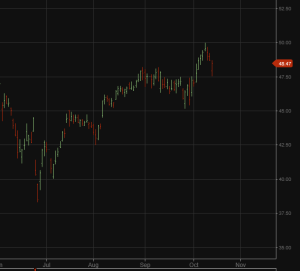
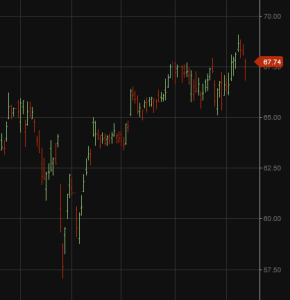
Intel shares dropped close to 6% in US trade after the company gave a slightly disappointing revenue forecast into the end of the year. The chip-maker said it expects Q4 revenue of $15.7 billion against the consensus estimates of closer to $15.9 billion. The company reported adjusted Q3 earnings of 80 cents per share versus analysts’ forecasts of 73 cents per share on revenues of $15.58 billion.

A bright spot in the report came from the growth in the client computing group; which is composed largely of PC chips. Revenues from the client computing group increased 4.5% to $8.9 billion from a year ago Q3 which includes a 4% increase in the price of chips used in notebooks.

Still, the tepid revenue guidance into Q4 was enough to influence investor sentiment and push the share price below $35.00 for the first time in a month. This comes after posting a new 5-year high at 38.10 on October 7th.


BHP 1QFY17 Production Results

The 1QFY17 production result for BHP was weaker than the market had expected. Weather related issues were mainly the cause.

BHP maintained FY17 shipping guidance for Iron Ore at 265-275mt. Petroleum volumes are anticipated to improve in the year ahead following recent issues with weak production from the Gulf of Mexico assets and lower shale volumes.

Forecast FY17 revenue to be in the range of $35b, EBIT of $7b, DPS of $0.50, which places the stock on a forward yield of 3%.

Many analysts have a bearish outlook for commodity prices in Fy18 and as a consequence, lower forecast EPS and DPS for the majors. Our view differs slightly and we think any pullback early next year will most likely create a solid “buy on the dip” opportunity for both BHP and RIO.

Our algorithm engines will track these and other major resource names for potential entry conditions.

BHP.ASX

bhp


Australian Bank Earnings Preview

2H16 reporting season for WBC, NAB and ANZ starts on 27th of October with NAB kicking off.

We’ll be keeping an eye on expenses and cost discipline along with trends within the bad debt exposure. There’s a strong likelihood that dividends will be cut slightly, especially in WBC and NAB. Westpac is on a payout ratio above 80%. They may look to scale this back a little.

Overall revenue is likely to flat at best and profits will show some deterioration on the same time last year.


US Earnings – Netflix Surges 19%

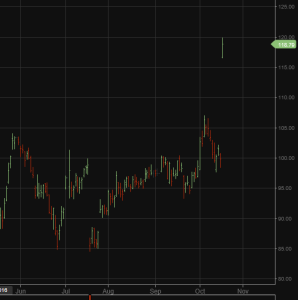
  •  NETFLIX surged over 19% to new high for the year at $118.80 as the video streaming service reported stronger-than-expected earnings, and a total of 3.6 million new subscribers for the quarter. This brings NETFLIX total number of subscribers to over 86 million worldwide.

They reported earnings of 12 cents a share, which double analysts estimates of 6 cents a share as revenue for the quarter climbed to $2.16 billion from $1.58 billion during the same time last year. The company attributed the strong earnings to a popular schedule of original programming.

Now that the technical price level of $117.00 has been cleared, the next key price target will be  $131.00; the all-time high posted in December 2015.

Netflix (NFLX.NAS)

nflx

Recent Buy Ideas Revisited

Sonic Healthcare (SHL.ASX)

shl

Amcor (AMC.ASX)

amc

James Hardie (JHX.ASX)

jhx

Lend Lease (LLC.ASX)

llc

Newcrest (NCM.ASX)

ncm

Resmed (RMD.ASX)

rmd

For more analysis on our recent buy recommendations and market stratagey, please keep an eye out for tomorrow’s mid-week market update video report. It will be sent out tomorrow morning as a blog post.


US Earnings – Bank of America

Bank of America reported 3Q15 earnings that beat on both the top and bottom line. The outperformance (beating estimates) we’ve seen so far in the earnings numbers across the banking sector are based on forecasts which have been downgraded, or set a relatively low target benchmark .

Nevertheless, we’ve seen nothing so far to suggest that S&P500 average EPS will not meet or exceed the required $30 – $32 per share to support current market valuations.

Bank of America (BAC.NYS) posted earnings of $0.42 per share on revenue of $4.45b, which represented  6.6% gain on the same time last year. ROE dropped to 7.3% which is low by industry comparisons.

BAC.NYS

bac-nys


Global Macro

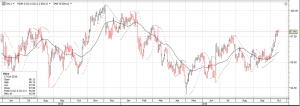
The US Dollar Index reached a seven month high of 98.10 on Friday as both US Inflation data and the Retail Sales report beat expectations. The Greenback gained ground against the GBP, JPY and the CHF, but it was the move against the Euro which held the most technical significance going into the weekend.

The EUR/USD posted a NY close below 1.1000 for the first time since mid-June and looks likely to challenge key support at the 1.0950 level.

Thursday’s ECB meeting could possibly be an important pivot point in both the single currency and global equity markets. The idea that recent stock market valuations are heavily reliant on central bank stimulus could be tested if ECB chief Mario Draghi isn’t clear about the direction and composition of future EU monetary policy.

During the last four ECB meetings, there has been extreme volatility in both the currency and equity markets. The March 10th meeting saw the EUR/USD trade in a 400 point range while during the June 2nd meeting the single currency moved over 200 points higher on the day.

From an equity perspective, the German Dax dropped close to 600 points during the March 10th meeting and close to 250 points after the meeting in June.

Granted, the expectations for expansion on the QE purchase pool and extension of the duration of stimulus were much higher than forecasted for this week’s meeting.

However, we’ve seen a lot of conflicting headlines about the central bank’s thinking since the last meeting. Two weeks ago there was high level talk about tapering asset purchases and last week that was reversed with comments about extending and expanding the current level of stimulus.

During the last meeting, Mr Draghi expressed confidence about the resilience and positive outlook for the Eurozone economy but also lowered the staff growth forecasts and announced EU committees to evaluate additional stimulus options. With recent EU growth aggregates showing stabilization across the region, Mr Draghi has cause to express an optimistic tone.

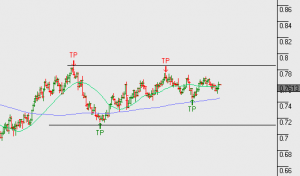
The AUD/USD managed to recover into the weekend and retake the .7600 handle. The RBA minutes and the domestic employment report are the key data points for the Aussie this week. The early forecasts are for a bounce back in manufacturing and construction jobs to lift employment growth.

USD Index
usd


Australian Bank – Earnings Preview

The upcoming bank results will likely demonstrate that revenue and profit growth estimates may be too high.

We are expecting cost control to become an increasing focus for investors analysing bank results. Pressure continues to build on Boards to reconsider their dividend positions. Payout ratios at 80% appear too high given the added capital requirement banks face in the next 18 months.

WBC and NAB are likely to modestly reduce dividends. Out of the 4 majors, ANZ is the only bank with positive a technical structure.

ANZ.ASX

anz


US Bank Earnings Exceeded Low Market Estimates

On Friday night JP Morgan, Citi and Wells Fargo all reported.

Wells Fargo’s profit dropped for a fourth straight quarter. JP Morgan and Citi beat low expectations, as strength in bond trading volumes picked up in the third quarter.

Citi Group outperformed expectations for third-quarter net profit after trading revenue surged 35 percent. Net income exceeded market expectations, (although fell 11%), coming in at $1.24 per share.

Citi Group (C.NYS)

citi

Well Fargo (WFC.NYS)

wells

JP Morgan (JPM.NYS)

jp

Investors will focus this week on the upcoming earnings results for  Goldman Sachs and Morgan Stanley.

Dow Jones

dow-jones

In this month’s market strategy recording, we looked at the key levels in the S&P500 and the Dow Jones, with a focus on old resistance becoming new support. S&p500 earnings need to deliver on average, $30 – $32 per share to meet market expectations.

If you missed the recording this month, please sign up at www.investorsignals.com


Global Macro

With the prospect of a “hard Brexit” becoming a reality, market participants who had expected a “soft” Brexit, or no Brexit at all have had to adjust their UK price forecasts. The Sterling, for example, has depreciated more than 5% against the G10 currency basket over the last week and some analysts are calling for a  drop to parity against the USD by the end of the year.

Going back to late June, the GBP depreciation was considered beneficial for the UK following their decision to leave the EU. The orderly decline in the Sterling, alongside the easing of monetary policy and decline in 10-yr Gilt rates, would serve as an economic cushion to keep exports and equity prices steady while trade deals with other EU nations were being negotiated.

However, the recent down move in the GBP has not been orderly, nor has it coincided with lower yields across the UK Treasury curve. The 10-year Gilt yield has risen more than 20 basis points over the past week as the GBP/USD has dropped over 600 points. Granted, G-7 Treasury rates have risen across the board but nothing like the UK rates. The 10-year yields in the US and Germany have risen by 8 and 7 basis points, respectively.

In the equity market, the FTSE 100, which is now viewed as a currency play given the heavy weighting of companies that rely on foreign earnings, has returned over 13% for domestic investors this year, but has lost close to 7% for unhedged USD-based investors over the same period. Further, the return on the broader FTSE 250 is even worse with domestic investors up 3.2% and USD-based investors down 14.5% during 2016.

On balance, we believe it’s reasonable to expect that the uptick in yields and recent political developments will support the Sterling while carving out a base above recent lows. The GBP/USD has rebounded over the last two sessions. The recovery has been fuelled by UK Prime Minister May’s concession to allow Parliament to vote on the Brexit decision. Hearings before the British high court will continue until Monday, which could delay the process of when Article 50 is invoked.

The AUD/USD fell sharply after yesterday’s weaker-than-expected Chinese trade balance reports.

AUD/USD

aud

FTSE 100

ftse