Key US Earnings Reports

Goldman Sachs surprised to the upside with Q4 EPS announced at $5.08, which was well above the market estimate of $4.73 and nearly 4 times the EPS of $1.27 reported a year ago. This was based on quarterly earnings of $8.17 billion versus forecasts of $7.76 billion.

Like other banks in the sector, Goldman benefited from a sharp uptick in trading activity. Net revenues from the institutional client services division were up 25% from a year ago, led by a 78% increase from the fixed-income, foreign exchange and commodities unit. Goldman shares closed down $1.45 at $234.

Citigroup had a mixed report with Q4 earnings beating expectations, but missing on their revenue figures. The banking giant announced EPS of $1.14 on revenue of $17.01 billion. Analysts were expecting EPS of $1.12 on revenue of $17.26 billion.

Trading revenue was higher at $3.20 billion, but considerably below the expectations of $3.45 billion. Fixed-income revenue also missed to the downside with Q4 reported at $2.21 billion verses an expected $2.83 billion number. Shares of Citigroup closed down 1.7% at $57.40, well below the one-year high of $61.50 posted January 4th.

Shares of NETFLIX posted an all-time high of $135.15 as earnings were marginally better than expectations, but the number of new subscribers increased sharply. The on-line entertainment company announced Q4 earnings of 15 cents per share on revenue of $2.48 billion.

These numbers were slightly better than the street’s forecast of 13 cents per share on revenue of of $2.47 billion.

More importantly, NETFLIX exceeded its own subscriber growth estimates by gaining 7.05 million new subscribers versus estimates of 5.2 million. This represents the biggest quarterly gain in the company’s history and triggered the initial rally in their shares. By the close, the share price had settle back to $133.25
Banks to Deliver Low Growth

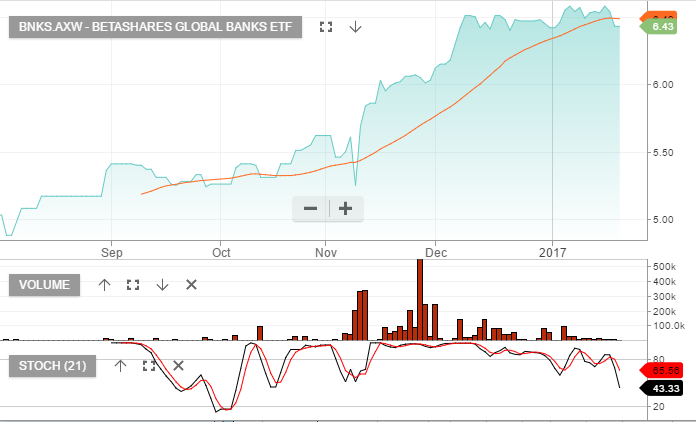
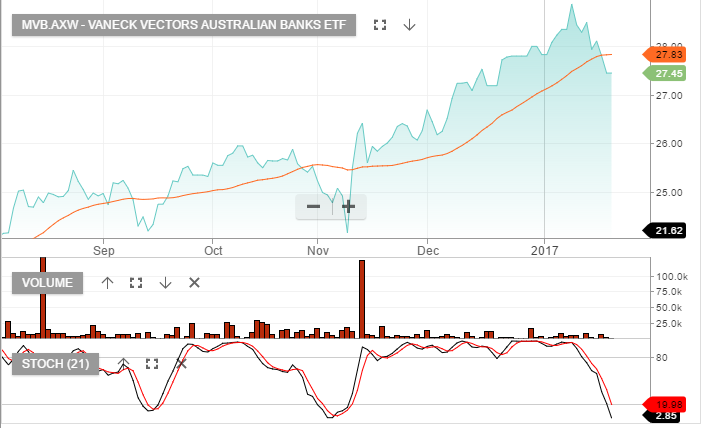
The market has priced in a better and brighter outlook for the Australian  banks during the past 6 months.

During the middle of last year, we had off-shore hedge funds shorting our banks. Concerns about capital requirements, bad debts ticking up from one-off corporate failures and concerns about the Australian property market nearing peak prices.

Six months later and the market is thinking about better underlying conditions, reduced risk of capital raising, improving credit quality from the recovery in commodity prices and better operating margins. As a result, the valuation discount has now diminished following the 20% rally in bank names.

Our base case is that the environment has not actually changed materially from where we were 6 months ago. The news flow has turned more positive but that’s about it.  The underlying issues remain the same or are intensifying, in our view.

We watch with interest the Chinese markets and in particular the risk of weaker property prices in China and the sentiment impact it will have on Australia. This is one of our key risks to Australian bank prices in 2017.

We expect low levels of credit growth due to over-leveraged household balance sheets and pressure from  regulators to improve the quality of housing lending.

At best we see the banks at full value; and our most likely investment case is for further weakness driven by a pickup in global macro risk-off sentiment.

Our bank hedge into February/March remains in place and we’re expecting share prices to remain at or slightly below current prices over the coming months. The risk for further share price weakness will likely pickup towards the middle of the year.

Chart – Global Bank ETF

Chart – Australian Bank ETF


RIO Tinto: Better Production Numbers

Following on from our earlier report, mining giant Rio Tinto posted solid Q4 production results with several divisions slightly beating calendar year 2016 guidance and their flagship Iron Ore operations meeting expectations.

More important than the actual production results themselves has been the continued strength of the global commodity price environment, which is driving earnings expectations into a higher range.

As such, it’s reasonable to expect the increase  in cash flow from higher metal prices could see RIO surprise the market with a higher dividend or a share buyback in its upcoming annual result in February.

We expect the exceptional second half strength in Iron Ore, Coal and to a lesser degree base metals, will help to significantly boost the immediate earnings for RIO.

This increase in revenue has boosted our short-term earnings forecast, which has resulted in an increase in our near-term price target to $65.00.


US Banks – Technical Update

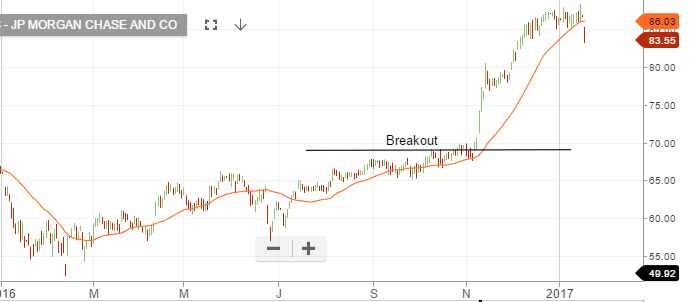
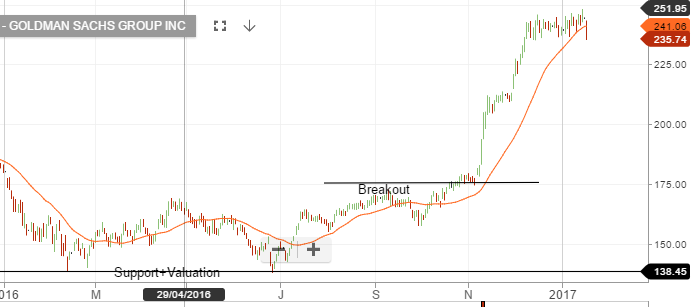
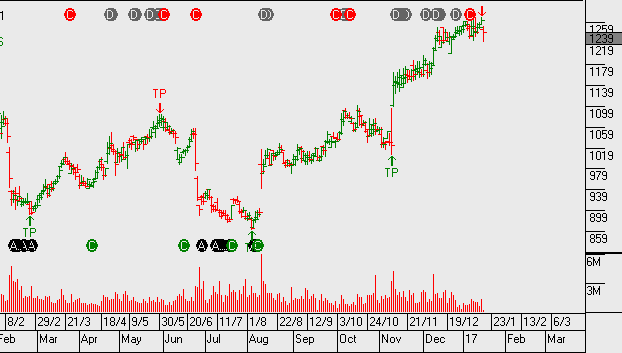
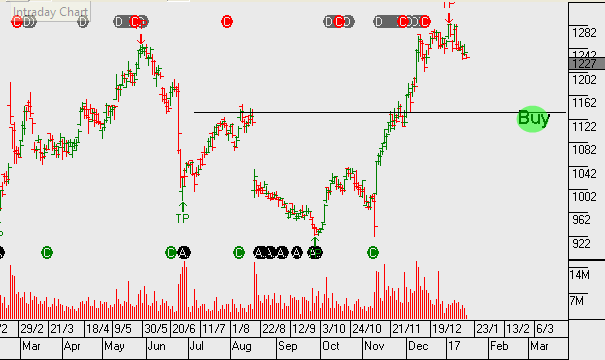
Dow Jones large cap financials JP Morgan & Goldman Sachs were down 3.63% and 3.5% respectively in overnight trade.

The charts below show the price action rolling-over in the past few trading sessions, following the earnings results on Friday that failed to meet market expectations on the revenue front.

This will have ongoing implications for ASX banking stocks. The rally in domestic bank shares were mainly a by-product of the US banking share rally, rather than factors directly related to an earnings pickup within the Australian market.

Chart – JP Morgan


Chart – Goldman Sachs

Crown – Jamie Packer re-joins the board

The share price in Crown Resorts (CWN) has staged a solid rebound since hitting a low of $10.30 in early November. With Jamie Packer re-joining the board and some new capital management initiatives,  there could be further upside from the current price of $11.70.

An analyst report yesterday noted that Melco Crown, in which CWN owns a 11.2% stake, has declared a USD 650 million special dividend to be paid in early February.

Aside from this dividend payment, the gaming giant has lowered its VIP revenue projections, adjusted revenues for CWN’s lower equity stake in Melco, resulting in a lowering of its EPS estimates out to 2019 by close to 2%.

The company’s board reshuffle highlights that CWN has yield and near-term capital management appeal with the prospect of further de-leveraging from offshore strategic initiatives.

Taking into account the trimming of its earnings forecast, the group is trading on 9.3 times fiscal EBITDA projections.

Short Positions – Starting to Roll Over

Over recent weeks, we’ve highlighted a number of stocks that are overvalued and susceptible to any increase in market volatility or risk-off period.

Stocks that have rallied due to higher US interest rates are starting to retreat as the yield on the US10-YR starts to slip lower from the recent 2.64% high. Companies affected in this group include Computershare and QBE.

Australian Banks are beginning their sell-off and our bank hedge is starting to pay-off.

Exiting property plays, especially where there’s development risk will likely prove worthwhile in the coming months. We’re happy to stay exposed to the best-of-the-best only in this space and sell tight covered calls.

The issue we see is that the US bank results out so far, is probably as good as it gets for US 4Q earnings. Over the next two weeks, multinationals, industrial names and then big technology will announcement their results.

If we see an average EPS run rate for the S&P500 that fails to meet the $132 per share expectations, and in fact averages somewhere in the range of $120 – $125, then the Dow Jones will struggle to move higher.

With the above in mind, we’ve been making adjustments to portfolios to hedge an uptick in volatility and deliver returns through an aggressive derivative overlay.

Chart – US 10YR
Chart – CPU
Chart – QBE


Strong Demand For LNG

With a 27% price increase since mid-November, LNG is one of the hottest commodities in the world.

New data on LNG rates show that the price of shipped natural gas for Asian delivery has jumped $1.95 per MMBtu to $9.20 per MMBtu.

A big part of the increased demand is coming from China, which saw its LNG imports rise to a record high of 47% in November as compared to the same time in 2015, to a total of 2.66 million tons.

South Korea was also reported as a big driver for LNG demand , with that nation buying cargoes to replace power generation lost during maintenance of four domestic nuclear power plants.

Our preferred energy names remain WPL, ORG & OSH.

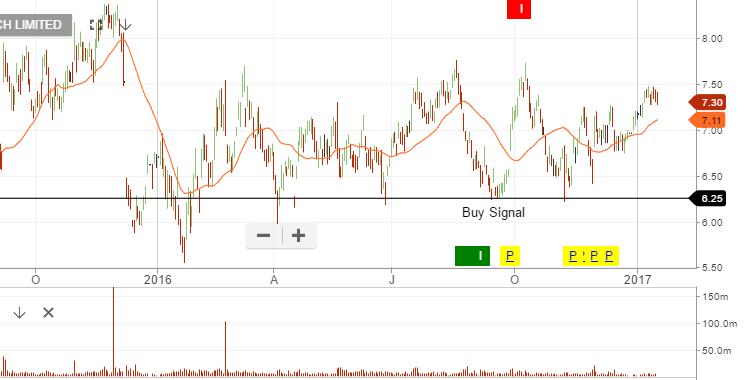
Chart – OSH


US Retail Sales Post A Mixed Result

Friday’s US Retail Sales report showed strong demand for automobiles and furniture, providing further evidence that the economy ended the fourth quarter with momentum at the retail level.

The Commerce Department reported that retail sales rose 0.6% in December after increasing by 0.2% in November. Sales were up 4.1% on a year-on-year basis from December 2015 and rose 3.3% for all of 2016 versus 2.3% for all of 2015.

The Core Retail sales figures, which exclude cars, gasoline, building materials and food, rose 0.2% after being flat in November.

The Core Sales data corresponds more closely with the consumer spending component of the GDP and printed below the 0.4% forecast. Despite the smaller gain in Core Retails sales, the consumer spending trend in the US remains solid.

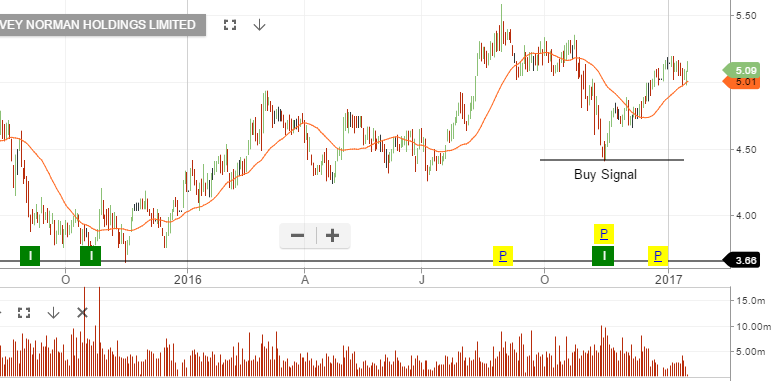
Chart – HVN

This Week’s Key Earnings Reports

US Financial markets will be closed on Monday for a bank holiday. After that, the rest of the week has several top financial names which will be reporting Q4 earnings. The dates and the street estimates for earnings and revenue are as follows:

Tuesday:    Morgan Stanley (65 cents/ $8.46 billion)

Wednesday: Goldman Sachs ($4.74/ $7.76 billion)

Citigroup           ($1.12/ $17.29 billion)

Thursday:   American Express ( 98 cents/ $7.95 billion)

IBM   ($4.89/ $21.70 billion)

Friday:     General Electric  ( 46 cents/ $33.94 billion)

With stock index prices pushing up against record highs, earnings reports will likely have to be flawless to match the market’s expectations. If any of these first-tier financial names post materially lower numbers, the risk is that the market may have gotten ahead of itself in the post-election rally.