Key US Earnings Reports

Goldman Sachs surprised to the upside with Q4 EPS announced at $5.08, which was well above the market estimate of $4.73 and nearly 4 times the EPS of $1.27 reported a year ago. This was based on quarterly earnings of $8.17 billion versus forecasts of $7.76 billion.

Like other banks in the sector, Goldman benefited from a sharp uptick in trading activity. Net revenues from the institutional client services division were up 25% from a year ago, led by a 78% increase from the fixed-income, foreign exchange and commodities unit. Goldman shares closed down $1.45 at $234.

Citigroup had a mixed report with Q4 earnings beating expectations, but missing on their revenue figures. The banking giant announced EPS of $1.14 on revenue of $17.01 billion. Analysts were expecting EPS of $1.12 on revenue of $17.26 billion.

Trading revenue was higher at $3.20 billion, but considerably below the expectations of $3.45 billion. Fixed-income revenue also missed to the downside with Q4 reported at $2.21 billion verses an expected $2.83 billion number. Shares of Citigroup closed down 1.7% at $57.40, well below the one-year high of $61.50 posted January 4th.

Shares of NETFLIX posted an all-time high of $135.15 as earnings were marginally better than expectations, but the number of new subscribers increased sharply. The on-line entertainment company announced Q4 earnings of 15 cents per share on revenue of $2.48 billion.

These numbers were slightly better than the street’s forecast of 13 cents per share on revenue of of $2.47 billion.

More importantly, NETFLIX exceeded its own subscriber growth estimates by gaining 7.05 million new subscribers versus estimates of 5.2 million. This represents the biggest quarterly gain in the company’s history and triggered the initial rally in their shares. By the close, the share price had settle back to $133.25

US Banks – Technical Update

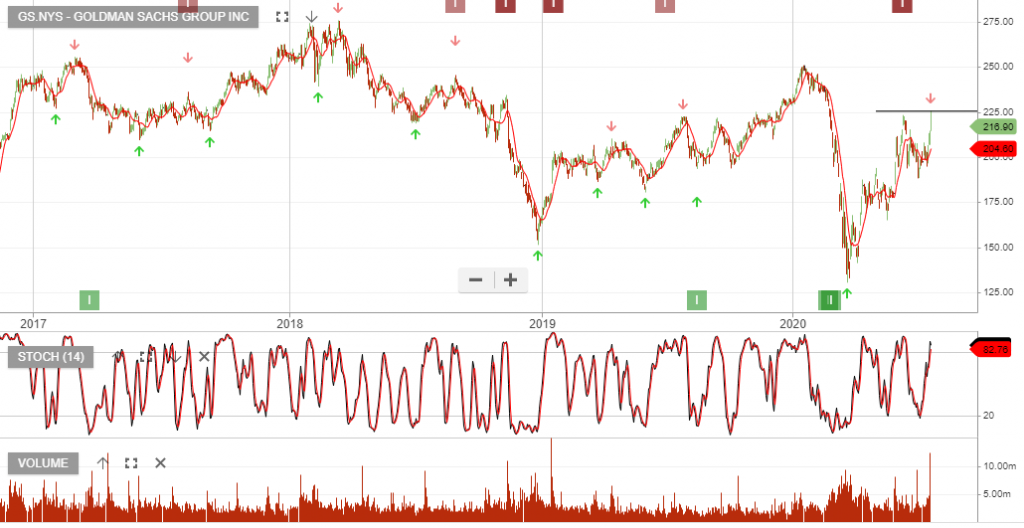
Dow Jones large cap financials JP Morgan & Goldman Sachs were down 3.63% and 3.5% respectively in overnight trade.

The charts below show the price action rolling-over in the past few trading sessions, following the earnings results on Friday that failed to meet market expectations on the revenue front.

This will have ongoing implications for ASX banking stocks. The rally in domestic bank shares were mainly a by-product of the US banking share rally, rather than factors directly related to an earnings pickup within the Australian market.

Chart – JP Morgan


Chart – Goldman Sachs

US Retail Sales Post A Mixed Result

Friday’s US Retail Sales report showed strong demand for automobiles and furniture, providing further evidence that the economy ended the fourth quarter with momentum at the retail level.

The Commerce Department reported that retail sales rose 0.6% in December after increasing by 0.2% in November. Sales were up 4.1% on a year-on-year basis from December 2015 and rose 3.3% for all of 2016 versus 2.3% for all of 2015.

The Core Retail sales figures, which exclude cars, gasoline, building materials and food, rose 0.2% after being flat in November.

The Core Sales data corresponds more closely with the consumer spending component of the GDP and printed below the 0.4% forecast. Despite the smaller gain in Core Retails sales, the consumer spending trend in the US remains solid.

Chart – HVN

US Bank Earnings Preview

The fourth quarter earnings season kicks into high gear this week when the first of the major US banks report tomorrow night. Expectations are mixed, based on forecasts that include the impact of the FED raising interest rates and the Presidential election.

Bank of America and JP Morgan are both expected to report solid bottom-line growth. On the other hand, Wells Fargo is expected to say that its earnings have slipped from a year ago.

Below is a quick overview of what is expected from these three banks.

BoA Q4 profit is expected to come in at 38 cents per share, which would be close to a 30% gain from the year-ago period. The consensus has earnings pegged at 40 cents per share.

JP Morgan is expected to announce it had earnings of $1.47 per share, which would be up from $1.32 per share a year-ago on revenue of $23.70 billion.

Wells Fargo is expected to post Q4 EPS of $1.00 per share which is down three cents from a year ago on revenue of just over $22.00 billion.

US Wages and Inflation

The US Federal Reserve officially ended their stimulative policy of Quantitative Easing (QE) on October 29, 2014.

Since then, investors have been following the monthly Non-Farm Payroll (NFP) report for insight about how the condition of the US Labor market would influence US interest policy, the US Stock market and the US Dollar.

Within the NFP report, the three main components are the headline new job creation, the un-employment rate and weekly hourly earnings.

For most investors, the headline new jobs data has been the key metric for gauging whether the FED was likely to lift rates or leave policy on hold.

However, as the US is reaching a full-employment zone and the unemployment rate is nearing its lower bound below 5%, we are seeing a change in the policy implication dynamic towards wage growth and its impact on inflation.

Since the FED first lifted the FED Funds target rate in December 2015, the 10-year note yield has risen from 1.30% to 2.50%.

The FED understands that US wage growth is feeding directly into core inflation aggregates and will likely  shift their policy-making focus away from new job creation to wage growth during 2017.

In last Friday’s NFP report, wages rose .4% for a new cyclical high on a year-on-year basis to 2.9%. This is the fastest pace since 2009. We see the importance of the wage component increasing through the year as the knock-on effect into core inflation is seen in subsequent data sets.

In other words, as we move further into 2017, it’s reasonable to expect investors may be taking positions in the US stocks, bonds and the US Dollar based more on the growth of weekly wages than the number of new jobs created.

On balance, we consider the recent rise in wages as a transitory event which may trigger short term headwinds to the recent stock market rally. Over the longer-term, we still consider the Bull market in stocks to continue with a gradual rise in 10-year yields.


Crude Oil Dumps on Iraqi Export Data

The price of West Texas Intermediate (WTI) crude oil dropped over $2.00, or 3.8%, to $51.90 in New York trade as Iraqi exports posted a record high for the month of December.

This is the biggest daily drop in over five weeks as investors are now concerned about Iraqi compliance with the OPEC production cuts agreed to on November 30th in Vienna.

Crude Oil posted its biggest gain since 2009 last year, largely based on the agreement from OPEC and 11 other countries to curb output starting January 1st.

Non-compliance has been a recurring theme in previous OPEC agreements, and the Iraqi export data may be the first sign of a crack in the most recent production accord.

The close below $52.00 in the front month WTI contract is the first trade below the 30-day moving average in over a month and suggests further downside extension below $51.50.

On the ASX, Oil Search (OSH) reached a 2 month high of $7.45 yesterday but will likely trade lower today. Technically, we look for initial support at $7.00 with the Pre-OPEC key support level at $6.40.

Dow Jones Index – This Warrants A Closer Look

We’re interested in the large pickup in traded volume over the past few weeks in the Dow Jones Index. By any measure the volume is abnormal, even compared to prior end of year volume traded.

The conclusion we draw from this is: whilst ETF’s are helping to accelerate index volumes, it seems a reasonable conclusion that it could be part of a series of indicators which are helping to suggest that we’re near an exhaustion point in the US equity rally. We’ve seen market tops coincide with big volume distribution patterns like this before.

Chart – Dow Jones


Dow Jones – Where is Fair Value?

Both the Dow Jones 30 and SP 500 finished the first week of 2017 in positive territory gaining 1% and 1.5%, respectively.

Many market commentators are suggesting the potential for overbought conditions as the major US stock indexes have added about $2 trillion in share value over the last 8 weeks.

There’s no question that the Bulls are currently in charge. However, with earnings season just a few weeks away, investors need to be cognizant of the index earnings required to maintain these lofty price valuations.

Earnings over the last three years have been in a tight range between $116.50 and $118.00. Based on our calculations, if US companies don’t post EPS growth of 10% and only deliver a flat $120.00 of average annualised EPS, the Dow Jones 30 is worth 16,500 points with 10-year bond yields at 2%.

Although energy and commodity companies should help to lift the average from the prior 12 months, bank earnings should also be up in the fourth quarter. With this in mind, the middle ground may result in 5% average EPS growth ($125 per share), which then supports the Dow Jones Index trading at or near 18,000 points.

Dow Jones


Gold: A Corrective Move Higher

In our 2017 preview, we noted that Gold was ending the year in a  stabilization pattern after falling sharply from the November highs. This fall saw the yellow metal drop from $1330 to $1120 (16%) in just over a month.

So far this week, Gold has moved from around $1140 to the current level of $1180. We feel this move is a combination of short-covering and a generally weak tone in the US Dollar. Technically, Gold has posted its first close above the 30-day moving average since November 9th, which suggests that this corrective move has more upside potential in the near-term.

Our base case is that the US Dollar will continue to consolidate from its sharp rally over the last two months, which will lift Gold prices higher. The daily charts point to the November high of $1220.00 as the next significant upside target within this corrective phase, and a good place to exit long positions.

US Bank Share Price Trends

On 13th of January, the first of the major US financial institutions begin announcing their fourth quarter earnings results.  Bank of America, JP Morgan and Wells Fargo will be the key results to watch.

The rise in US financials has been significant by any measure; multiples have expanded ahead of what investors are hoping to be record levels of profit and bullish forward guidance. The US financial sector has been boosted by the expectation of higher interest rates, deregulation and high trading earnings to drive profits.

However, we have concerns: economic growth in the US is not that strong, the year-over-year GDP growth rate was only 1.7 percent in the third quarter, S&P500 average year on year EPS growth was only +4% in the third quarter and it’s had to see growth improve dramatically in 2017, especially with a stronger US dollar.

Chart – Bank of America
Chart – JP Morgan
Chart – Goldman Sachs